As AI technology rapidly evolves and fundamentally transforms how businesses operate, dentsu Japan (the domestic Dentsu Group) has embarked on a new challenge, declaring its evolution into an "AI-native company."In July 2025, five domestic companies collaborated to establish the cross-functional " dentsu Japan AI Center " (hereafter, AI Center), bringing together approximately 1,000 specialized professionals. This initiative, which extends beyond advertising and marketing to encompass corporate operational reform and new business creation, forms the core of the AI-driven growth strategy " AI For Growth."
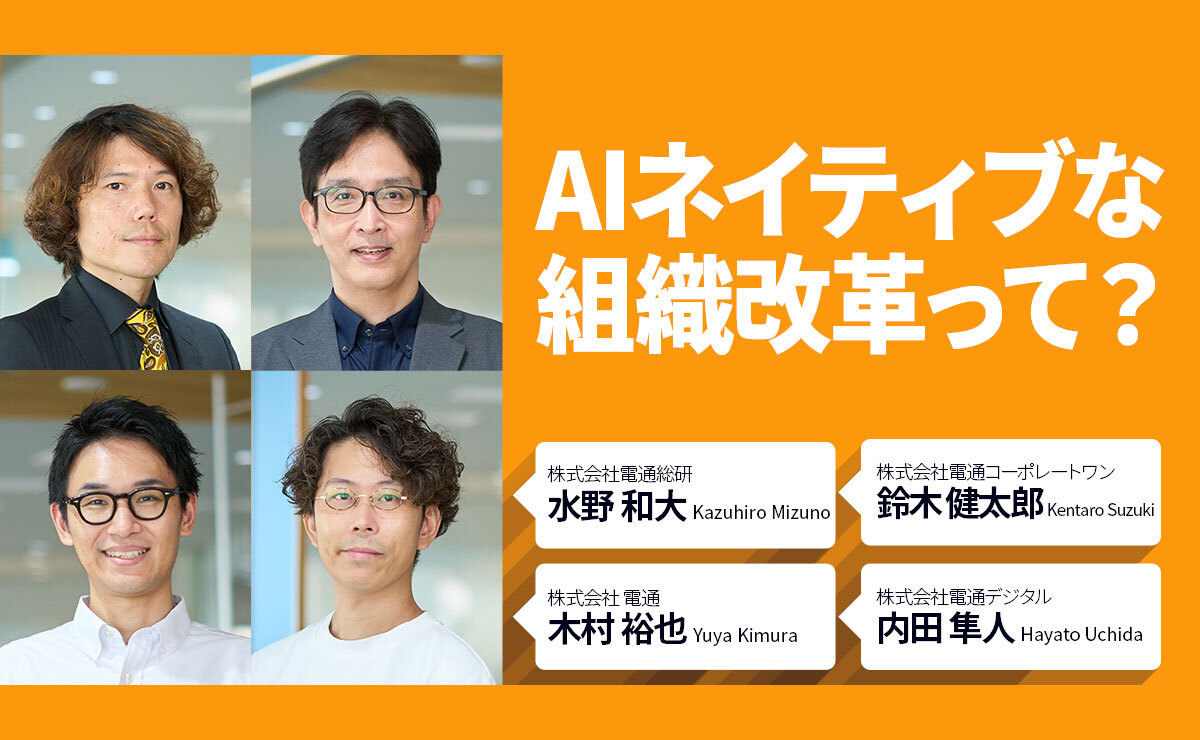
This time, we interview key figures from the AI Center in a two-part series.In Part 1, we spoke with Hirok azu Mizuno of DENTSU SOKENINC., Kentaro Suzuki of DENTSU CORPORATE ONE INC., Yuya Kimura of Dentsu Inc., and Hayato Uchida of Dentsu Digital Inc. about the background and role of establishing the AI Center, the ideal corporate form for the AI-native era, and Dentsu Japan's initiatives to support client growth.
Establishing a Core Organization to Drive Transformation into an AI-Native Company
Q. First, please tell us the background and purpose behind establishing the AI Center.
Mizuno: The AI Center is the core organization driving dentsu Japan's transformation into an "AI-native company." AI has evolved beyond mere operational efficiency; it now has the potential to transform corporate management strategies and organizational culture. Consequently, client needs have deepened, with increasing demand to leverage AI not just for cost reduction, but for creating new value and as a driver of business growth.Furthermore, dentsu Japan itself recognized the need to expand its business domain beyond the traditional advertising agency model into a marketing partner business.
Amid intensifying competition in the AI market and changing external environments, such as data privacy protection, accelerating dentsu Japan's AI strategy requires transforming its existing business model and organizational structure while leveraging its strengths.Therefore, we have consolidated the AI resources of five domestic group companies (Dentsu, Dentsu Digital, SEPTENI HOLDINGS CO.,LTD., DENTSU SOKEN INC., and Ignition Point Inc. ) to establish an AI Center boasting approximately 1,000 specialized professionals.
Kazuhiro Mizuno, DENTSU SOKEN INC.
Q. The AI Center is composed of six units. In the first part, we gathered the leaders of three units: the "AI Operational Efficiency Unit," the "AI Marketing & Creative Advancement Unit," and the "Integrated Marketing AI Agent Development Unit." Could you explain the role of each?
Suzuki: Unit 1, the "AI Business Efficiency Unit," aims to enhance operational efficiency within dentsu Japan through AI utilization. We focus on establishing the foundational IT infrastructure, building systems to address increasingly specialized needs, and implementing AI across various business processes.
dentsu Japan has various operational processes, such as client meetings, internal information sharing, and creating presentation materials. The Technology Office at DENTSU CORPORATE ONE INC., where I belong, develops in-house enterprise systems to streamline these processes. Leveraging this expertise, we are currently conducting Proof of Concept (PoC) projects to demonstrate the usefulness of AI-driven automation for various use cases.
For example, when producing a commercial for an automaker, we might search internally for a creator with experience in automotive commercials and an understanding of the sensibilities of women in their 30s. While existing systems can identify past commercial works and personnel assigned to commercial production, a function where AI suggests appropriate creators based on this data would further streamline operations. We are also advancing PoCs for various other AI systems.
Kentaro Suzuki, DENTSU CORPORATE ONE INC.
Kimura: Unit 2, the "AI Marketing & Creative Advancement Unit," is a team conducting research on process advancement and developing AI solutions. They are successively developing products and services covering the entire marketing & creative process, including AI-powered copywriting, idea generation, and persona interviews.
Uchida: Unit 3, the "Integrated Marketing AI Agent Development Unit," is a team that connects individual AI systems to provide integrated marketing experiences. We utilize AI products developed by Unit 2 and apply them not only within dentsu Japan but also to various client companies.
However, each client company's marketing process is unique. For example, after an AI develops a marketing plan, some clients may want to deepen user insights, while others may need to allocate advertising budgets or directly create internal proposals. To address these needs that individual AI cannot fully meet, we integrate multiple specialized AI agents to deliver the entire marketing process as a seamless experience.
Creating a state where anyone can use AI, even without writing prompts
Q. What vision do you envision for transforming into an "AI Native Company"?
Suzuki: Unit 1's mission isn't to have every employee master AI technology comprehensively. Instead, it's to create a state where AI is naturally leveraged for daily operational efficiency. For example, by processing tasks behind the scenes using AI technology, we reduce three processes down to one. We want to achieve this state where AI is used natively. We hope that dentsu Japan, transformed into an AI-native company, can become a good model case for business consulting with other companies.
Kimura: I also don't believe that "all employees being able to write prompts = AI-native." The development philosophy of Unit 2 is about enabling AI technology use without needing to write prompts. We are developing products where ideas emerge simply by inputting themes or hypotheses.
Dentsu Inc. Yuya Kimura
Kimura: Susumu Namikawa, who drives AI strategy at dentsu Japan, highlighted two key ways to leverage AI: "creating time" and "casually stepping outside boundaries." I share this view. While "creating time" through operational efficiency is essential, AI's true value lies in enabling "casually stepping outside boundaries" – like someone who couldn't draw now generating art with AI, or someone struggling with business plans drafting proposals effortlessly.
We should utilize AI as a tool to unlock and expand individual capabilities and corporate potential. Together with AI, we can reach realms unattainable by humans alone. This approach represents the ideal stance for an "AI Native Company."
Determining which tasks to apply AI to is crucial
Q. What process do you follow when supporting AI implementation for client companies?
Uchida: Generally, the process begins by identifying where to implement AI. Following that, we conduct an AI implementation verification. If effectiveness is demonstrated, we roll it out across the entire operation and begin full deployment.
The most critical aspect here is determining "which business processes to apply AI to." If business processes aren't well-organized, it's not only difficult to pinpoint which tasks carry high workloads and significantly impact the business, but starting from scratch also incurs high costs.
This is where packaged "specialized AI agents" prove invaluable. Utilizing these allows for the rapid creation of concrete, functional prototypes, enabling early verification of effectiveness and accelerating the organization's overall adaptation speed.
At the AI Center, we develop specialized AI agents packed with our proprietary marketing methodologies. We believe it's crucial to meticulously customize these AI agents to fit each client company's specific business processes. Simply implementing AI uniformly risks diluting the company's unique strengths. Therefore, we tailor the AI agents considering brand strategy and target customers, enhancing the precision of the ideas proposed by the AI.
Dentsu Digital Inc. Mr. Hayato Uchida
Supporting business transformation and change management: Dentsu Japan's unique accompaniment support
Q. Could you tell us about current challenges and the results achieved through AI agent implementation?
Uchida: Challenges during implementation include conflicts with existing operational frameworks and ambiguity in role division between humans and AI. AI literacy and approaches to working with AI vary among users, leading to problems like "not being able to fully trust AI" or conversely, "becoming overly reliant on AI." We address these by customizing AI agents for each specific use case of the intended users.
It is precisely beyond these challenges that the true value of AI lies. Marketing environments, in particular, often involve themes without clear-cut answers. The key outcome of introducing AI agents is a dramatic acceleration in hypothesis testing and decision-making. This frees frontline staff from repetitive tasks, allowing them to focus their time on higher-value activities.When introducing AI agents, rather than viewing AI as mere machinery, defining each role for the AI agent as if it were a new member joining the company could lead to AI-native organizational transformation.
Mizuno: AI implementation offers the advantage of enabling swift hypothesis testing and decision-making for various challenges. Beyond that, the Dentsu Group's strength lies in providing ongoing support and driving change management for client companies.
At Dentsu Japan, when introducing AI agents, we not only conduct business inventory, design business processes, and tune the AI, but also provide ongoing support for our clients' business transformation and BPR (Business Process Reengineering). We formulate management strategies based on AI, creating new systems and organizational cultures. We also have a well-established framework to support this change management.
Companies today are required to transform into "AI-native companies" that integrate AI into every process, from strategic planning to operational execution. Rather than a myopic focus on AI-driven operational efficiency, the co-creation of knowledge between humans and AI is what will drive further business growth. In Part 2, we will delve deeper into the missions of Units 4-6 and the strengths of dentsu Japan's AI transformation support.
Cross Innovation Headquarters Engineering Technology Center
Director
Since joining DENTSU SOKEN INC. (formerly ISID), has exclusively served as an Application Architect, responsible for the architecture and development of mission-critical projects and new service-oriented products. In recent years, has led numerous AI solution development projects, AI platform construction, and various SI×AI initiatives. Aims to transform all Japanese companies into AI-native enterprises.
After working at financial institutions, DENTSU SOKEN INC. (formerly ISID), Dentsu Inc., and Dentsu Group Inc., assumed current position in 2022. Oversees planning, development, and operation of IT systems across the entire Dentsu Group (particularly in the corporate domain), driving initiatives ranging from scratch development to package implementation and infrastructure foundation development to achieve both cost efficiency and operational improvement.Since 2019, he has led the accounting system renewal project from its conceptual phase, consistently overseeing planning, requirements definition, and testing. Currently, he is advancing the establishment and implementation of an AI platform across group companies to realize a common IT platform for dentsu Japan.
After serving as a new business manager and design department head at IT startups and entertainment companies, joined Dentsu Inc. in 2021. As a Creative Director/Service Designer, engaged in business and product concept development and customer experience design across various industries. Concurrently serving as Unit Leader of the AI Marketing & Creative Advancement Unit at the dentsu Japan AI Center since 2025, driving company-wide AI product development.
After working in the IT industry and new business development, supported CRM strategy planning and execution at an internet advertising agency. Led the construction of a Customer Data Platform aimed at enhancing customer experience, expanded data integration operations, and established the AI Innovation Promotion Office to spearhead generative AI adoption both internally and externally. Currently at Dentsu Digital Inc., driving the provision of specialized AI agents to individual companies, systematizing development processes, and building the dJ Integrated Marketing AI Agent.