Note: This website was automatically translated, so some terms or nuances may not be completely accurate.
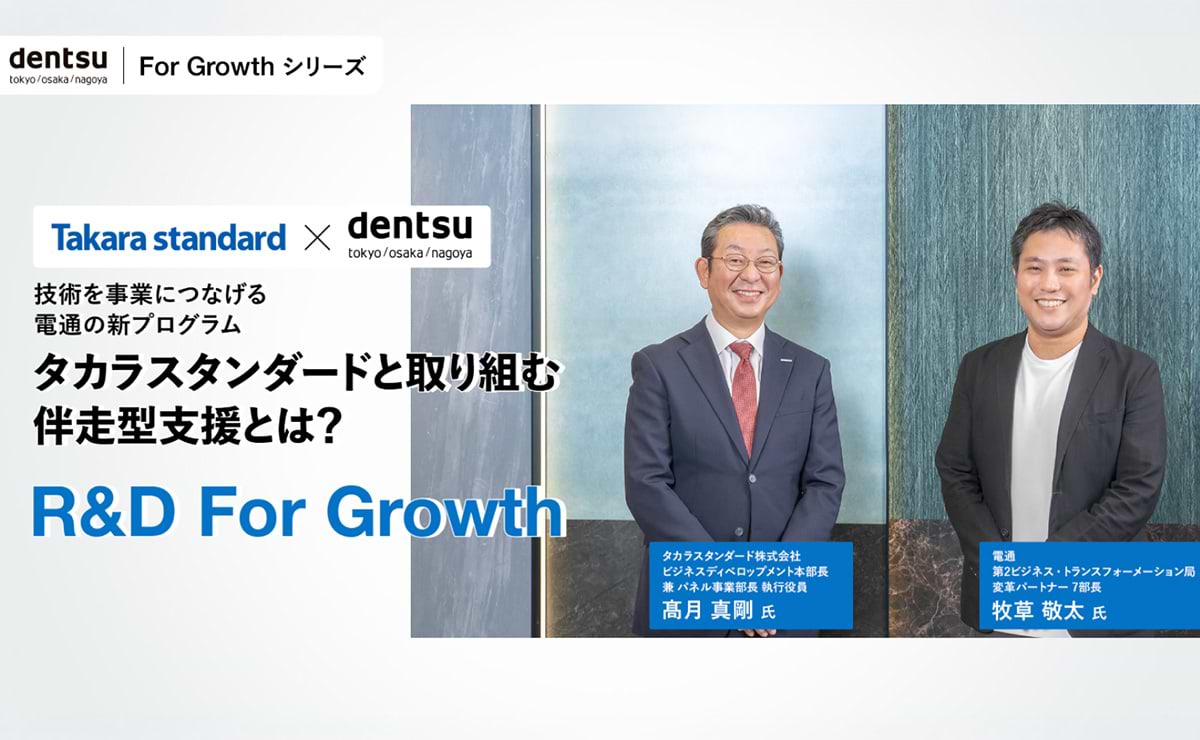
What is the collaborative support program with Takara Standard?
Shinji Takatsuki
Takara Standard Co., Ltd.
Keita Makikusa
Dentsu Inc.
Interview video discussing the initiatives of both companies
The importance of technology as a source of corporate competitiveness is greater than ever. However, in reality, many companies are unable to fully translate the results of their R&D (research and development) into business. If R&D, business management, and marketing remain disconnected, valuable technologies will go to waste.
In response, Dentsu Inc. has launched “R&D For Growth,” a practical support program designed to connect a company’s technological value with business creation. It brings new perspectives to companies and guides them toward R&D transformation. Here, based on the case study of Takara Standard’s Panel Division, we examine Dentsu Inc.’s unique approach and the reality of its hands-on support.
*This content is a reprint of a PR article originally published on August 6, 2025, in the Nikkei Business Digital Edition SPECIAL. https://special.nikkeibp.co.jp/atclh/ONB/25/dentsu0806/
Why Is R&D Transformation Necessary Now? Three Challenges Hindering Business Growth
Even in Japan, often referred to as having experienced “the lost 30 years,” there are companies that continue to grow steadily. “One major common factor among them is that they are companies that are fundamentally transforming their R&D structures,” points out Mr. Makigusa of Dentsu Inc.’s Business Transformation Division 2.
“There are numerous examples of companies expanding their business and significantly increasing their business value by applying their core technologies to new fields. On the other hand, it is also true that many companies struggle with the fact that their investment in R&D does not easily translate into business or value creation,” says Mr. Makigusa.
He explains that there are three major barriers to this. The first is that the company’s core technologies are not widely communicated to business divisions. The second is that new business divisions—which should be able to identify new applications—lack access to these technologies. And the third is that even if a product reaches the market, it is difficult to convey its value to customers, making it hard to achieve commercial success.
These three challenges were precisely the issues faced by Takara Standard’s Panel Division. Although the panel materials, which applied the company’s proprietary enamel technology, possessed excellent durability and ease of cleaning, the division struggled to monetize them because it could not effectively communicate their value to the appropriate departments or the market.
Dentsu Inc. has been supporting the Panel Division’s growth since March 2024. Through thorough, hands-on support—from strategy formulation based on technological value to implementation—combined with the Panel Division’s own efforts, the division achieved profitability in just one year. What were the key factors behind this success? Let’s explore the end-to-end approach that was later systematized as “R&D For Growth.”
Redefining the Technical Value of Enamel as the Cornerstone of Business Creation Strategy
Takara Standard is a manufacturer of residential plumbing fixtures that leverages its advanced enamel technology to produce and sell bathroom and kitchen products. In 1967, the company launched the world’s first enamel kitchen. Today, it still boasts the top market share for kitchens in Japan. Within this context, the Panel Division is responsible for products outside the bathroom and kitchen categories.
“In 1985, we developed ‘Emwall,’ an enamel exterior cladding material. The Panel Division was established as the department responsible for selling this product. Although it was called a division, it functioned essentially as a sales force. While its members were sales professionals who had consistently made proposals tailored to product characteristics to existing sales channels and clients, they lacked the strategic and tactical vision needed to chart long-term business growth, and the division had been operating at a loss for a long time.”
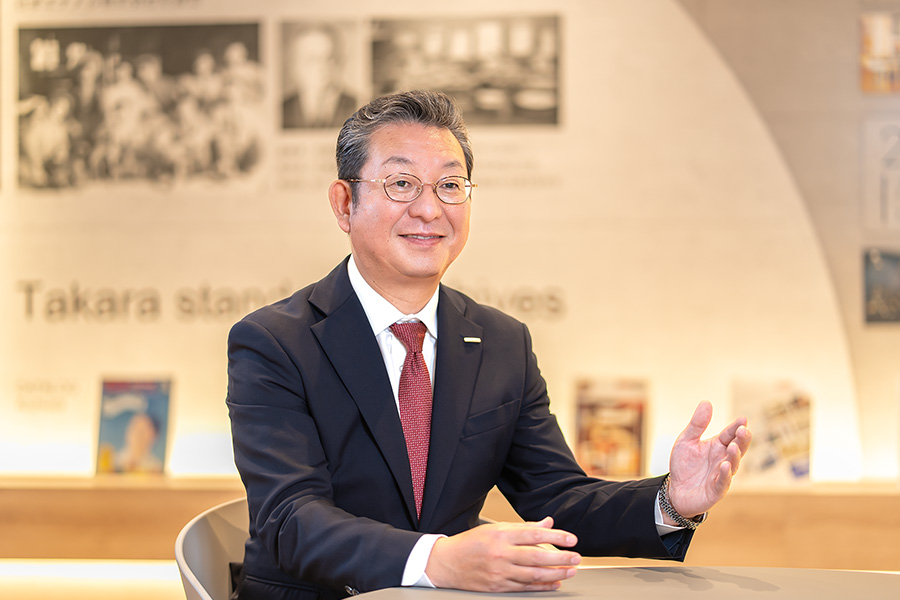
This is according to Mr. Takatsuki, an Executive Officer at Takara Standard. He says that from the moment he assumed the role of General Manager of the Panel Division in 2023, he sensed issues with the division’s approach. It was during this time that he was introduced to Mr. Makigusa, who was in charge of the BX (Business Transformation) sector, by a sales representative from Dentsu Inc. with whom he had worked on advertising projects.
“That was the first time I learned that Dentsu Inc. also provided consulting services for new business ventures beyond advertising. As we met in person and discussed our current situation, I realized they could be a real asset to us, so we invited them to participate in our internal meetings,” said Takatsuki.
During the internal meetings, the BX team conducted a detailed review of the challenges facing the Panel Division, its vision for the future, and the enamel technology that forms the foundation of its operations. Based on this, the project proposed by Dentsu Inc.’s BX team to address these challenges met Mr. Takatsuki’s expectations.
“The proposal incorporated perspectives we couldn’t have come up with ourselves, and I felt a tangible sense that this wouldn’t just end up as a theoretical strategy on paper. I believed this was something we absolutely had to do, so I immediately reported it to the president. Shortly after receiving the top management’s approval, we welcomed Dentsu Inc. as an official partner and began the initiative,” said Mr. Takatsuki.
The transformation project kicked off in March 2024. To deepen their understanding of enamel technology, the Dentsu Inc. BX team led by Mr. Makigusa first visited the Chita Plant. They believed that the source of the technology’s value lay precisely on the production floor.
“I had the impression that ‘enamel = pottery,’ but when I actually saw the site, I realized that Takara Standard’s unique craftsmanship is evident in every process—from glaze formulation to glazing, firing, and finishing. While this is a major strength, it also poses the challenge of technical knowledge being tied to specific individuals. I intuitively felt that clearly articulating that technical value would lead to business growth,” said Mr. Makigusa.
Takara Standard’s enamel combines features such as “resistance to staining and long-lasting cleanliness,” “resistance to fading and scratches,” and “superior design aesthetics.” These characteristics stem from enamel’s ability to repel dirt and impact while appropriately controlling light reflection.Dentsu Inc.’s BX team redefined this characteristic as “technology that permanently controls the reflection and repulsion of diverse materials.” By consolidating these multifaceted features into a single core concept, they shed new light on the technical value of enamel.
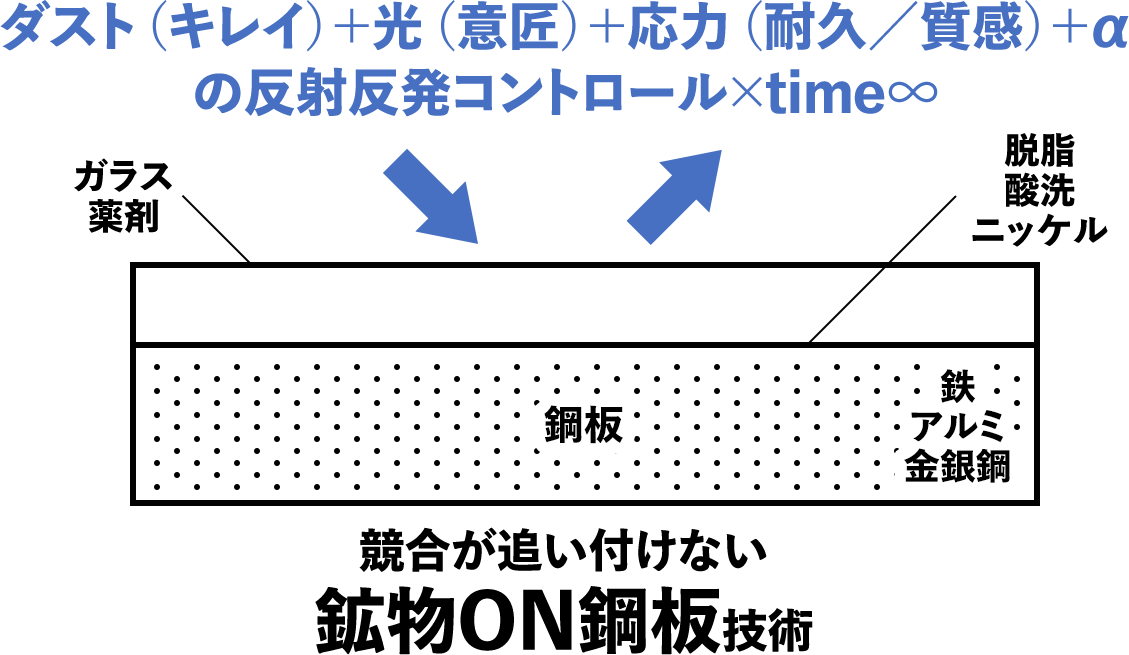
Furthermore, we visualized these redefined and rediscovered values and shared them with everyone as a single image. This clear visualization of the technical concept fostered a shared understanding that even the client’s executive leadership and technical departments found convincing, serving as a solid foundation for subsequent strategic planning.
“We thought we understood the value of enamel better than anyone else, but looking at it from a third-party perspective, we realized there were values we hadn’t yet discovered. I was truly amazed by the speed and depth of Dentsu Inc.’s understanding. Thanks to their keen observation of our enamel technology and their ability to clearly articulate values we hadn’t even seen ourselves, the direction of our strategy became clear,” said Mr. Takatsuki.
Successfully returned to profitability through sales revitalization. Moving toward further business growth through R&D transformation
The Panel Division’s next strategy, born from redefining value, is to enter new markets.
“While enamel is primarily used in everyday plumbing applications, we thought that by leveraging its ‘reflection and repulsion control’ properties, it could perform well even in harsher environments. For example, the potential applications are diverse, ranging from hot spring and bathing facilities to underwater settings, or locations prone to salt damage and strong UV radiation,” said Mr. Makigusa.
To stimulate new demand for enamel panels, the division is currently conducting market research and collaborating with the R&D department on product development.
At the same time, the company is focusing on immediate reforms to eliminate the Panel Division’s operating deficit. To increase profitability, it is essential to understand not only technology and the market but also sales processes and cost structures. Mr. Makigusa’s team identified improvement measures based on sales monthly reports and cost statements, which had previously been managed separately within the company, and linked these to a business strategy grounded in technological value.
“Based on this strategy, we decided to first narrow our sales targets to public transportation—starting with subways—and educational and cultural facilities. Our plan is to raise awareness of Ho-Ro from there and use that as a springboard for further expansion. As a result of the division—which had previously operated in silos—working together as a unified team, we were able to post a profit in fiscal year 2024. I believe this is a result of Dentsu Inc. taking charge of the strategic aspects, which allowed us to focus on sales,” says Takatsuki with a smile.
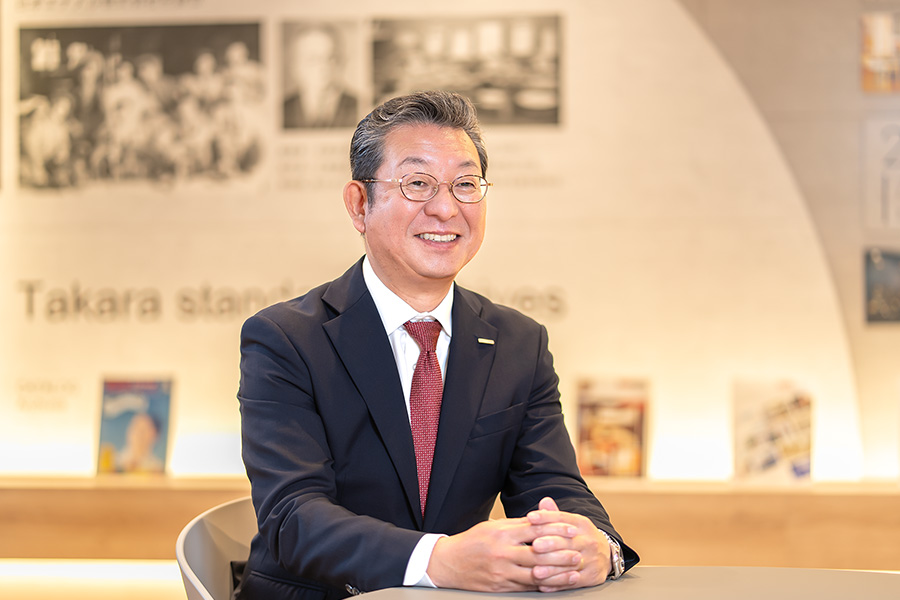
Although the project was a huge success from its very first year, this is merely the beginning of the transformation. The Panel Division, operating directly under the Business Development Headquarters established in January 2025, has been tasked with pioneering new business areas. In other words, this is where the real R&D transformation begins.
Takara Standard plans to open an “R&D Center (tentative name)” in Yao City, Osaka, in 2026 to serve as a research and development hub for its core enamel technology, and to expand the Fukuoka Plant with a new wing in 2028, thereby increasing enamel production capacity by approximately 1.5 times.
“Now that the strategy and roadmap for its implementation have been clarified, we can see exactly what needs to be done,” says Takatsuki, outlining the company’s vision. “We plan to expand the use of our enamel panels—which have received high praise in public facilities—into the private sector and new markets.”
Dentsu Inc. will accompany them on this journey as a partner. This is because the team’s mission is to provide end-to-end support—going beyond mere strategy formulation to encompass business creation, market expansion, and marketing. With the number of members from both companies involved in the project steadily increasing, including those in the R&D department, expectations for the future of this transformation are growing.
Transforming R&D into Business Results Through End-to-End Support
Redefining the value of technology and transforming it into business—Dentsu Inc.’s “R&D For Growth” program systematizes this series of processes, which were implemented through Dentsu Inc.’s support for Takara Standard.
“R&D For Growth” is Dentsu Inc.’s unique, end-to-end support program that starts with a company’s technological assets and encompasses business creation and marketing. Its defining feature is a practical approach that handles everything from strategy formulation to marketing aimed at commercialization in a seamless, integrated manner.
“Our aim is to ensure that R&D activities do not end with research and development, but evolve into ‘R&B (Business)’ that connects to new business and market strategies,” explains Mr. Makigusa.
The program consists primarily of three approaches. The first is “Technology Value Re-framing,” which delves deeply into a company’s technology to redefine and visualize its intrinsic value.The second is “Business Concept Modeling,” which analyzes and conceptualizes commercialization potential from the perspectives of society and consumers, using the technology’s value as a starting point. The third is “Marketing Design,” which guides the conceptualized business toward success. By providing end-to-end support throughout these phases, the program aims to assist companies in expanding their business and establishing a foothold in the market after launch.
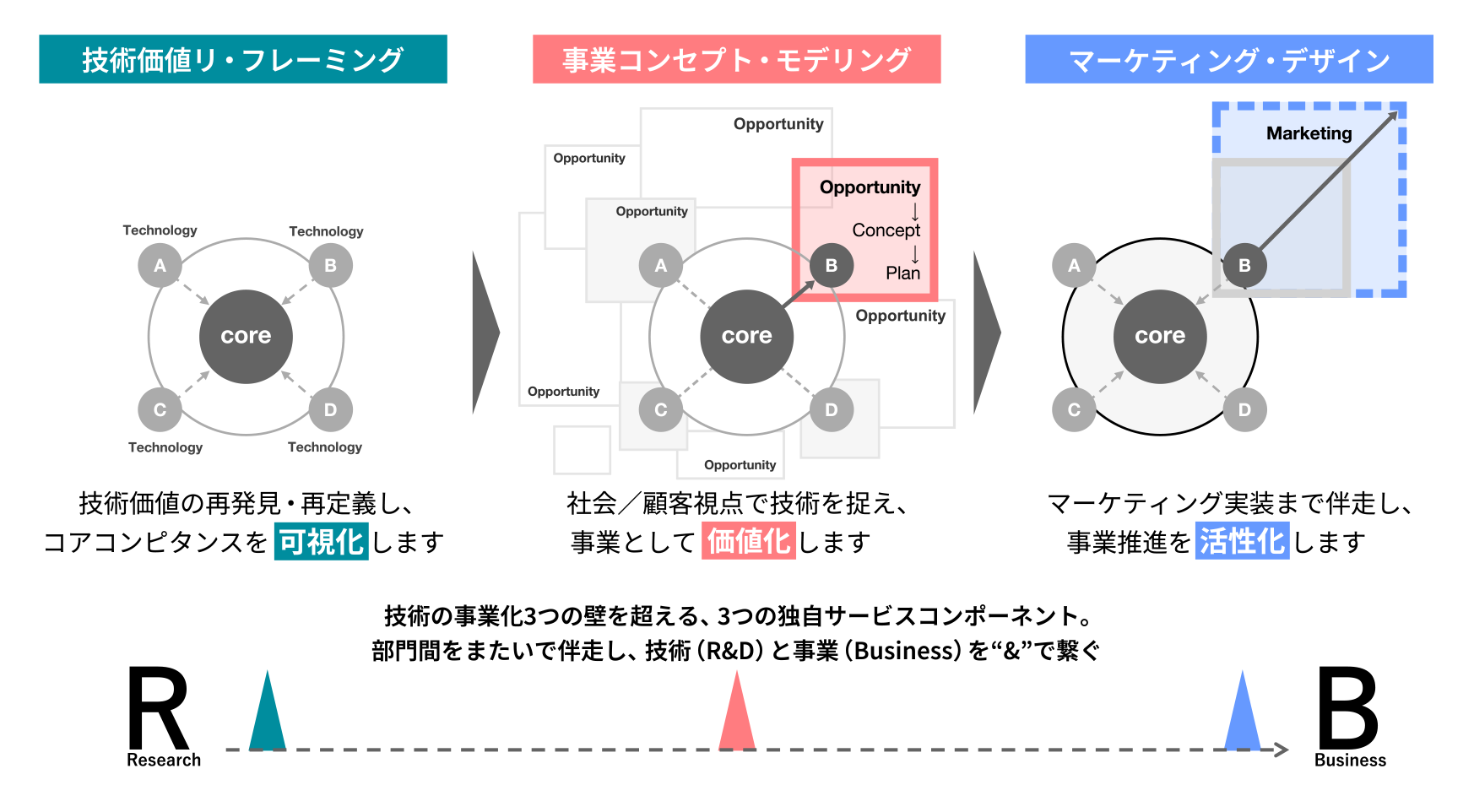
This is made possible by three strengths unique to Dentsu Inc. Namely, “Creative Concept Development,” which understands technological value and expresses it from a unique perspective; “Customer Insights and Proprietary Verification Schemes,” which identify opportunity markets for technology based on vast consumer research data and link them to validation; and “Marketing Communications” in the execution phase, leveraging insights from our advertising business.
“Furthermore, our ability to serve as a hub within client companies is another strength. We hear that many companies have silos between their R&D and business divisions. By acting as a bridge, we believe Dentsu Inc. can drive cross-departmental transformation,” says Mr. Makigusa.
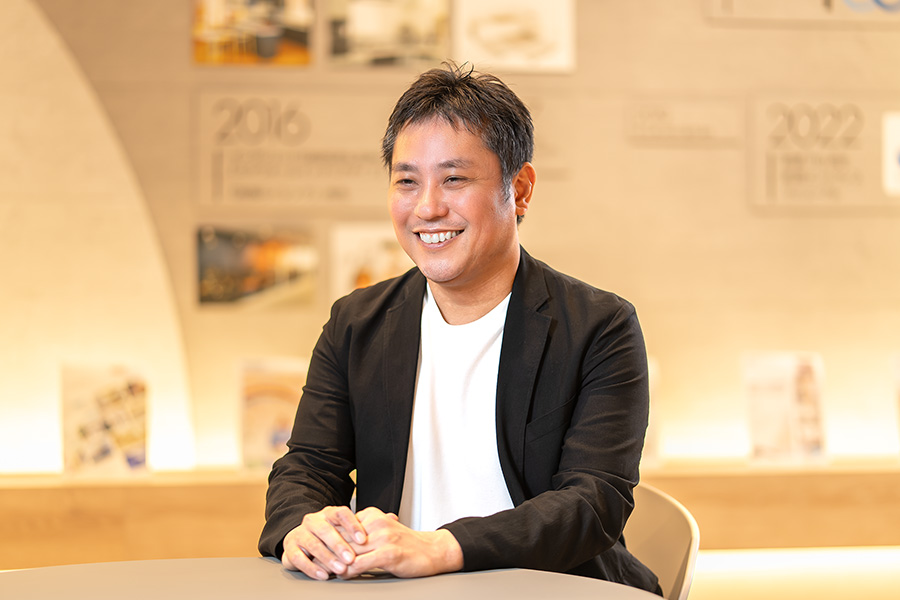
There is no set “template” for “R&D For Growth.” It is provided on a bespoke basis for each company, tailored to the client’s technological value, business challenges, and growth strategy. This is another appeal that framework-based consulting lacks.
“For Japanese companies to grow, now is the time for true R&D transformation. We aim to continue supporting the growth of many clients and revitalize Japan as a technological powerhouse,” said Mr. Makigusa.
Dentsu Inc.’s “R&D For Growth” is a program that uncovers new value for companies by focusing on technology. Why not take the first step toward transformation to achieve solid business growth in the future?
Click here for the detailed “R&D For Growth” eBook
https://www.d-sol.jp/ebook/r-and-d-for-growth
Was this article helpful?
Share this article


Newsletter registration is here
We select and publish important news every day
For inquiries about this article
Author
Shinji Takatsuki
Takara Standard Co., Ltd.
Executive Officer, Head of Business Development Division and Panel Business Division
Keita Makikusa
Dentsu Inc.
Business Transformation Division 2
Transformation Partner Division 6 Manager, BX Producer