At Dentsu Group’s local offices around the world, proposals rooted in consumer insights and co-creation with local and Japanese companies take place every day. In this series, we will introduce regional market characteristics and tips for Japanese companies entering new markets through the perspectives of global expatriates leading business in various locations.
In Part 2, we focus on Thailand, the ASEAN country with the highest number of Japanese companies operating there. In Thailand, where the wellness market is rapidly expanding due to growing health and beauty awareness, we spoke with Kenji Yano of Dentsu One Bangkok, who led the rebranding project for Suntory Wellness, a company that markets health foods and other products. He shared his insights on the branding challenges Japanese companies face in Thailand’s increasingly competitive market and the key points for successful co-creation.
Shifting Focus from Products to “Quality of Experience” — The Surprising Changes Among Thai Consumers
──First, please introduce yourself. What kind of work do you do at Dentsu Inc. Thailand?
Yano: Dentsu Thailand Group (hereinafter “Dentsu Thailand”) will celebrate its 50th anniversary in 2024 and is one of the Dentsu Group’s overseas offices with the longest history. We have a total workforce of just under 1,000 employees, including locally hired staff. Dentsu Thailand brings together professionals in creativity, media, customer experience design, data and technology, and AI to provide clients with one-stop integrated solutions.
Additionally, over the past year, we have launched initiatives to address diverse challenges within our clients’ value chains, including BX (Business Transformation) to support business and organizational transformation, as well as efforts to expand client revenue and solve social issues through sports and entertainment content.
Within this framework, I lead the Dentsu One Bangkok team at Dentsu Creative, which oversees the creative sector. Our primary focus is providing marketing services to Japanese and local Thai companies. We deliver multifaceted solutions by integrating resources within our group—covering everything from brand strategy development, creative planning and production, and event activations to media planning and the formulation and execution of PR strategies.
――What are the current characteristics of the Thai market?
Yano: While Thailand has long been a familiar and beloved country for Japanese people and Japanese companies, economically speaking, it has yet to fully join the ranks of developed nations. This is because its three major sources of income—agriculture, tourism, and foreign investment—all lack stability due to the impact of political instability and global geopolitical tensions. GDP growth for 2026 is projected at 1.6% (according to the World Bank), suggesting an overall stagnation.
On the other hand, behind these numbers—that is, what is actually happening on the ground—is a “refinement in the quality of consumption.” The era of simply buying things is over, and there is a growing number of highly mature consumers who prioritize self-expression on social media and whether products align with their personal values. The increase in Thai visitors to Japan due to the weak yen and strong baht also suggests that Thai consumers have become more discerning.
I truly feel that Thailand today is no longer merely the “core of an emerging economy,” but has become a market where the “quality of experience” is just as important—if not more so—than in Japan.
――Specifically, what consumer behaviors or market changes are you focusing on?
Yano: In Thailand, new shopping malls, restaurants, and cafes open almost every year, and the streets are bustling with numerous giant outdoor billboards and LED displays. It’s a common sight to see fashion-conscious locals taking photos and videos for social media at photogenic spots.
Our job is to capture these real-world insights into “what moves Thai people today” through our proprietary survey data and authentic voices. We then translate these “evolved true feelings” into the next strategic move for our clients’ businesses.
Scenes from a bustling shopping mall
A Brand Rebuilding Project Tackling the Growing Wellness Market
――Now, let’s hear about the branding case study for Suntory Wellness that Dentsu Inc. was involved in. How did this project get started?
Yano: In 2024, Suntory Wellness acquired NBD Healthcare, a Thai health food manufacturer. NBD is a company that operates numerous brands in the supplement and skincare markets across Southeast Asia, with a focus on Thailand. Following this acquisition, it became necessary to restructure the company’s brand portfolio.
The biggest challenge in this project was “how to organize the many individual brands and connect them to the future.” So, we decided to form a single team by bringing together the strengths of Tokyo-based Dentsu Inc. and dentsu APAC with local resources in Thailand to rebuild the “core” of the brand.
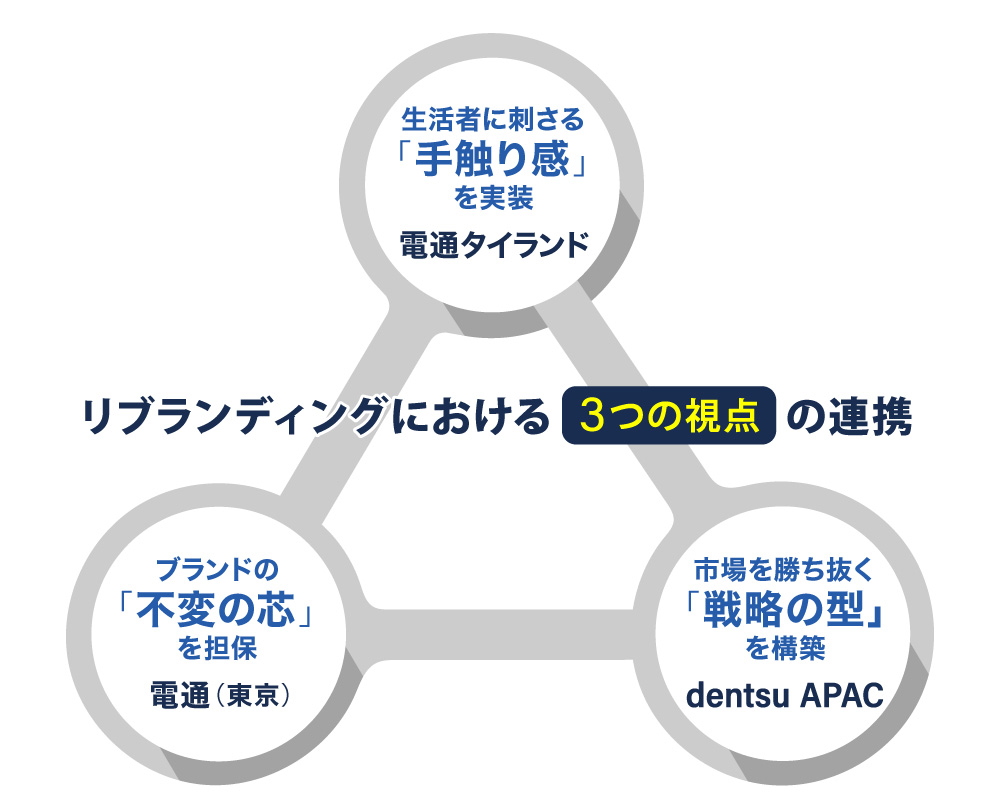
The Dentsu Inc. team in Tokyo works closely with Suntory Wellness on a daily basis. Joining them was Taku Morigami (Integrated Strategic Partner) from dentsu APAC, an expert in brand consulting who has dedicated himself to solving challenges for various clients, as well as the planning team at Dentsu Thailand, which possesses deep knowledge of the local market. By uniting these three parties, we formed a team capable of providing a comprehensive overview from both a strategic and market-oriented perspective.
The many products lining the store shelves
――What process did you follow to rebuild the brand’s “core”?
Yano: The first step was to clarify the brand’s current positioning. We carefully interviewed consumers and Suntory Wellness stakeholders to understand the brand’s “ideal” state and desired direction, and through workshops, we shaped the goal image envisioned by the stakeholders. Then, by identifying the current competitive landscape, future consumer needs, and trends, we proposed a unique, strong, and distinctive positioning.
However, while we use the term “consumers” in a general sense, for our client, Suntory Wellness, this includes not only end-users but also retailers such as drugstores and wholesalers involved in the distribution channel. Therefore, predicting future consumer demand alone is insufficient to fully grasp market needs.
What is required is a multifaceted analysis of brand perception and the desired brand image held by all stakeholders to build a compelling, unique, and strong brand positioning.
――So, rather than simply consolidating numerous brands, you formed a single core concept while incorporating various perspectives from across the supply chain.
Yano: The reason this project succeeded was that we wove together three distinct perspectives into a single vision.
The team in Tokyo (Dentsu Inc.) built an unwavering “core” (core values) centered on the “soul” (vision and values) of the brand that Suntory has cherished for many years. The APAC team, keeping an eye on trends across Asia and drawing on success and failure cases from various Asian countries, then constructed a “winning framework” to determine how to organize the brand for efficient growth and to succeed in the market.Furthermore, local planners in Thailand shaped the strategy by bringing real-world insights—such as “what Thai people truly think versus what they say” and “how products appear on store shelves”—to the table.
It wasn’t simply a matter of reorganizing the names of the group’s brands; it was precisely because we engaged in repeated discussions from these multifaceted perspectives that we were able to establish a positioning that everyone—from the sales staff on the front lines to the executive leadership at headquarters—could agree on and feel confident in.
After about six months of close collaboration, we completed a brand platform that incorporated the brand’s positioning, concept (idea), essence (core value), significance, role, and personality. This “brand bible” has become an indispensable resource that frontline staff turn to whenever they face uncertainty.
Tips for Japanese Companies to Re-establish Their Presence in the Thai Market
――Through this project, in what ways did Dentsu Inc. Thailand’s strengths come to the fore?
Yano: Dentsu Inc. Thailand has been working with Japanese and local clients in Thailand for over 50 years. Our fundamental mission is to help clients leverage the local market insights we’ve accumulated through our long track record and experience, as well as our ability to quickly identify changes in consumer lifestyles and trends, in their marketing activities.
We are not just a company that creates TV commercials and online ads. Our strength lies in understanding Thai consumers more deeply than anyone else and directly linking that understanding to our clients’ “business growth.”
In the age of AI, when convenient products are everywhere, it is essential for brands to have the power to make people think, “I like this company” or “I can trust this.” To achieve this, we don’t stop at simply devising a strategy. We work backward from the moment the product or service reaches the customer’s hands—even considering how it will appear on a smartphone screen—to craft a “tangible form” that best fits today’s Thailand.We believe our greatest strength lies in our ability to combine a “practical, on-the-ground sensibility” built up over 50 years with the latest “future forecasting.”
Going beyond the scope of a traditional advertising agency, we operate as an IGP (Integrated Growth Partner—a partner that supports clients’ sustainable growth across a broad spectrum beyond advertising and marketing, contributing to the revitalization of society). We work closely with clients throughout their entire value chain to solve their challenges. This is the essence of Dentsu Inc. Thailand today.
A meeting at Dentsu Inc. Thailand
――Finally, could you share a message for Japanese companies considering expanding into Thailand?
Yano: As reported in various media outlets, the image of Japanese companies and brands in Thailand may be starting to feel the pressure of overwhelming volume as Chinese companies expand into the market. However, the “trust” and “high quality” that Japanese brands have built up over many years remain powerful assets.
What matters is “accurately translating” those strengths to align with the current atmosphere in Thailand and communicating them effectively. Companies that have updated their core values are certainly succeeding in this market. I believe what is strongly needed now is to reexamine the strengths and core values that Japanese brands possess and express them with confidence both internally and externally.
We have implemented projects similar to this one for B2B and financial clients as well. The insights and know-how accumulated through these cases will surely be useful for Japanese companies considering expansion into overseas markets.
As brand partners, we aim to empower Japanese companies to establish an overwhelming presence in Thailand.
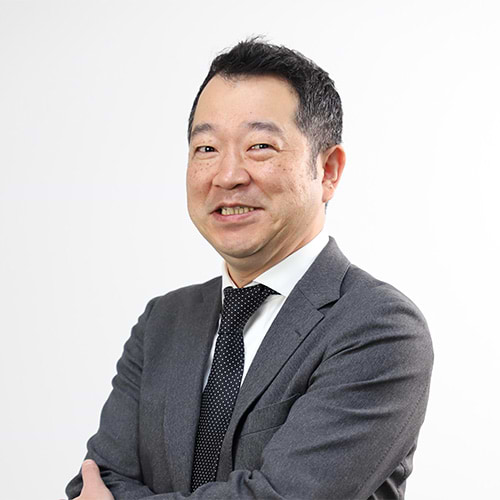
After joining Dentsu Inc., I worked in the Media and Sales divisions before taking on sales roles for Japanese clients in Thailand, the Philippines, and China. In April 2024, I was reassigned to Thailand in my current position, where I lead the Dentsu One Bangkok team, providing integrated marketing solutions—including creative services—to both Japanese and local clients.
Also read
Three Key Perspectives for Brand Rebuilding: Insights for Entering Thailand’s Wellness Market

 Hints for Japanese Clients Entering New Overseas Markets [2/3]