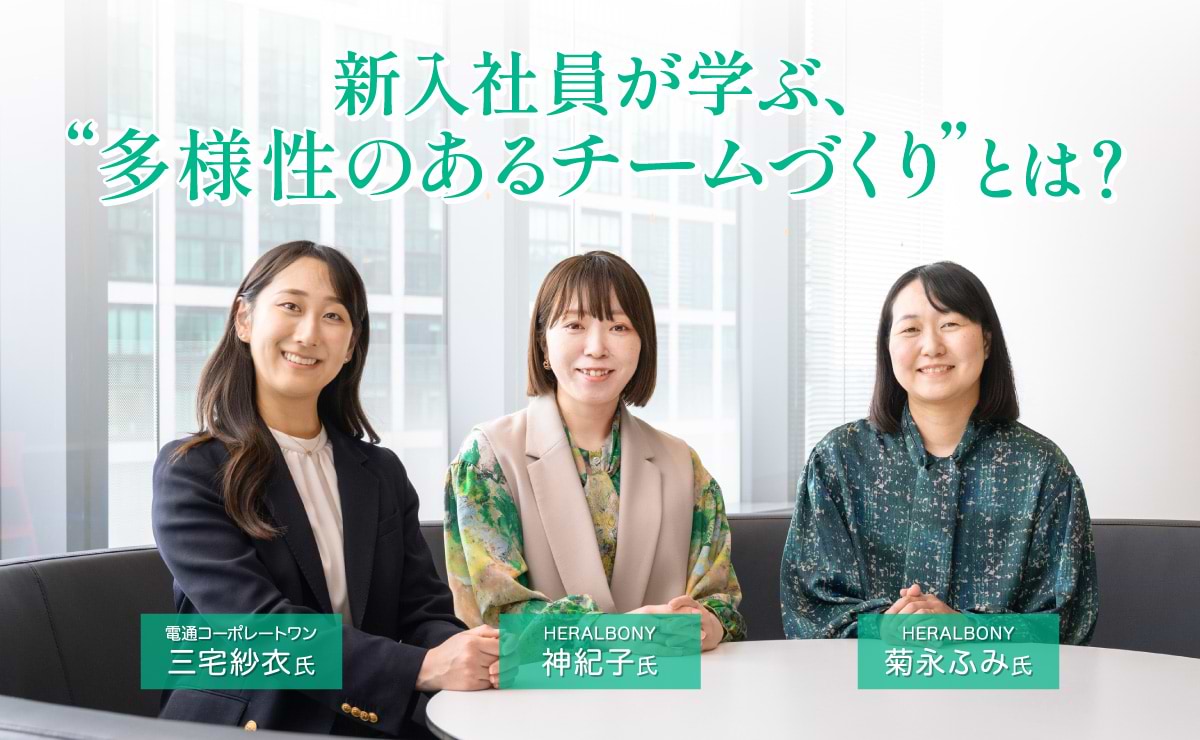
(From left) Sae Miyake of DENTSU CORPORATE ONE INC.; Noriko Kami and Fumi Kikunaga of HERALBONY
When working in an organization, it is essential to cultivate a mindset of “working as a team” with people whose circumstances and perspectives differ from your own. At Dentsu Inc., to help new employees develop this mindset, we have consistently emphasized the importance of “imagination” through new employee training and other initiatives.
For the fiscal year 2026 new employee training, a “hands-on” DEI program was implemented as part of the DEI training. The program introduced “PEACE,” a card game-style workshop developed by HERALBONY ACADEMY, the training division of HERALBONY.
Under the concept of “FUN × Inclusion,” this program allowed new employees to learn about team building while simulating the experiences of minorities with characteristics such as “not being able to see” or “not being able to hear.” What they realized through this experience was that what they take for granted may not be the norm for others.
In this article, Noriko Kami and Fumi Kikunaga of HERALBONY, along with Sae Miyake of DENTSU CORPORATE ONE INC., discuss the vision behind the program and the changes observed in the new employees following the training.
HERALBONY A creative company dedicated to “Let Your Uniqueness Shine,” working alongside distinctive artists to create new culture. The company operates the “HERALBONY” brand—which aims to bring about social change by “wrapping oneself in art”—and manages the licensing of over 2,000 artworks created primarily by artists with intellectual disabilities from Japan and abroad. It also engages in diverse business activities, including the planning and production of products and spaces.
A Gateway to DEI: An Experiential Training Program That Deepens Understanding Through “Hands-On Experience,” Not Just Knowledge
Miyake: I’d like to start with a brief self-introduction, so I’ll go first. I’m Miyake, and I’m in charge of talent development in the Development Division of the HR Management Office at DENTSU CORPORATE ONE INC. I served as the project leader for the FY2026 new employee training program, where I was responsible for designing the curriculum and overseeing its implementation.
Kami: I’m in the Welfare Division at HERALBONY, where I serve as the head of HERALBONY ACADEMY.
Kikunaga: I’m also part of the Welfare Division, and I’m in charge of content development for HERALBONY ACADEMY.
Miyake: Thank you. First, could you tell us about HERALBONY ACADEMY and what it does?
Kami: HERALBONY ACADEMY is a training and education initiative that goes beyond mere talk of diversity and DEI; we aim to create a world where each individual respects differences, finds them fascinating, and seeks to understand them. Guided by our mission statement, “Toward a world where 8 billion people find differences fascinating,” we offer experiential DEI programs.
Miyake: When was HERALBONY ACADEMY founded?
Kami: It’s been almost a year since our official launch, but we launched the predecessor to this—the experiential DEI program (DIVERSESSION PROGRAM)—about two and a half years ago. HERALBONY, which had been carrying out various initiatives centered on art, conceived this training initiative as our “Phase 2” to take a step beyond art.
At the time, we brought together various ideas—such as running a café where people with disabilities could thrive—and explored ways to help people most tangibly experience diverse perspectives that transcend the boundaries of “minority” and “majority.” Training emerged as the solution we arrived at. Furthermore, inquiries from companies we’d collaborated with on art projects—asking us to “conduct training” or “teach them about DEI”—also served as a driving force.
Miyake: So you were also sensing a need from those around you.
Kikunaga: Yes. We also receive inquiries from companies saying, “We want to improve our understanding of disabilities” or “Please teach us how to be considerate,” but we never intended for people to gain knowledge about disabilities solely through classroom-style training. Rather, we believed that the process itself—experiencing differences firsthand and coming to understand each other’s situations through trial and error—was what truly mattered.
In fact, through our ongoing conversations, Kami and I have come to recognize our differing assumptions and perspectives, and we’ve deepened our mutual understanding. We believed that delivering this process through our training would be a key strength of HERALBONY ACADEMY.
Kami: The strength of our training lies in presenting the messages we want to convey as “questions,” allowing participants to feel them more deeply through experience and to reflect on them—even when those reflections lead to feelings of confusion. For people who haven’t had the opportunity to think deeply about DEI before, this becomes a catalyst for inevitably encountering social issues related to diversity. Through this process, I believe they may discover new ways of thinking, new worlds, and new insights within themselves.
The impact of these “questions” and the experience of not being able to answer them on the spot are things that stay with people. I believe the meaning of corporate training lies in delivering these “questions” to people we haven’t been able to reach before and planting “seeds” that may sprout in the future.
From Student to Professional: The Challenge of “Exercising Imagination” Faced by New Employees
Miyake: Earlier, you mentioned the predecessor to your current DEI training program. What kind of training did you initially offer?
Kikunaga: We launched the program around October 2023, targeting B2B companies. Initially, it was a program that used a puzzle-solving game, where participants took on different roles—such as “hard to see,” “hard to hear,” or “unable to make eye contact”—while playing.
In this scenario, some participants find themselves in roles where they have no idea what the current situation is, how far the puzzle-solving has progressed, or even what information is being shared at all. Amid these “misalignments” in perception, participants work to understand each other’s situations anew and explore ways to make progress that works for everyone. Through this process, they realize things like, “I was so focused on my own task that I didn’t have the bandwidth to pay attention to those around me,” or “We didn’t share the necessary information sufficiently.”
This experience serves as an opportunity to deepen discussions on how to create a better environment as a team. Believing that this mirrors situations encountered in actual work, we offered it as a training program.
Miyake: Actually, I’ve participated in this mystery-solving game myself. Through that experience, I truly felt the difficulty of achieving results while also creating an environment where everyone can perform at their best by communicating smoothly with members who have diverse characteristics. Did Mr. Kikunaga lead the design of this program?
Kikunaga: Yes. Having previously worked in creating experiential entertainment, I felt that by actually experiencing something—rather than just passively receiving knowledge—knowledge and emotion become connected, and imagination expands. I designed this program to provide that kind of learning experience.
Miyake: As you mentioned, “expanding one’s imagination”—in our annual interactions with new hires, the biggest challenge we faced was “cultivating the imagination” needed to understand others’ perspectives and circumstances.
Many people struggle to adjust when their environment changes after leaving college. That’s why we’ve consistently encouraged them to think broadly—not just from their own perspective—about “what roles and behaviors the company, their supervisors, and colleagues expect” and “how they can contribute to society through the company.”However, as you pointed out, words alone aren’t enough to get the message across. That’s why we decided to introduce HERALBONY ACADEMY’s experiential DEI program this year, believing it would serve as a catalyst for new employees to gain insights on their own.
I also sense that your training places a strong emphasis on “FUN”—ensuring participants enjoy the experience. Is there a specific reason behind that?
Kami: Yes. I believe DEI is fundamentally a core skill for business professionals, but in reality, it often only reaches those who are already interested in the topic. If people only have a vague sense that it’s necessary, they tend to shy away from it.
So, by creating “FUN” as a gateway, we thought even those who had been hesitant could learn about DEI through a fun and positive experience. This is also based on Albony’s own philosophy—that engaging with art can change one’s perception of disabilities.
Reexamining What You Take for Granted Through the “PEACE” Card Game-Style DEI Program
Miyake: The “PEACE” workshop—featuring our original card game—that we conducted this time is characterized by having participants play the same game twice under different conditions, allowing them to experience the difference between the first and second rounds, isn’t it?
Kami: In the program, participants first attended a roughly one-hour lecture to acquire basic knowledge about DEI, and then experienced “PEACE.” “PEACE” is an original card game that utilizes role cards such as “invisible,” “wheelchair user,” and “silent,” and is inspired by author Teppei Kasahara’s “ The Habit of Gathering.”Each member takes on the role described on their role card, and the first round proceeds as is. This creates situations where, depending on the role, players “can’t see the cards on the table” or “don’t know what conversations are taking place during the game.” Taking these differences into account, before the second round, everyone works together to devise new rules to make the game more enjoyable for everyone, and the second round is played using those rules.
Finally, as a “work session to apply what we’ve learned to daily life,” we had everyone think of a scenario in their daily lives where someone is struggling and come up with a solution.
Miyake: After conducting this training, I realized that “environmental design” within the team is crucial for everyone to thrive while respecting and leveraging each other’s “differences.” I’d love to hear about the vision you two have for “PEACE.”
New employees taking on roles and playing the card game
Kikunaga: The purpose of “PEACE” is to help participants experience firsthand that what they take for granted may not be the norm for others. In the first half, they gain insights through experience, and in the second half, they work through trial and error to implement improvements so that everyone can enjoy the activity. I designed this program hoping that, through this process, members from diverse backgrounds would update their understanding of these differences in what is “normal” when working together. The creative ideas and new value creation that emerge from this are the true power of diversity.
Miyake: By starting from the premise that some people might find this environment uncomfortable, we can transform the game into one that’s easy for everyone to participate in and enjoy simply by making small adjustments to the rules or how we interact. Passing that perspective on to the participants is a major lesson of this program, isn’t it?
Kami: DEI is still often viewed solely in terms of human rights, but it’s not limited to that. Through “PEACE,” we’re working to help people experience firsthand that, in addition to the human rights aspect, harnessing differences can be a truly powerful force. When we can harness those differences, it should become a new source of strength—both for the company and in terms of gaining business opportunities and new insights.
Furthermore, I believe that when we turn our attention to unconscious assumptions and overlooked challenges, the way we draw out each individual’s potential changes, enriching both the employees and the organization itself.
Kikunaga: During this training session, when creating new “PEACE” rules, some teams went beyond the framework of the card game and started playing a picture word chain game. At first glance, this might seem to deviate from the original intent of the exercise, but it was an action they took after thinking through “the best way for everyone to have fun” in their own way.
However, I think they likely learned something—such as “Oh, there’s that approach too”—by being exposed to the creative ideas of other teams. I found it wonderful that the session became a space where participants could use their imagination to inspire and elevate one another in this way.
After the Heralbony training, the new hires’ awareness of DEI changed more than expected!
Miyake: “In our daily lives, there may be things we’re not aware of that could be challenges for someone else.” I feel this served as the first step for the new hires to start imagining such possibilities.
We conducted surveys before and after the training—what were your thoughts on the results?
Kikunaga: Frankly, I felt it was well worth conducting. In the pre-training survey, the most common responses were that they didn’t feel there were any particular issues regarding DEI or that they didn’t know much about it. However, after the training, it seemed they had come to realize that they, too, are part of society’s diversity. Through this realization, I believe they became able to pay attention to the differences in others and gained a perspective on “how others are” and “how society is.”
Miyake: I, too, feel that the new hires have clearly changed since the training ended. For example, the term “unconscious bias” has started coming up in their everyday conversations. This is because they’ve taken the time to digest the meaning of the term and truly understand it. I feel they’ve begun to imagine different perspectives and make a conscious effort to be more mindful.
What about you, Mr. Kami?
Kami: As reflected in the survey results, I was deeply moved by the enthusiasm I saw from everyone during the workshop that day, as well as the words and ideas that emerged from it. Everyone absorbed the material with great flexibility, and especially during the final exercise, they were generating ideas while taking the topics personally.
This was the first time we’ve conducted this training for new hires, but I’d like to extend it to even more of them.
Miyake: I certainly felt that they were using their own imagination and generating ideas with enthusiasm. What I wanted to convey to the new employees was the importance of “using imagination” toward others, based on the premise that everyone might be carrying something that isn’t visible on the surface. This training served as a catalyst for addressing that challenge.
Kami: I believe the insights and inspiration each new employee gained from this training will transform what they bring to the world going forward and reach even more people.
Kikunaga: In fact, I was deeply moved by a comment from one of the new employees who said, “I became aware of ways to go beyond my own assumptions and communicate something beautiful and true to people in various circumstances without hurting anyone.” It reaffirmed my belief that they are the talent who will change this society, and I’m very much looking forward to what lies ahead.
Miyake: Thank you. I look forward to watching how these new employees will contribute to building teams where everyone can thrive when they begin working alongside people with diverse perspectives and backgrounds toward a common goal. I’ll continue to watch over them closely.
Creating an Environment Where Everyone Can Thrive and Be Accepted for Who They Are
Miyake: Finally, could you share your vision for HERALBONY ACADEMY?
Kami: Since meeting Kikunaga, I’ve gradually come to realize that I, too, possess “unconscious privilege as part of the majority.” That’s precisely why, to help more people become aware of this, I want to go beyond our current corporate training programs and focus our efforts on children’s education as well.
While Japan has a wonderful culture of cooperation and compassion, it can also make it difficult for people to express their true selves, and many struggle as a result. To convey the message that “it’s okay to be yourself,” it’s important to create more opportunities for people to realize that “nothing is a given,” and to establish natural points of contact where people can interact with a diverse range of individuals, including those with disabilities. We aim for a world where children interact with diverse people from an early age and naturally accept differences.
Kikunaga: My goal is to create a society where people with disabilities can work and live while being accepted for who they are.
In my own work as a deaf person, I’ve been able to engage in training and development thanks to the support of environments equipped with sign language interpreters. At the same time, I feel that the development of such environments is still insufficient, and I see it as a social loss and a challenge that many people are unable to fully realize their potential. Rather than viewing people through the lens of “disability,” we must engage with each individual and create an environment where everyone can work on an equal footing. To achieve this, I want to expand opportunities across various fields—such as cafes, creative industries, and business management—where people with disabilities can truly shine.
Miyake: I realized that environmental design is not just about a single team—it’s about society as a whole. Thank you very much for your time today.
After graduating, she joined Recruit Co., Ltd., where she gained experience in sales and new business development. At age 30, after studying abroad in the Philippines and traveling around the world, she confronted the injustices of society and her own unconscious biases, leading her to resolve to dedicate herself to solving social issues. Upon returning to Japan, she joined Globis Co., Ltd. and simultaneously earned an MBA from the Globis Graduate School of Management.In 2023, resonating with HERALBONY’s mission, I joined the company as the lead in launching the Welfare Division.
Currently, as the head of the Welfare Division, I also serve as the General Director of HERALBONY ACADEMY. I am responsible for planning and developing training programs and workshops, serving as a lecturer, and driving business growth in the areas of corporate DEI promotion and inclusivity.
Fumi Kikunaga
Heralbonie Co., Ltd.
Welfare Division
Content Creator
Deaf. After completing the Graduate Program in Special Education at Tokyo Gakugei University, she worked as a child guidance counselor for 10 years while also founding the General Incorporated Association “I-Gengo Lab.”, where she serves as Representative Director.Developer of “I-Gengo” escape games. Content creator. While primarily focused on producing puzzle games and providing content, she is committed to building teams where Deaf and hard-of-hearing individuals can take the lead. Drawing on her experience at I-Gengo Lab. and driven by a desire to further change perceptions of disability, she joined Heralbonie. She is primarily responsible for developing corporate training programs and serves as the program lead.
Sae Miyake
DENTSU CORPORATE ONE INC.
Human Resources Office, HR Management Division, Training Department
After working in the media division at Dentsu Inc.,
she was seconded to DENTSU CORPORATE ONE INC., where she gained experience in human resources, focusing on training and development initiatives as well as internal communications.
She is currently in charge of talent development, primarily planning and managing programs to support the growth of young employees. As the leader of the FY2026 New Employee Project, she oversees the design and execution of the entire training program while coordinating with numerous stakeholders.