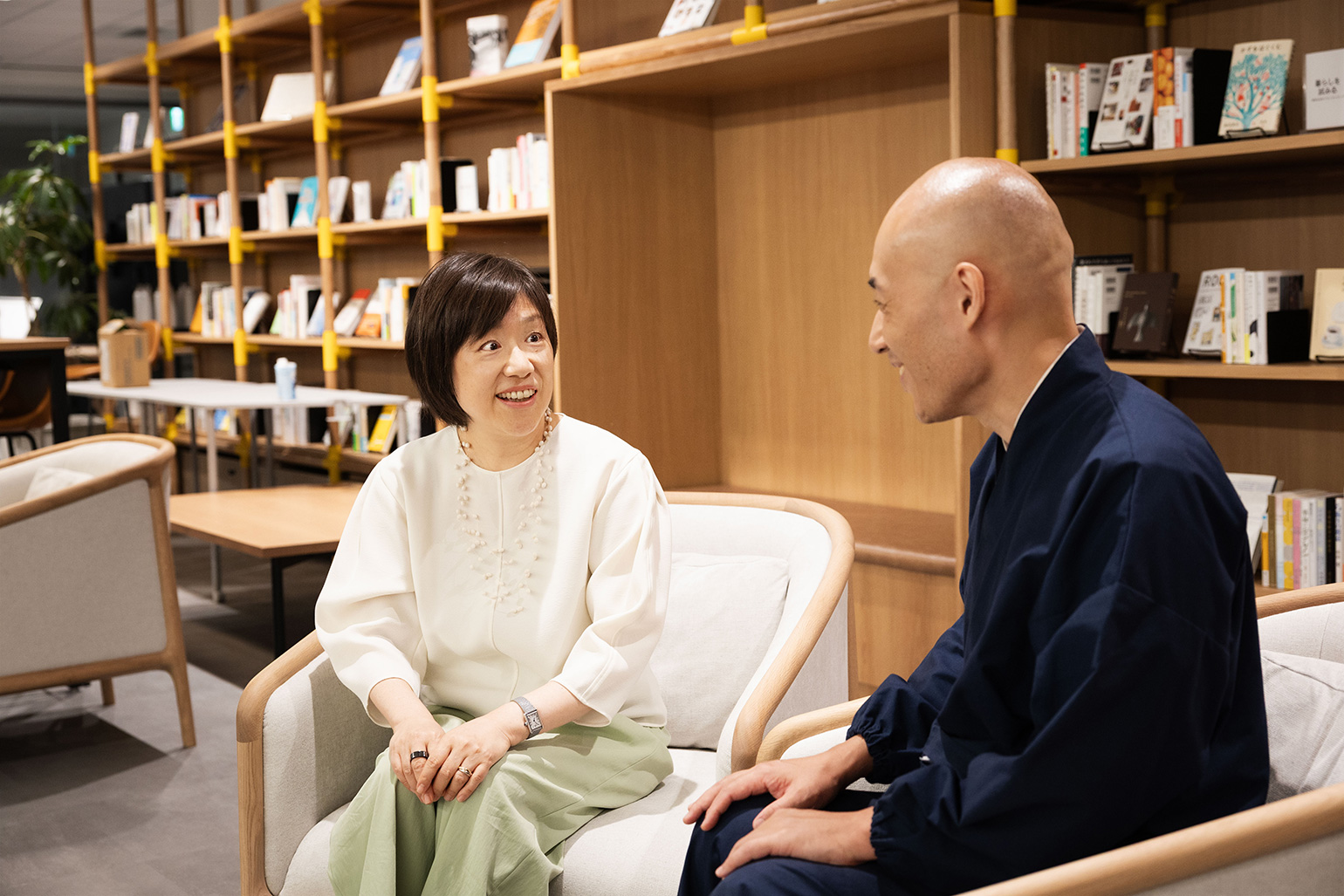
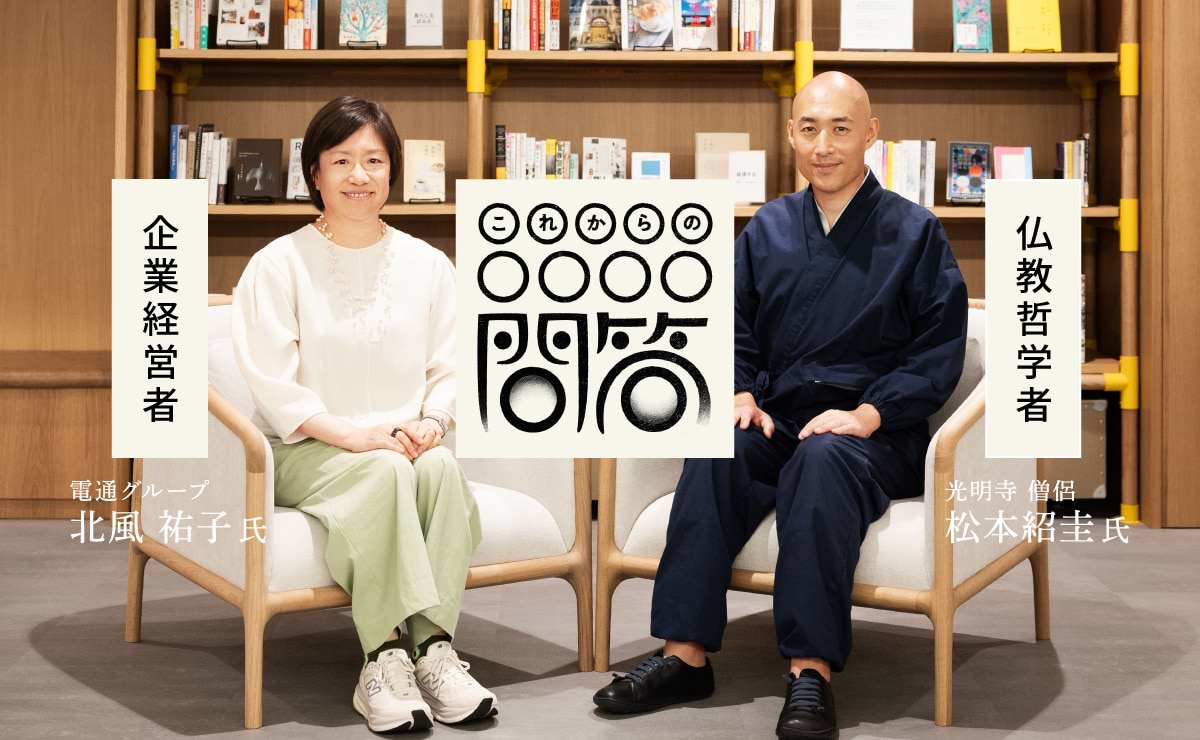
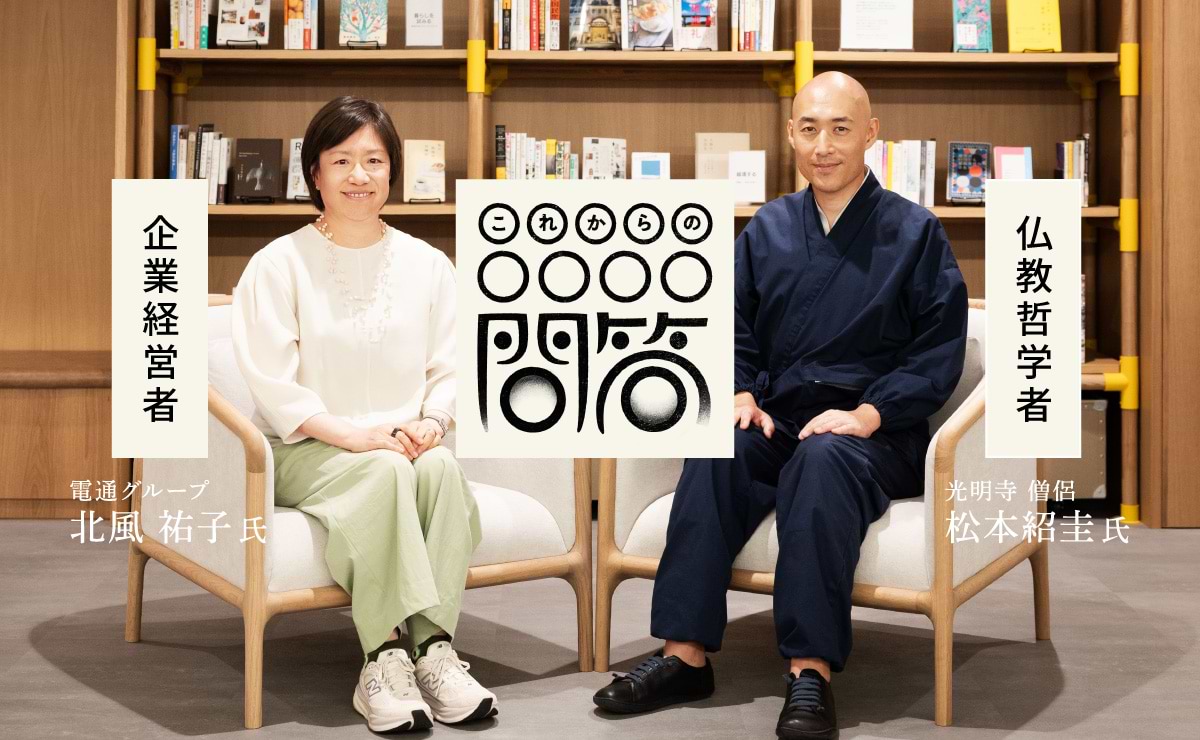
An experimental endeavor to explore the essence of the concerns faced by business professionals from the perspective of Shōkei Matsumoto, a Buddhist monk and philosopher. In this episode, we welcomed Yuko Kitakaze, Global Chief Sustainability Officer (GCSO) of the Dentsu Group, as our guest for a conversation on the theme of “Corporate Integrity.”
What are the commonalities between corporate “integrity” and the Buddhist concepts of “karma” and “body, speech, and mind”? What insights for management emerge from these connections? In an era of increasing uncertainty, we present a dialogue where modern management challenges intersect with Buddhist philosophy.
Becoming a “Good Ancestor”: Seeking Ancient Wisdom in an Age of Chaos
Ido: I hear that business executives actually come to you, Mr. Matsumoto, for advice.
Matsumoto: Yes, I receive a wide variety of inquiries. Business concerns don’t fit into a single mold; they vary completely depending on the individual’s circumstances. As society as a whole becomes more chaotic and uncertainty grows, I think more and more people are feeling that “we need a different perspective than before.” That’s why I believe there’s a growing trend of turning to the wisdom that has been passed down through the ages.
Ido: I’ve heard that, precisely because of these times, there’s a phrase that you hold dear, Mr. Matsumoto.
Matsumoto: It’s the question, “How can I become a good ancestor?” This is also the central theme of the book *The Good Ancestor*, which I translated. In modern times, we tend to prioritize short-term results, but what’s truly important is the long-term perspective of what we can leave behind for the next generation.
For example, sustainability and forestry aren’t issues that can be resolved overnight. Even as technology advances, there are things that simply must be nurtured over time. Precisely because we live in an era of rapid change, there are challenges we must tackle with patience and perseverance. In that sense, I believe the question of “how to become a good ancestor” will become increasingly important going forward.
Ido: I see. Our guest today is someone who is driving corporate strategies—including sustainability and DEI, which certainly cannot be resolved overnight—on how companies should engage with society. Please welcome Yuko Kitakaze from Dentsu Group GCSO. What were your thoughts after hearing Mr. Matsumoto’s remarks just now?
Kitakaze: Nice to meet you. I really resonate with the idea you just mentioned—"how can we become good ancestors?" In my work on sustainability, I often use the phrase, “Let’s keep passing the baton—leaving things in the best possible state and saying, ‘The rest is up to you.’”
We aim to leave things in the best possible condition for our generation and then pass the baton to the next generation, saying, “The rest is up to you.” Each person’s life is short, but I believe that time is like a gift to oneself—that is, life itself. I want to pass on this precious gift I’ve received in the best possible condition. We share this sentiment within our team as well.
“Integrity” in Business and “Karma” in Buddhism
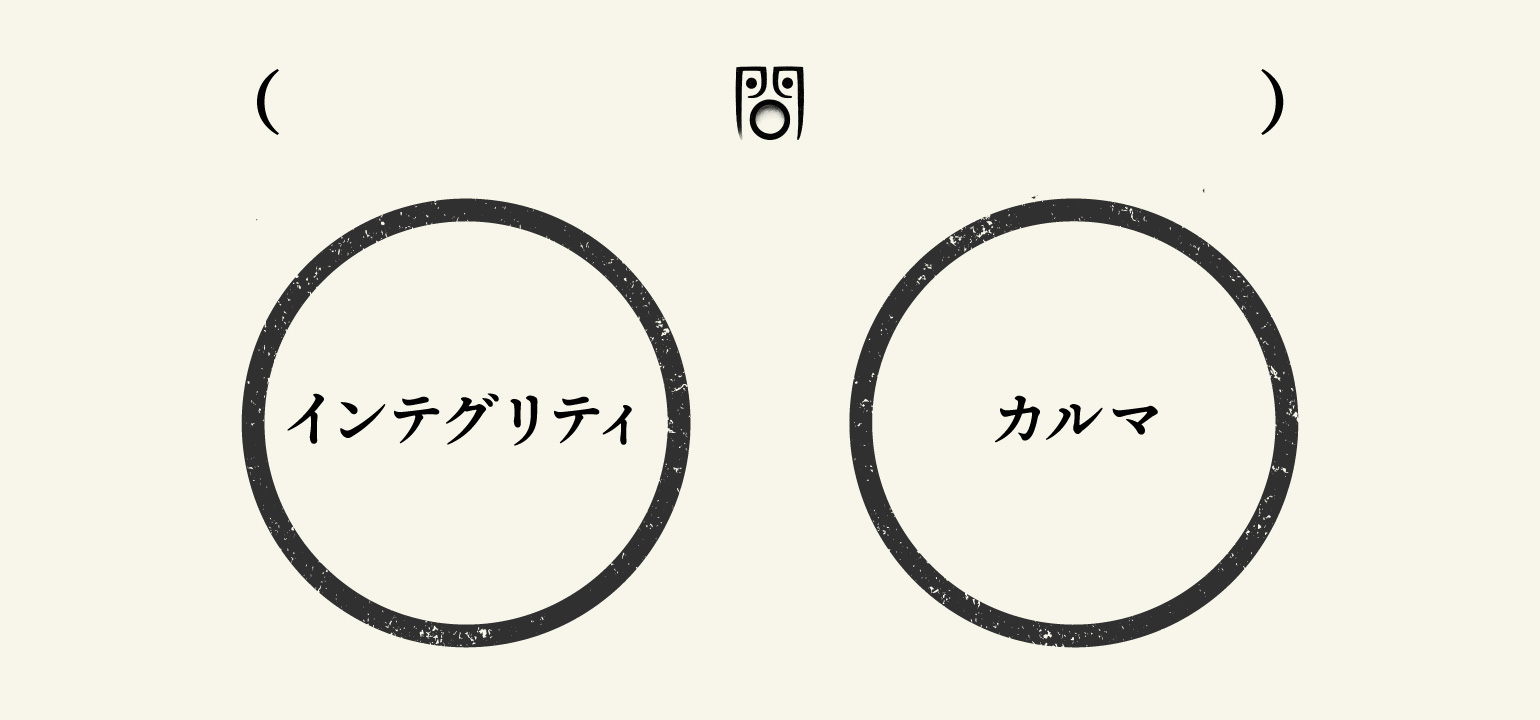
Ido: Our theme today is “integrity.” First, what exactly does integrity mean in a corporate context?
Kitakaze: We view integrity as the starting point for all our corporate activities. It is sometimes translated as “sincerity.” However, it’s not just about following the rules. I believe it’s an attitude of constantly asking ourselves what society expects of us, and it serves as the foundation for all our decisions. Corporate philosophies and purposes are, of course, important, but integrity is the foundation upon which they rest. I believe it’s crucial for the entire organization to embody this value.
Matsumoto: I see—it can also be translated as “sincerity.” It’s a word that can be interpreted in various ways, but to me, the concept of “minimal discrepancy” feels closest. It’s a state where what you think, what you say, and what you do align as closely as possible. In Buddhism, there’s a concept that overlaps with this: “karma.”
Kitakaze: When you say “karma”… it brings to mind “deeds” or the idea of a burden carried over from a past life…
Matsumoto: Yes. Since it’s a concept that has historically been fraught with various complexities, I’ve chosen to frame it a bit differently. How about thinking of it as “habits ingrained in one’s mind and body”?
For example, the very words I’m speaking and the actions I’m taking right now are the result of habits I’ve accumulated over decades, aren’t they? That’s precisely why they aren’t easy to let go of. In that sense, karma is a heavy burden.
In Buddhism, this concept of karma is divided into three categories: “body, speech, and mind.” “Body” refers to physical actions; “speech” refers to words; and “mind ” refers to the heart or consciousness. In other words, it’s about what we think, what we say, and how we act. I believe we can interpret this to mean that living a better life depends on these three aspects aligning as closely as possible.
I see the Buddhist concept of integrity reflected here.
Ido: I see. So that’s what you mean when you say, “Integrity is having minimal discrepancy.”
The “Three Questions” to Keep Body, Speech, and Mind in Alignment with Karma
Kitakaze: When you’re working, there may be situations where these three aspects threaten to drift apart. These are moments when, even though you actually feel something isn’t quite right, you’re tempted to go with the flow, telling yourself, “It’s just part of the job, so it can’t be helped.”
That’s why we’ve established three checkpoints to guide our decision-making. The first is, “Can I talk about my work to my family with pride?” The second is, “Can I find common ground with my colleagues?” The third is, “Can I explain this properly to our customers and have them understand and agree?” These may all seem obvious, but the more challenging the situation, the more we make a point of returning to these three principles.
However, even so, there are times when I still feel uncertain. Are there any tips on how to think that can help me keep my “thoughts, words, and actions” aligned?
Matsumoto: Actually, I don’t think we need to be too fixated on the goal of “staying on track.” In Buddhism, there is the concept of “impermanence” (mūjō). It teaches that everything is in a state of flux. Just like a river, the world is constantly changing, and people change as well. I believe karma is also in a constant state of flux.
When you think about it that way, a state that is 100 percent free of deviation doesn’t really exist. Rather, both people and society change while gradually drifting apart. It could even be said that this drift creates friction, which becomes a driving force and gives rise to new value.
Therefore, there’s no need to reject deviation itself. Trying to achieve perfect alignment can sometimes actually cause suffering.
Kitakaze: That’s certainly true. On the other hand, as a company, I also believe we must not overlook “unfavorable discrepancies.” For example, if a project becomes something you can’t explain to your family or loved ones, that’s a dangerous sign.
I believe the concept of “integrity” also serves as a brake to prevent companies from heading in the wrong direction.
“Shared Karma” in Organizations and the Role of Purpose
Matsumoto: I believe the concept of karma applies not only to individuals but also to organizations. Companies accumulate habits that have been ingrained by various people from every angle over time. This is what we call corporate culture. Past successes and decision-making criteria are deeply embedded in it, and this becomes the organization’s behavioral pattern. From a Buddhist perspective, I view this as “shared karma” (karma shared by multiple people). The larger the company, the heavier this burden becomes.
Just as a large ship cannot change course immediately when it veers off course, a company cannot change easily either. It’s not just a matter of individual integrity; the integrity of the “company as a ship”—that is, how it behaves—is also put to the test.
Kitakaze: That’s absolutely true. What we find particularly frightening is when “no one feels anything is amiss anymore.” When you’ve been in the same organization for a long time, things just become the norm. There’s a risk that no one will question, “Why are we doing this?”
That’s why people with different backgrounds and external perspectives are so important. The very act of realizing, “Oh, it can look that way too,” helps keep an organization healthy.
Matsumoto: There’s a saying that only new hires notice “the elephant in the middle of the office, ” isn’t there? The longer people stay, the less they see that elephant.
I’d like to ask you about this, Mr. Kitakaze. These days, it’s said that every company, regardless of its nature, must establish proper systems—including compliance measures—to ensure organizational ethics are upheld. In Buddhist terms, this involves untangling “shared karma,” or intertwined patterns of behavior. On the other hand, I think there’s also a concern that taking this too far could lead to everything becoming homogenized.
I believe “shared karma” is a vital element for companies—it’s both their culture and their individuality—but what are your thoughts on this?
Kitakaze: Exactly. Since we’re a company that values ideas, we can’t do interesting work in an organization where everyone shares the exact same values. It’s dangerous to reach a point where people think, “Everyone at this company says the same thing.”
We have people with diverse ways of thinking and experiences, and each person has a slightly different perspective. I believe those differences are the source that gives birth to new ideas.
Matsumoto: Just as differences between individuals can serve as a driving force, I think an organization that embraces diverse differences can generate the energy needed to create something new. That’s exactly what diversity is all about.
However, if we simply stop at “everyone is different,” there’s no point in coming together as an organization. I suppose that’s why “purpose” has been emphasized in recent years—to allow for slight differences while still moving forward with momentum.
Kitakaze: We also value our purpose. That said, even within our company, there’s no end to the discussions about “how we should interpret it.” Precisely because it’s our reason for being, there’s no simple answer. We have it in our DNA to do interesting things and take on challenges that fill the future with hope, so I think these discussions arise precisely because of that.
Matsumoto: What concerns me is the tendency to view “purpose” as a “goal to be achieved.” In Buddhism, there’s the “parable of the finger pointing at the moon.” The finger pointing at the moon is merely there to indicate the direction. If you get fixated on the finger itself, you’ll lose sight of the moon, which is the whole point. For example, during a nighttime voyage, the moon and the North Star show you which way to go, but you can’t actually reach them, right?
It’s the same with purpose. For a collective of individuals, each with their own unique tendencies, to gain momentum while aboard the ship of shared karma, isn’t it crucial that purpose functions not as a “goal-oriented mindset” that we “must reach, ” but rather as a “vector-oriented mindset” that says, “Let’s move in this direction”?
Each person stands in a different place and carries different karma. That’s why it’s not necessary for everyone to move at the same speed.
Kitakaze: While sharing a common direction, it’s okay for each person to walk at their own pace. That way of thinking is very practical. Using the ship analogy, it’s exactly like a compass.
Matsumoto: That’s right. Today is better than yesterday, and tomorrow is better than today. Even if we take a few steps back, we can simply start over from where we are now. Mahayana Buddhism strongly emphasizes this way of thinking, and I believe that the accumulation of these small steps leads to the progress of the entire organization.
Ido: For people like you, Mr. Kitakaze, who are in a role where you drive action at the corporate level, what do you think is the best way to proceed from here?
Kitakaze: Listening to what you just said, I realized that it’s important to focus on moving in a better direction while I’m alive and while I’m still with the company. It might sound a bit laid-back, but if I aim too far into the future, I end up feeling a sense of helplessness.
Matsumoto: The concept of the “Good Ancestor” is similar. It’s not just about future generations—it’s about the idea that “the me of today is also the ancestor of the me of tomorrow.” Audrey Tang from Taiwan used the expression “one-day ego”: passing the baton from yesterday’s self to today’s self, and from today’s self to tomorrow’s self, one small step at a time. I believe that accumulation is what leads to the future.
Ido: Thank you very much. Next time, we’ll explore the themes of “business decisions” and “commemoration.” Please look forward to seeing what new insights emerge.
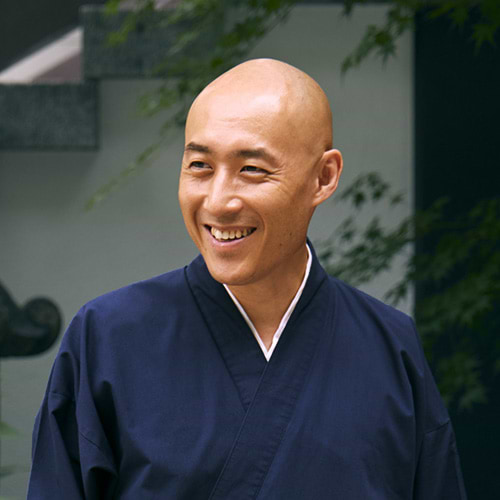
Member of the World Economic Forum’s Global Future Council on Responsible Leadership. Starting in 2025, he will serve as Mercator Visiting Professor at the University of Bonn in Germany. Drawing on ancient wisdom, he addresses contemporary issues such as ecology, AI, and responsibility toward future generations.His book *A Monk’s Guide to Cleaning: A Path to Mental Clarity* has been translated into 20 languages and became a global bestseller. He is also the translator of Roman Kurznarich’s *Good Ancestors: Can We Become “Good Ancestors”?*
Yuko Kitakaze
Dentsu Group Inc.
グローバル・チーフ・サステナビリティ・オフィサー 兼 電通 取締役
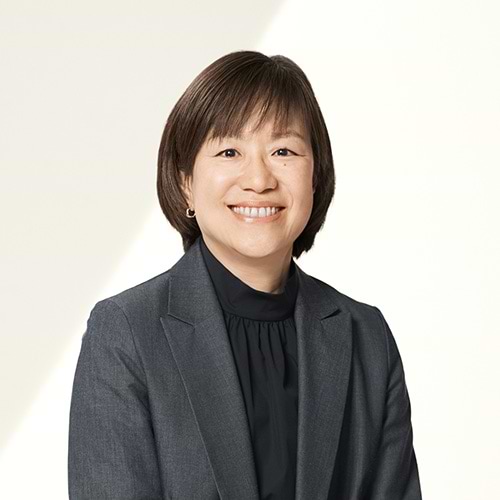
After graduating from the Department of Social Psychology at the University of Tokyo’s Faculty of Letters, she joined Dentsu Inc. She has led projects from planning to implementation in the fields of marketing and product and service development. She founded the company’s first lab, “Mama Lab.” After serving as Director of the Creative Planning Division 4, Executive Officer of Dentsu Japan Network, and the company’s first Chief Diversity Officer, she currently drives sustainability strategies as the person responsible for enhancing non-financial value.Recipient of the WBCSD 2025 Leading Women Awards; juror for the SDGs category at the 2024 Cannes Lions; official columnist for Forbes JAPAN; and Pink Ribbon Advisor. A forward-thinking leader.
After graduating from Nihon University’s College of Art, I worked as a production coordinator for video content at a TV commercial production company. Subsequently, at an audio streaming startup, I gained experience in a wide range of roles—including sales, planning, and community management—that are characteristic of a startup environment.
After being involved in every stage of content creation—from “creating” to “delivering” to “nurturing”—I joined NewsPicks Studios. Currently, with a focus on sponsored content proposals, I am responsible for the entire process, from strategic planning to the curation of program guests and performers.
Leveraging a perspective gained from working across production, business, and community operations, she specializes in planning based on user data and designing content that directly addresses clients’ business challenges.
Also read
Corporate “Integrity” is Connected to “Karma”: Seeking Insights for Management in Buddhist Thought

 Buddhist Philosopher × Business Executive: “A Dialogue on the Future of ◯◯◯◯” [1/2]