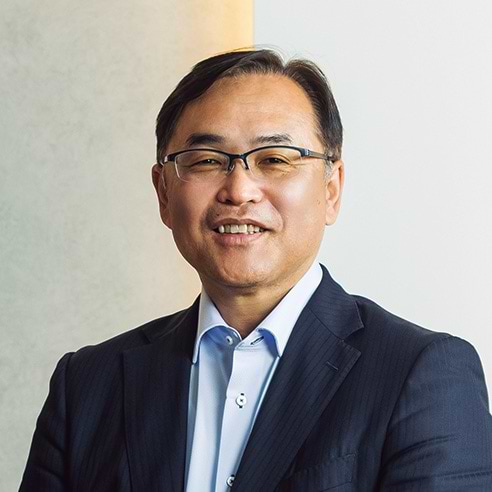
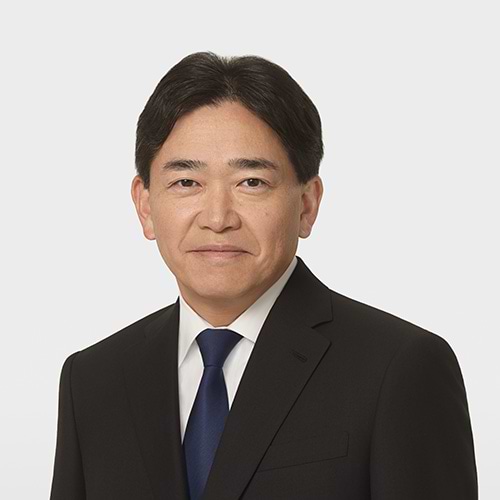
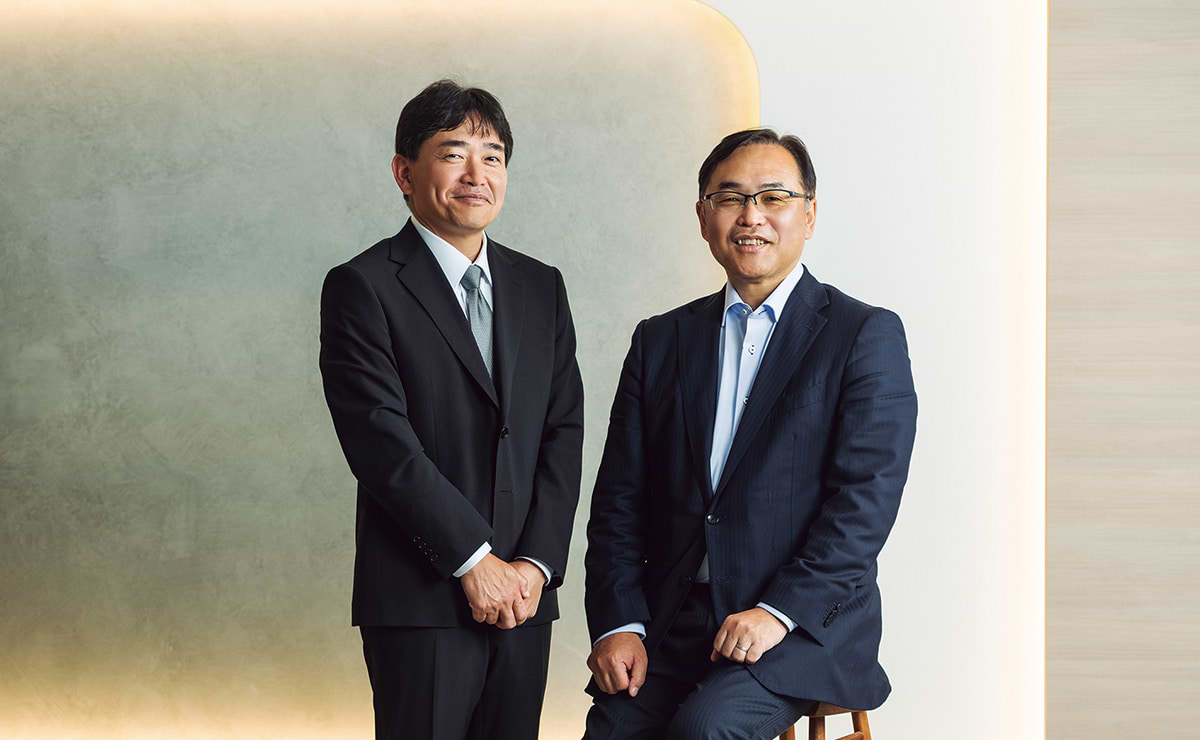
(From left) Yoshimasa Watabiki, Director, Representative Executive Officer, and Executive Vice President of the Dentsu Group; COO of dentsu Japan; and Takahiro Nakajima, Professor at the Institute for Oriental Culture, University of Tokyo
dentsu Japan Series: Exploring “People”
Integrity is highly valued in Western business management and is considered a fundamental concept taught in MBA (Master of Business Administration) programs. However, embedding this Western-derived concept within Japanese companies is by no means an easy task. Against this backdrop, the Dentsu Group has been working to reform its organizational culture with integrity at its core. What does this management philosophy bring to the company, and how does it transform it?
Through a dialogue between Yoshimasa Watabiki (Director, Representative Executive Officer, and Executive Vice President of the Dentsu Group), who is leading this reform, and philosopher Takahiro Nakajima (Professor at the University of Tokyo), who explores how people can “transform together,” this article explores practical knowledge for incorporating philosophy into management—from a code of conduct centered on integrity to methods for generating profits, and even the evaluation and development of employees.
People won’t act if you force them. Root it in “discovery”
Watanobiki: At dentsu Japan (the domestic Dentsu Group), prompted by a series of incidents related to the Tokyo 2020 Olympic and Paralympic Games, we established a committee and have been working to reform mindsets and behaviors. At the core of this reform is the establishment of an organizational culture that prioritizes “integrity” above all else. When we first started using this term, it was unfamiliar to employees, and there was the added difficulty that its meaning was hard to grasp even when translated literally.Nevertheless, as we moved forward with these reforms, comments such as “How does that align with integrity?” and “Isn’t that problematic from an integrity standpoint?” began to emerge naturally from within the company.
To begin with, the term “integrity” itself is open to a wide range of interpretations, and there was some initial confusion about how to make judgments and take action. Ultimately, however, I believe the understanding that the process of each individual developing their own personal standards is what truly matters gradually took root and became deeply ingrained within the company.
Nakajima: Integrity is one of the fundamental concepts of Western thought and forms the core of the code of conduct in Western society. I view its adoption by Japanese companies as a very positive development. The term originates from Latin, combining “in” and “tangere” to mean “do not touch.” It carries the implication of not being broken by external influences and not betraying others.Peter Drucker also frequently used this term, and in Japanese it has traditionally been translated as “sincerity” or “honesty.” While this isn’t incorrect, terms like “sincerity” and “honesty” tend to be understood as purely internal, personal matters. However, integrity is precisely the concept that defines the nature of our relationships with others.
Watanabiki: Even though everyone understands that integrity is a very important concept, I felt it was difficult to embed it as part of our organizational culture. Therefore, rather than unilaterally imposing a standardized definition, our company has encouraged employees to reflect on integrity and engage in dialogue about it.
For example, we ask executives and employees to respond with statements like, “In this kind of situation, this is what I would do,” and we compile these responses into an “Integrity Hint Book” to share with the entire company. We also hold regular dialogue sessions where management and employees discuss the topic of integrity. I’ve participated in about 10 of these sessions so far; I’ve taken the initiative to share how I think and act, and I’ve also learned a great deal from the employees.On the front lines, we hold small-group dialogue sessions, providing each individual with an opportunity to reflect on the concept of integrity and how to embody it. In this way, we are striving to embed integrity as part of our organizational culture.
Nakajima: When an organization is undergoing a transformation, integrity serves as an excellent guideline. However, it requires a process of breaking it down into digestible parts and truly internalizing it. Simply brandishing integrity like the magic pouch from the *Mito Komon* series—asking, “Can’t you see this?”—will never work. It’s a concept that’s best discovered through collective participation, where everyone deepens and broadens its meaning together. I believe that’s the best way to approach it.
People don’t tend to think deeply on their own. It is only when a group gathers and repeatedly practices thinking together that ideas truly deepen. Therefore, dialogue sessions are not only a venue that contributes to integrity but also a place for learning. They are not a forum where supervisors unilaterally impose their ideas on subordinates, but rather a space where we discover things together and reexamine the very nature of human relationships. I feel that what is important is a “performative” space, as described in philosophy.
Professor Takahiro Nakajima, Institute for Oriental Culture, The University of Tokyo
On this point, I’m often reminded of the chapter titled “Conflict” in Zen Master Dōgen’s *Shōbōgenzō*. When we hear the word “conflict,” we usually want to cut it off, but Dōgen says that’s not the case. When a teacher and disciple dive into conflict together, the conflict gradually fades away.Trying to do it alone won’t work, nor will trying to cut it off. The only way is for two or more people to dive in together.
Watanabiki: In organizations where integrity is deeply ingrained, leaders approach their work from the perspective of their subordinates. Furthermore, I feel that things tend to go very smoothly when there are one or two people bridging the gap between the leader and the front lines to provide additional guidance.
The “Pine, Bamboo, and Plum” of Profit: Earning Without Causing Harm
Watahibiki: We are a private company, and while we pursue profits, some employees struggle to balance that pursuit with integrity. For example, suppose we’re handling advertising for a product whose sales are stagnating, and a proposal we made to a client struggling to turn a profit is adopted. In that case, is it right for Dentsu Inc. to be the only one to profit? Or they might worry: Are the products or services we want to sell truly the best fit for the client? However, I believe this is a healthy kind of dilemma.
Nakajima: Through repeated discussions with Professor Emeritus Colin Mayer of the University of Oxford, we arrived at the conclusion that “there are three levels of profit: pine, bamboo, and plum.”It is indeed better to aim for “pine”-level profit. In Professor Mayer’s words, this is “true profit” or “harmless profit.” Isn’t striving for profit that causes no harm the mission of companies moving forward? Looking back at history, there have been companies that profited by creating problems. But in the end, that only strangles them—it’s “plum”-level profit or worse.
Instead, the profit gained by solving problems is the best kind. The world is full of social challenges, and there are people in need. It is the role of companies to solve these issues on a scale that individuals cannot achieve alone. After all, the etymology of the word “company” comes from “a group of people who eat bread together.”People are prone to loneliness, but when such people come together—earning the trust of others who say, “We want you to solve this problem”—they generate profits. By managing relationships between the company and others based on integrity, they improve the quality of those profits. This is the ideal cycle, and companies of the future will inevitably shift in that direction.
Watanobiki: I strongly resonate with the idea of generating profit by solving problems rather than creating them. As a leading company in our industry and as marketing professionals, we are confident in our ability to identify our clients’ challenges and propose solutions. However, we do not want to stop at making one-sided proposals; instead, we want to work with clients to devise solutions and bring them to life by integrating our ideas. Through this process, our clients’ profits increase, and we also earn a fair profit. That is the model we aim to establish.I want to place even greater emphasis on our ability to solve problems, and I believe that doing so will elevate the Dentsu Group’s work to a higher level and enhance our social value. If we are to commit to integrity, I want us to aim for that level of excellence.
Human Co-becoming: Becoming More Human Together with Others
Watanobiki: Some argue that integrity won’t take root unless it’s linked to our HR systems, but this is truly difficult. Performance evaluation systems inevitably tend to place heavy emphasis on short-term results. Even though we understand the importance of building medium- to long-term relationships with clients, there are aspects of our current evaluation system that leave us with no choice but to assess short-term results.
Nakajima: When I served as director of the Institute for East Asian Studies, I also struggled with evaluating faculty members. While there are evaluation metrics for faculty, such as the number of papers and books published, a high number does not necessarily make someone a good scholar. Quality is rigorously scrutinized, and some people devote long periods of time to tackling major works. Even if there appear to be no results along the way, they are struggling and making efforts day by day. It is precisely this kind of endeavor that should be evaluated.
What I’ve been thinking about lately is the “language” a person possesses. What kind of language do they use? People change through language, and their actions and ways of thinking evolve as well. How much language do they have at their disposal, and how persuasively can they articulate it? The very sensation of “having acquired new language” is what matters most. Shouldn’t people who possess such linguistic dynamism be held in higher regard? They open up new conceptual horizons and produce excellent work.
Another concept I’ve been emphasizing in recent years is “Human Co-becoming”—the process of becoming human together with others. This is a concept that stands in contrast to the idea of the “Human Being.” Humans are imperfect and require care; precisely because of this, we can only become truly human in relation to others.“Human Co-becoming” is also a translation of the ancient Chinese concept of “Ren” (仁). The character for “Ren” is composed of “person” (人) and “two” (二). Therefore, “Ren” cannot exist on its own; it can only exist in relation to others. Rather than a leader striving alone, if a few people say, “I’ll do it too,” those around them will follow suit, saying, “Well, then I’ll do it too.” If such groups emerge here and there, I believe that at some point, the landscape of the entire company will suddenly change.
Watanabiki: In the past, Dentsu Inc. had quite a few people who would hit a big home run once every five or ten years. I’m concerned that if we start evaluating employees based on their ability to consistently hit bunt singles, we might end up with fewer home run hitters.
We have established six behavioral guidelines called “dentsu Leadership Attributes” (dLA), and one of them is “Develop talent that is better than oneself.” It is important not to judge people solely by your own standards, but to embrace new strengths and abilities. I believe that by doing so, the range of challenges we can solve as a team will expand.
Integrity in the 21st Century: “Coolness” as a Standard
Nakajima: Philosopher Thomas Kaslis has stated that integrity and “intimacy” (a sense of closeness and inner connection) coexist in every culture.The difference lies in their balance, which also shifts with the times. For example, integrity is crucial in a courtroom; if intimacy creeps in, the process does not work well. However, the “Truth and Reconciliation Commission” established in post-apartheid South Africa sought to heal society not only by judging past crimes but also through “restorative justice”—offering forgiveness to those who spoke the truth about their acts of discrimination. That was an effort that placed intimacy at the forefront.
Japanese society does have a tendency to lean toward intimacy, but this also has its positive aspects, such as building rapport with others and enhancing the quality of engagement. Therefore, rather than discarding intimacy simply because we emphasize integrity, I believe we need to update our approach to intimacy.
Watanobiki: Our company has always been one with a strong sense of intimacy. We were good at fostering closeness and creating an atmosphere where everyone works toward the same goal. While that was one of our strengths, it may also have made it difficult to accept different cultures. I believe we are currently in the process of incorporating integrity into our organizational culture, which is characterized by strong intimacy, and moving up to a higher level.
Nakajima: We must now consider what integrity means in the 21st century. In ancient China, there is a concept called “li” (ritual), which exists in a complementary relationship with “ren” (benevolence). “Li” is a norm based on emotion; at its core, it is about “grace” or “dignity.”In the 21st century, I believe “li” as an external norm and integrity will begin to overlap. Emotions arise only when triggered by external stimuli; they do not arise on their own. Integrity, too, is a way of relating to others. I believe this discussion will ultimately transcend internalism and lead to the reconstruction of norms rooted in the body and emotions.
Integrity, too, is a form of “coolness.” If a ship safely navigates rough seas, that’s cool, isn’t it? Pursuing that requires creativity. Merely clinging to the status quo isn’t cool.
The term “aesthetics” derives from the Greek word “aisthesis” (to feel). Refining and updating the human capacity to feel—that is the very core of creativity. AI has neither a body nor emotions. That is what sets it apart from humans.
Watanobiki: Even at our company, I feel that the conversation on the ground is shifting—from a time when championing integrity was seen as somewhat “embarrassing” to a sense that putting it into practice is now “cool.”
There are two things we want to prioritize. The first is to further evolve into an entity that generates profits by solving societal problems. We want to solve our customers’ fundamental challenges and ensure that both parties earn fair profits. The second is to move “from institutional design to practical implementation.” It’s meaningless to simply create systems and guidelines for integrity. Going forward, we intend to shift our focus more and more toward putting these principles into practice.