Note: This website was automatically translated, so some terms or nuances may not be completely accurate.
LGBTQ+ 2026 Survey—What Everyday Barriers Were Revealed Through the Voices of LGBTQ+ Individuals?
Dentsu Inc. conducted its sixth “LGBTQ+ Survey 2026” (*). As in the previous survey, the analysis examined not only the attitudes and experiences of LGBTQ+ individuals but also the attitudes, knowledge, and behaviors of non-LGBTQ+ individuals. In this series, we will examine the latest survey results from various perspectives.
In the second installment of this series, we will examine the daily challenges, coping strategies, and desired changes faced by LGBTQ+ individuals—aspects that are often obscured by institutional frameworks—based on the digital book *Thinking We Understand vs. The Reality*, which was created using survey results and the real voices of those directly affected.
*The survey was conducted primarily by the dentsu Japan DEI Office—an organization within dentsu Japan, part of the Dentsu Group—in collaboration with dentsu DEI innovations, which conducts research and provides solutions on diversity, equity, and inclusion (DEI) issues.
<Table of Contents>
▼The Hidden Burdens of Daily Life That “Thinking You Understand” Cannot Reveal
▼A Significant Burden Caused by “Not Being Able to Talk About the Future,” Even More Than the Inability to Marry Itself
▼Why “Wanting to Live Together” Cannot Be Realized Right Away
▼The Nature of the Relationship Put to the Test in the Event of Illness or Accident
▼Hard-to-See Anxieties That Last Through Old Age and Beyond
▼Moving Beyond “Thinking You Understand”
The Burdens Hidden in Daily Life That “Thinking You Understand” Can’t Reveal
As introduced in the previous article, 67.0% of the general public supports the legalization of same-sex marriage, and 82.6% of those not directly involved responded that “even if same-sex marriage is recognized, it will not affect my life.” Understanding of and interest in the system are steadily growing.
On the other hand, there are still many who say things like, “Isn’t the civil partnership system enough?” or “Why not just get married abroad?” However, in reality, the lack of legal recognition for same-sex marriage goes far beyond the mere inability to file a marriage registration; it has various impacts on the daily lives and future plans of those directly affected.
Discussing the future.
Living together.
Being there for each other in times of illness or accident.
Facing the end of life with peace of mind.
These are everyday events that anyone in a relationship with a cherished or beloved partner should naturally take for granted and find joy in—yet they, too, are gradually being affected. The digital book *“What We Think We Know vs. the Reality”* highlights the daily burdens that are often obscured by the legal system alone, featuring the voices of those directly affected.
A greater burden stems from “not being able to talk about the future” than from the inability to marry itself
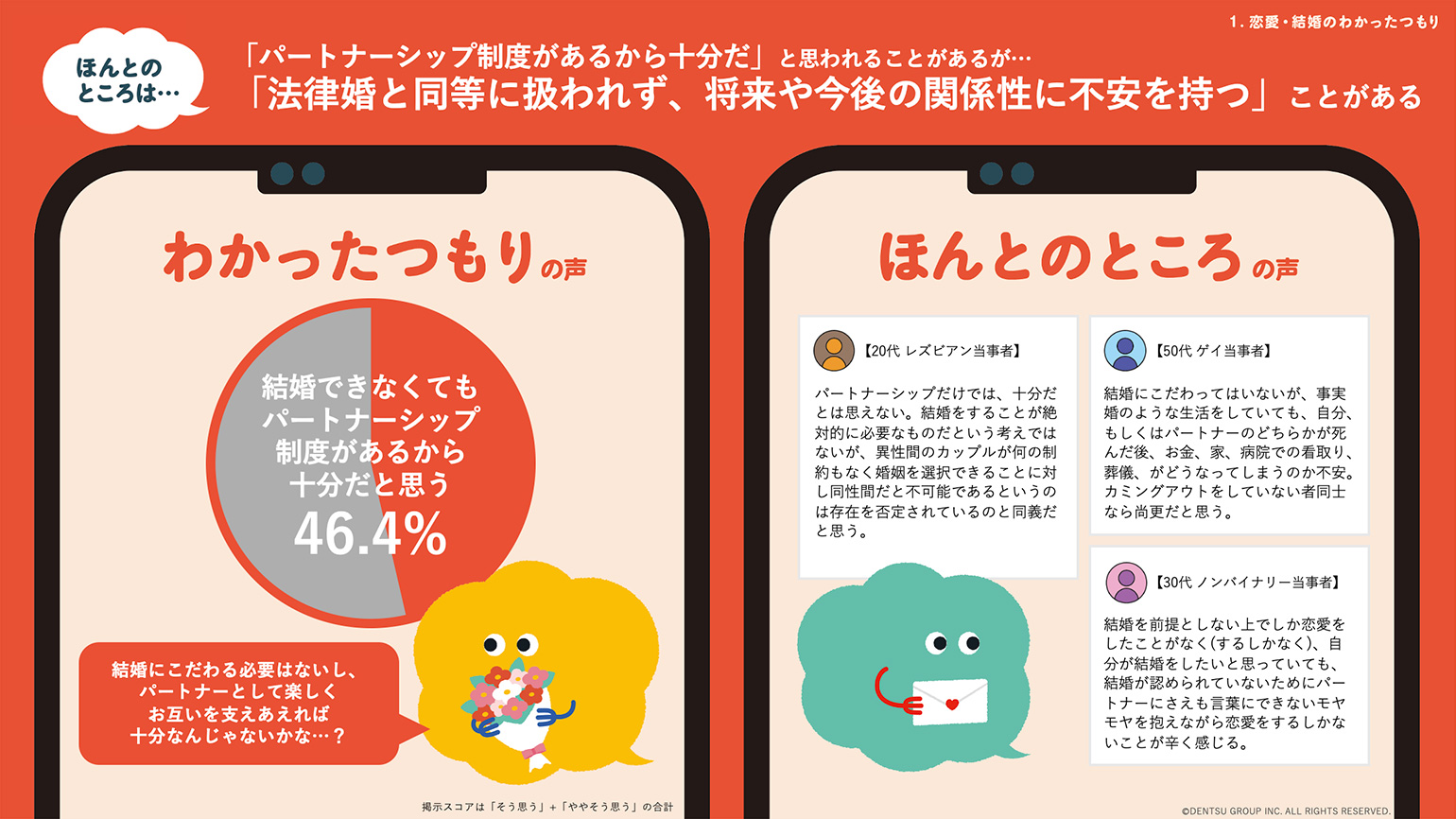
In the “Romance and Marriage” section, 46.4% of those not directly affected responded, “Even if we can’t get married, I think the partnership system is sufficient.” The idea is that as long as couples support one another, it doesn’t matter if they don’t adhere to the traditional form of marriage. This perspective itself appears to reflect a willingness to accept diverse ways of living.
On the other hand, those directly affected shared that even if they do not consider marriage an absolute necessity, not being treated the same as legally married couples causes them anxiety about their future lives and relationships. Some noted that because marriage is not legally recognized for them, they find it difficult to even express their desire to marry to their partner, and feel as though their options are closed off before they’ve even begun discussing the future.
It became clear from the voices of those directly affected that the impact extends not only to the inability to marry, but also to the stages leading up to it—the time when they could enjoy thinking about a future together, and the time spent confirming their feelings for one another and building trust. Even envisioning a future of walking through life together is not a given for everyone. This reality has emerged from this survey.
Reasons Why “Living Together” Isn’t Always an Immediate Reality
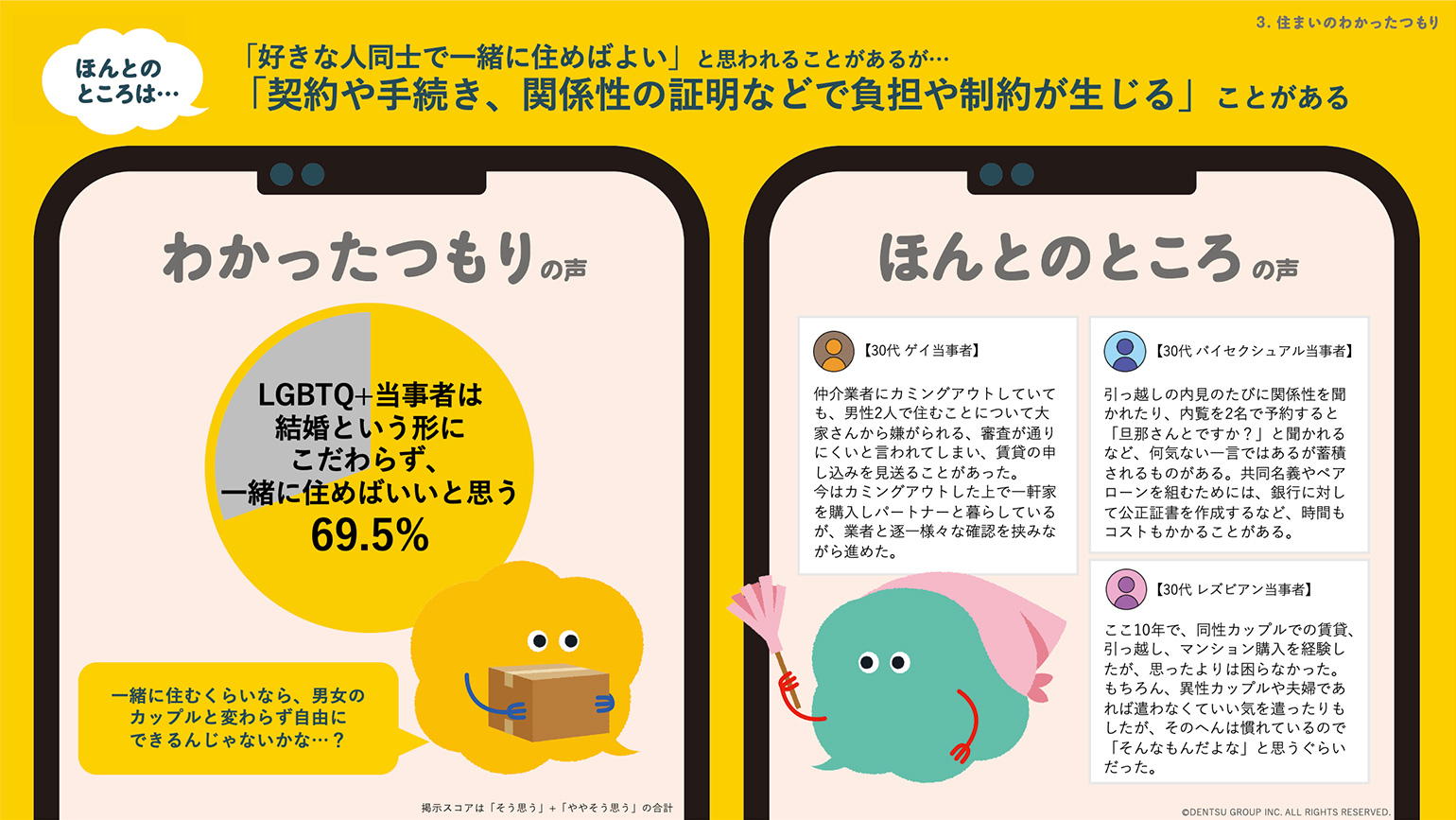
As a relationship progresses, conversations about the future—such as “Let’s live together” or “I’d love to live in a house like this someday”—can arise naturally. However, some people involved in these relationships say they feel hesitant even about uttering such words.
“If marriage isn’t an option, might saying I want to live together be taken too seriously by the other person?”
“If we move in together, I might be putting a burden on them by having to explain the situation to their friends, family, and others around them.”
“Even if I want to talk about our future life together, worries about the legal systems and procedures involved keep crossing my mind.”
Because of these concerns, some people find themselves unable to bring up the topic of the future.
Once the actual search for housing begins, people have reported various burdens they experience throughout the process—such as being asked about their relationship at every property viewing, landlords expressing reluctance because two men are living together, and the need for additional documents, such as notarized deeds, to secure joint tenancy or a joint mortgage.
Of course, services for LGBTQ+ individuals are expanding, and not everyone in this community necessarily faces significant difficulties when looking for a place to live. Even so, while things might proceed smoothly for heterosexual couples or legally married spouses, LGBTQ+ couples must explain, provide proof, and confirm their partner’s understanding as they move forward. Isn’t it the accumulation of these small burdens that makes it hard to see the reality behind the simple phrase, “Why don’t you just live together?”
The Nature of a Relationship When Illness or Accident Strikes
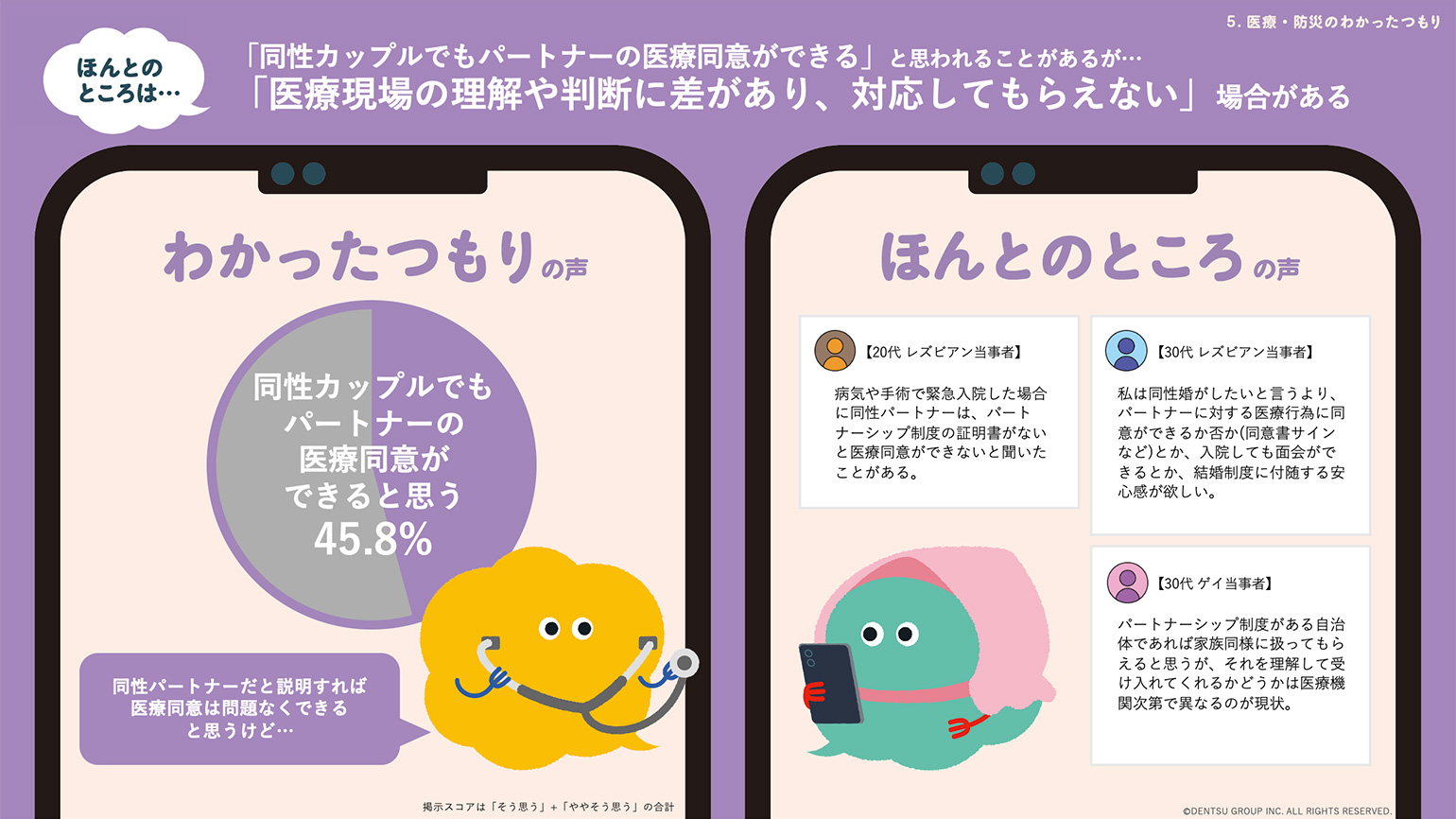
Under the “Healthcare and Disaster Preparedness” theme, 45.8% of non-LGBTQ+ respondents answered, “I think same-sex couples can also give medical consent for their partner.” Many people believe that if they simply state they are partners, they will have no trouble visiting, receiving explanations of medical conditions, or confirming medical decisions.
On the other hand, those directly affected expressed anxiety that whether they are treated as family during an emergency hospitalization, receive explanations of their medical condition, or are involved in confirming treatment decisions varies depending on the understanding and practices of medical institutions. Even if they have a partnership certificate or similar documentation, the way they are treated may not be consistent.
Illnesses and accidents do not always give us time to prepare. That is precisely why it is important to first recognize that some people in these situations are anxious about the possibility of being unable to visit their partner, receive explanations of their medical condition, or be involved in decisions regarding medical care during an emergency. In addition to fostering greater understanding in medical settings and reducing inconsistencies in responses and decisions, some suggest that opening up the option of legal marriage to same-sex couples would provide greater peace of mind in times of crisis.
Hidden Anxieties That Last Through Old Age and Beyond
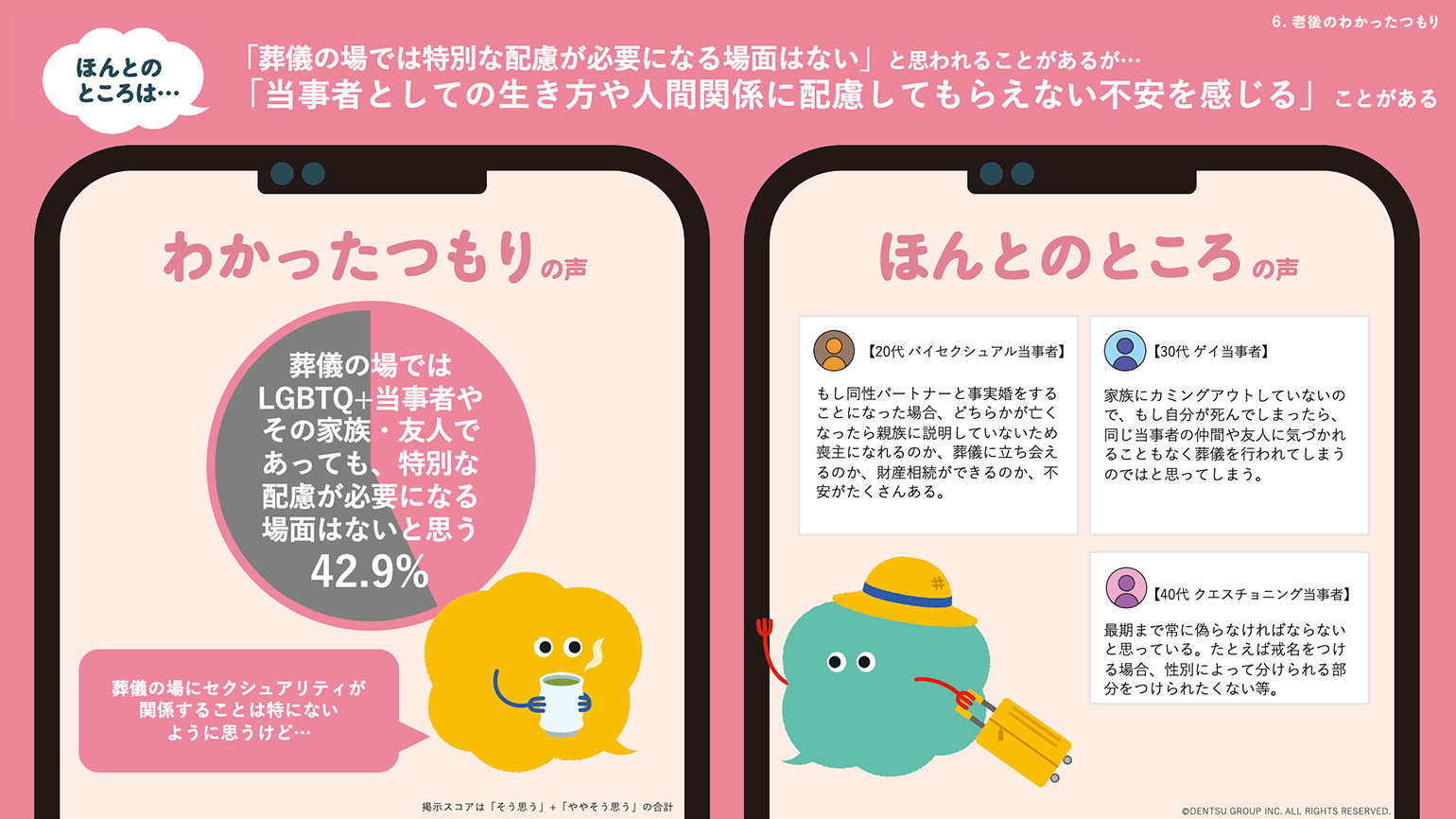
In this survey, “Anxiety about the end of life and the future (end-of-life planning)” ranked third in the number of comments submitted by respondents describing experiences of difficulty or unease.
On the topic of “old age,” 42.9% of non-LGBTQ+ respondents answered, “I don’t think there are any situations at a funeral where special consideration is needed, even for LGBTQ+ individuals or their family and friends.” However, LGBTQ+ respondents expressed anxieties such as whether they could serve as the chief mourner when their partner passes away, whether they could attend the funeral, whether they could inherit property or a home, and whether their relationship would be respected by relatives and those around them.
Beyond “Thinking You Understand”
From the beginning of a relationship through housing, healthcare, old age, and the end of life—the challenges that can arise in these various situations reveal a common underlying issue: “The relationship with a loved one is not recognized as a legal family.” The impact of this goes far beyond the single fact that they cannot file a marriage registration; it permeates every aspect of daily life.
Enjoying a romantic relationship.
Talking about the future.
Living together.
Supporting each other during illness or accidents.
Living with peace of mind until the very end of life.
For some people, these life events—which should naturally bring joy—are accompanied by anxiety and uncertainty. We were able to learn about this reality through the voices of those directly involved. That is precisely why it is so important not to stop at merely “knowing” or “understanding”—at the illusion of having it all figured out—but to look beyond that to the everyday lives that lie ahead.
This means not only considering institutional frameworks—including same-sex marriage—but also paying attention to the lives people lead before and after these changes, their relationships with others, and even the casual events of daily life. Isn’t it this kind of understanding—one step at a time—that will lead to a society where everyone can choose and live a life true to themselves with peace of mind?
In addition to the content introduced here, the digital book *“Thinking You Understand vs. The Real Story”* covers a variety of themes, such as “Work Styles” and “Children and Education.” We hope you’ll take the time to read it, engage with the voices of many people directly affected, and use it as an opportunity to look beyond the illusion of “thinking you understand” and toward the everyday realities that lie beyond.
Click here for the digital book: “Thinking You Understand vs. The Real Story”
[Survey Overview]
<Screening Survey>
・Target Area: Nationwide
・Eligibility Criteria: Ages 20–59
・Sample Size: 46,658 people
・Survey Method: Online survey
・Survey Period: January 19–27, 2026
〈This Survey〉
・Survey Area: Nationwide
・Eligibility criteria: Ages 20–59
・Sample Size: 6,240 respondents (600 from the LGBTQ+ group / 5,640 from the non-LGBTQ+ group)
・Survey Method: Online survey
・Survey Period: January 19–27, 2026
Note: The percentage of LGBTQ+ respondents has been weighted by prefecture, gender, and age group (20s–30s / 40s–50s) to align with the population distribution.
Note: Since the percentages in this survey are rounded to the nearest hundredth, the total may not add up to 100%.
Was this article helpful?
Share this article


Newsletter registration is here
We select and publish important news every day
For inquiries about this article
Author
Oshima Yoshika
Dentsu Inc.
Marketing Division 3 Marketing Consulting Division 1
Solution Planner



Ayaka Kaido
Dentsu Inc.
Creative Planning Division 3
Communication Planner