From daily meal recipes to wealth building, marketing plans, and business management—now that generative AI has become an everyday tool, more and more people are making decisions by interacting with and consulting generative AI on all kinds of matters.
In these “conversations with generative AI”—which have become one of the key touchpoints with customers—how are your company’s products and services being presented?
When companies tackle GEO (*), the first question they should ask is whether to prioritize “technical measures for the website” or “the information they want to convey to customers”—this decision determines the direction of their initiatives.
Some people read the AI’s response but do not visit the source site. If you measure results solely by website traffic, as in the past, you risk overlooking the changes taking place within the AI’s responses.
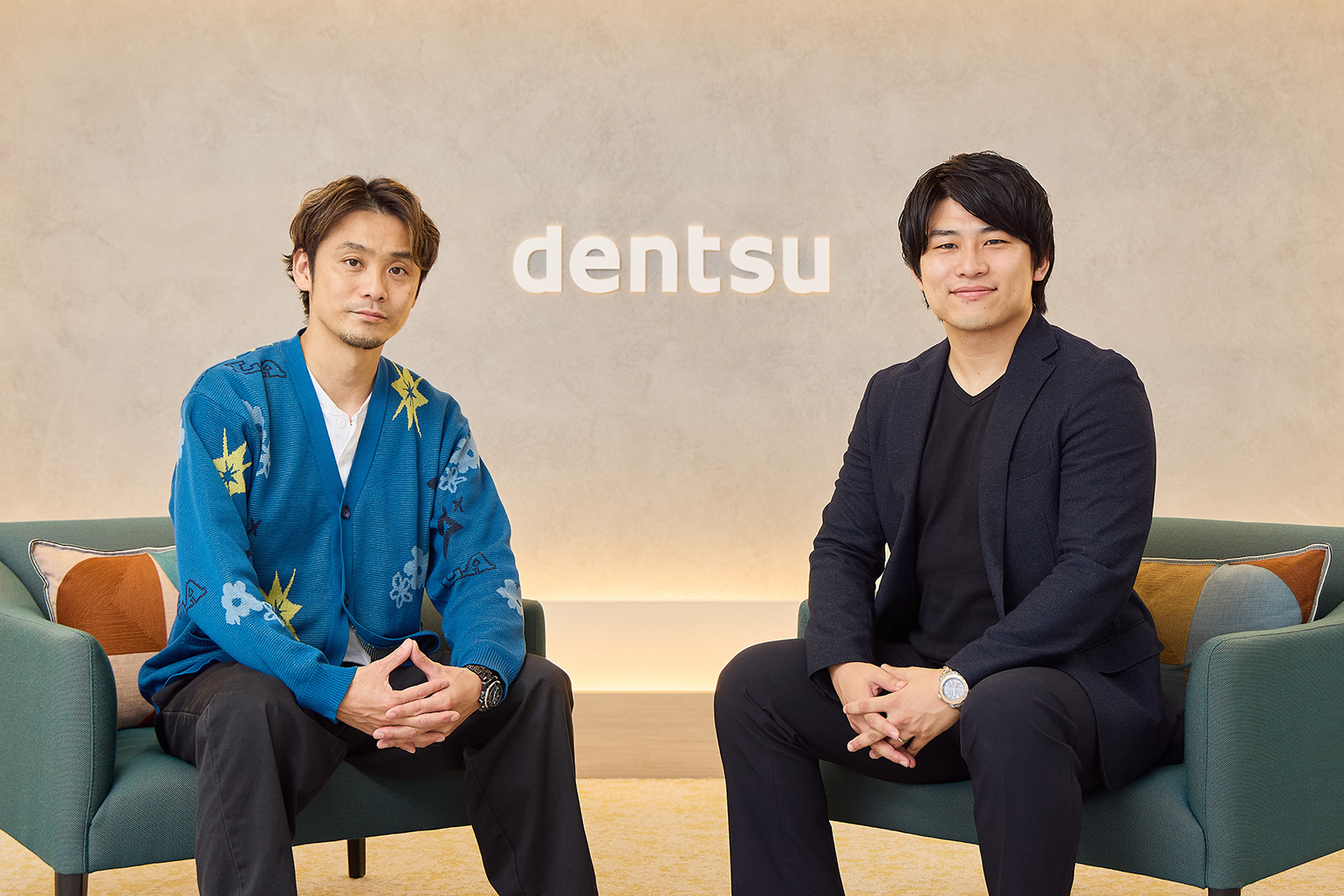
In this article, we spoke with Taro Yonematsu and Shota Jimoto—both GEO consultants at Dentsu Digital Inc.—about common misconceptions among companies tackling GEO and the process for moving from assessing the current situation to implementing effective strategies.
*GEO = Generative Engine Optimization. This refers to the concepts and strategies designed to ensure that information about a company’s brand, products, and website is appropriately mentioned, cited, or referenced in searches and responses generated by generative AI.
It Can’t Be Measured by Website Traffic Alone: 4 Misconceptions About GEO
──First, could you tell us about your respective areas of responsibility and your work on GEO?
Yonematsu: As the manager of the SEO Group, I’m involved in supporting both SEO and GEO. While SEO aims to drive traffic to our company’s website through search results for business-related keywords, GEO focuses on ensuring our company and services are accurately represented in conversations with generative AI.
Hachibata: I’m usually in charge of PoCs (proof-of-concept studies) for AI projects and the development of AI solutions in the marketing field. I believe GEO requires perspectives from both AI and SEO, so I collaborate across departments. I’m working on this together with members of our respective groups as well as interested members from other departments.
──Do the metrics you should focus on differ between SEO and GEO?
Yonematsu: I believe the key metrics do differ. For GEO, it’s important to determine whether our products or brands are “mentioned” in the AI’s responses. We also need to verify that our company’s accurate information and messaging are “recognized” as sources when the AI generates its answers. Furthermore, I believe it’s crucial to examine the order in which our offerings are recommended and “how they are described.”
Jichiro: That’s precisely why we need to be careful about using only website traffic as a performance metric for GEO. Some people read the AI’s responses but don’t click through to the source. I think it would be a waste not to monitor changes within the responses themselves just because the direct relationship with traffic or conversions isn’t immediately apparent.
When users ask the AI about a category or issue, do our company’s products or services appear as options? In that sense, I believe there are similarities to how mass advertising enters consumers’ unaided recall.
Yonematsu: In SEO, the focus has traditionally been on how to accumulate traffic and conversions via search engines. With GEO, however, even if it doesn’t lead to an immediate visit to the site, it’s essential to examine how your company is presented within the AI’s responses. Consequently, this approach requires a mindset similar to brand-centric marketing.
──Based on what you’ve just said, could you tell us about some common misconceptions companies tend to fall into?
Local: Broadly speaking, there are four.
(1) Measuring success based solely on traffic volume In addition to website traffic, it’s necessary to check for mentions, citations, and the way your company is discussed within the answers.
(2) Writing too much with AI in mind Ultimately, it’s people who choose a product and decide whether they like a company. You must not neglect the reader’s challenges or your company’s unique strengths.
(3) Focusing only on your own website AI also references third-party sites in addition to official websites. It’s important to pay attention not only to your company’s “claims” but also to third-party “evaluations.”
(4) Relying too heavily on technical solutions There are certainly points to check, such as page structures that are difficult for AI to parse. However, rather than automatically prioritizing technical measures from the start, you should assess the situation by observing what actually happens in the search results.
Yonematsu: Even if you use generative AI to produce a large volume of articles containing content that AI could answer, there’s no guarantee that AI will pick them up, nor that people will read them. First, you need to ask: Who is the target audience, and what problems does the information solve? I believe content created with that perspective in mind will resonate with both people and AI.
──When it comes to information outside your company’s website, what should you focus on?
Yonematsu: What you can publish on your own website is the company’s own “position” regarding its products and services. However, when discussing products, how they are evaluated by third parties also comes into play. While it’s certainly important to maintain your own website, you also need to pay attention to how your products are being discussed and evaluated externally.
Local: So it’s a matter of distinguishing between the company’s “position” and third-party “evaluations.”The sources cited by AI may differ depending on whether a question seeks detailed information on how to use a product or its specifications, or whether it broadly asks about options or recommendations. It’s important to examine what kinds of questions are being asked and which sites are being cited. Based on that, you should consider incorporating PR and external communications as needed. The key to successfully implementing GEO is not to limit your efforts solely to your own website. However, it’s essential to clearly disclose that the information is corporate-sponsored—never present it as if it were a third-party evaluation.
Shota Jichibu, Group Manager, AI Innovation Division, Data & AI Solutions Center, Dentsu Digital Inc.
What Kind of Questions Do Customers Ask AI? Assessing the Current Situation and Defining Challenges
—What should companies looking to get started with GEO do first?
Jichima: First, make a list of questions your target customers are likely to ask AI, and actually test them out. Don’t just include your company or brand name; think about “in what situations and when facing what kind of problem they would ask.” We design questions from the perspective of CEP (Category Entry Point—the trigger that brings a product or category to mind) and the specific task the product is meant to solve. Based on that, we check how our company and competitors are being mentioned, and which websites the answers cite.
Yonematsu: It’s not just whether our company appears—it’s also important to consider “in what context” it appears. We look at how the product is portrayed as helping to solve the questioner’s problem. The results of this analysis help us organize our strategies regarding who to target and what messages to convey.
──After the analysis, how do you prioritize your strategies?
Jibun: First, we clarify “what state we aim to achieve at the AI customer touchpoint.” Do we want existing customers to understand our product correctly? Or do we want to be included as an option for people who don’t know about us yet? The questions we investigate vary depending on the objective.
When reviewing actual responses, if critical information—such as pricing or duration—is incorrect, our “defensive” strategy of ensuring accurate communication takes priority. If our product can solve a problem but competitors are consistently recommended instead, we consider an “offensive” strategy to ensure we’re included as an option. We don’t simply start with a specific technical measure right away.
—So, that doesn’t mean technical measures aren’t necessary, right?
Yonematsu: Depending on how a page is implemented, generative AI may not be able to fully read the information on it. It’s necessary to check whether the implementation makes the information difficult to read or if it’s unintentionally blocking access by AI crawlers. However, since crawlers behave differently, there’s no one-size-fits-all approach.
Local: We need to determine what information to deliver to people while also making it easy for AI to read. Both are necessary. Rather than treating technical measures as an end in themselves, we’ll identify challenges based on actual responses and determine the order in which to address them.
──What metrics should we use to measure results?
Yonematsu: When evaluating effectiveness, in addition to mention rates and citation rates, we also examine the tone of the discussions—including whether they are positive or negative. While these are relatively easy metrics to track, linking them directly to business contributions is not straightforward. We work with company representatives to determine how changes in AI responses impact the business, and we set metrics accordingly based on specific objectives.
Local: Sometimes clients come to us after realizing that owned media strategies alone aren’t enough—they need a comprehensive plan that includes a communication strategy. Rather than considering metrics in isolation, it’s important to return to the fundamental question of what we want to achieve through the AI touchpoint.
Taro Yonematsu, Group Manager, Owned Media Division 2, XC1 Department, Dentsu Digital Inc.
Continuous Monitoring and Cross-Functional Collaboration: GEO—Start Tomorrow
—AI responses aren’t always the same, are they? Is it sufficient to conduct the analysis just once?
Yonematsu: Generative AI responses are personalized based on the user’s history and circumstances, and even under the same conditions, the answers aren’t necessarily identical every time. Therefore, when we conduct our analysis, we don’t base our judgments on a single response.During our research, we ask the same question multiple times and observe the results. We then examine the extent to which the brands and sources mentioned in the responses overlap across each instance. For example, if 10 companies appeared in at least one of three responses (excluding duplicates), and 8 of those appeared in all three, we would say the “overlap is 80%” (this is a concept known as the Jaccard coefficient). Therefore , it’s important to conduct ongoing observations and avoid making judgments based on a single response.
──What kind of internal structure is best for carrying this out?
Yonematsu: Ideally, it should be a cross-functional effort. Web managers and public relations (PR) staff should share a consistent communication strategy and collaborate within their respective roles. Even if the R&D department possesses valuable data that conveys the value of the company’s products or services, marketing and PR staff may not be aware of it. It is important not only to organize information that has already been made public but also to identify internal information and leverage it for communication.
Jichiro: On the other hand, each department has different missions and varying levels of understanding regarding GEO. One approach is to first test initiatives within a single department, create small success stories, and then expand them to other brands or business units. You can even start by incorporating an AI perspective into communication initiatives or PR campaigns that are already planned.
However, in terms of leveraging information from various departments for communication, cooperation across the board will ultimately be necessary. Don’t let GEO end as a “point” initiative—a mere tweak to a section of your company’s website—but instead integrate it into your overall marketing and communications strategy. To that end, I think it’s best to start small and gradually expand toward cross-organizational collaboration.
──Finally, could you share a message for those who are interested in GEO but are unsure where to start?
Jibuchi: First, try to consider what kinds of questions your target customers might ask the AI, what they hope to learn from those questions, and what problems they’re trying to solve. Generative AI is just one touchpoint with customers. It’s important not to focus solely on the AI itself, but to think about what message you want to convey to the people on the other end.
Yonematsu: Who are you communicating with, what are you conveying, and what solutions are you aiming to provide? I believe that is the essence of marketing itself. On top of that, it’s important to continually verify whether your intended message is actually reflected in the responses.
After the Interview
What became clear through this interview is that GEO’s efforts go beyond merely implementing technical measures for AI; they also focus on considering what to convey to the customers on the other end. Even as the nature of customer touchpoints changes with the times, why not take that first step—even if it’s a small one—while keeping in mind the perspective of who you’re reaching and what you’re conveying to them?
As the head of a group providing SEO/GEO consulting support at Dentsu Digital Inc., I have supported the growth of various companies. Most recently, I have participated in the development of analytical solutions for generative AI. Leveraging my knowledge in areas related to “search”—including advertising, web development, and the analysis of massive datasets—I drive consulting initiatives from a marketing perspective.
Data & AI Solutions Center, AI Innovation Division
Group Manager
Since joining Dentsu Inc., he has gained extensive experience in various aspects of the broadcasting business, including investing in movies and TV dramas, content tie-ins, and television program sales. In 2024, he was seconded to Dentsu Digital Inc., where he has been engaged in the development of marketing solutions utilizing generative AI and AI consulting. Leveraging the crossover of “Media × Content × AI,” he is committed to creating new value that helps clients overcome their challenges.