
Note: This website was automatically translated, so some terms or nuances may not be completely accurate.
Dentsu Inc. Conducts "Japan Brand Survey 2014" ― What people consider "excellent" about Japan: ASEAN sees "technology"; East Asia sees "food, anime, manga, hot spring travel"; Europe and America see "Japanese gardens" ―
In April 2014, Dentsu Inc. conducted the "Japan Brand Survey 2014" across 18 countries and regions* to support the marketing activities of companies engaged in "Cool Japan"-related initiatives—businesses expanding products and services overseas that leverage Japanese culture and strengths. This initiative is one of the services provided by Dentsu Inc.'s company-wide cross-functional project, "Team Cool Japan." It enables client companies expanding overseas to understand regional levels of pro-Japan sentiment (favorability toward Japan), interest in Japan and Japanese products, and perceptions of Japan. This information can be leveraged for overseas marketing activities and is also useful for companies domestically seeking to improve their services for foreign customers.
※18 countries/regions: China, Hong Kong, South Korea, Taiwan, India, Singapore, Thailand, Indonesia, Malaysia, Vietnam, Philippines, USA, Brazil, UK, France, Germany, Italy, Russia
The data obtained from this survey was organized under four categories: favorability toward Japan, interest in Japanese matters, interest/intent toward Japanese food, and plans/intent to visit Japan.
【Key Findings】
1.Favorability Toward Japan
◇Top 3Countries/Regions with Favorable Views of Japan: Vietnam, Malaysia, Thailand
• When asked "Do you like Japan?", Vietnam scored the highest, followed by Malaysia and Thailand, with ASEAN countries dominating the top positions.
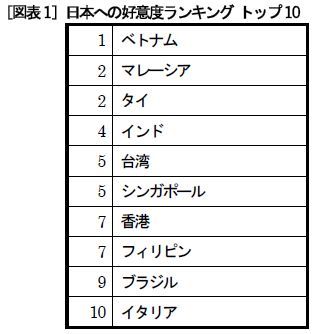
(Based on the combined score of "Very Liked" + "Somewhat Liked" on a 5-point scale)
◇People with high favorability toward Japan show greater interest in Japanese subculture and content
・Among the surveyed countries and regions, respondents who answered "Very Fond" of Japan showed a higher overall interest in modern subculture and content (such as fashion, characters, and movies) compared to the general population. This tendency was particularly strong among those who responded "very fond" in South Korea, the United States, the United Kingdom, Germany, and Russia—countries where overall favorability was not high. Specifically, interest in Japanese "music" was relatively high in South Korea, "anime/manga" in the UK, "fashion" in the US and Germany, and "films" in Russia.
2. Level of Interest in Japanese Things
◇Top 3 Japanese things of interest: "Japanese food," "Travel to Japan," "Japanese fashion"
・When asked about Japanese things they were "interested in," the top 3 with high overall scores were "Japanese food," "travel to Japan," and "Japanese fashion."
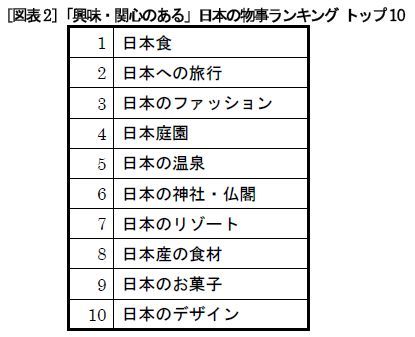
◇GrowingPopularity of "Japanese Fashion" in ASEAN Countries
・Interest in "Japanese fashion" and "Japanese design" was particularly high in ASEAN countries, with variations observed by country/region for certain items.
・Items showing a score increase of 10 points or more compared to last year include "Japanese cosplay," "Japanese fashion," "Japanese music," "Japanese movies," "Japanese traditional performing arts," and "Japanese traditional crafts." This indicates growing interest in Japanese culture across both modern and traditional aspects.
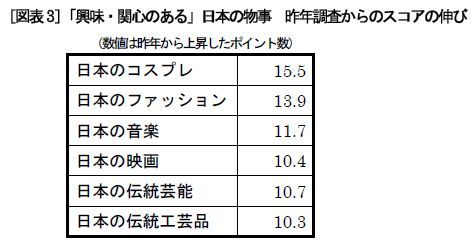
・Among these, "Japanese Cosplay" saw the largest score increase, reflecting the deepening fusion of the Japanese anime/manga boom with fashion.
◇Top 3 Japanese things considered"excellent":"AV electronics," "anime/manga," "robotics"
・When asked about Japanese things considered "excellent," the top three items with high overall scores were "Japanese AV electronics," "Japanese anime/manga," and "Japanese robotics."
・While technology-related items dominated the top ranks, "Japanese cuisine" and "Japanese games" also made the top 10.
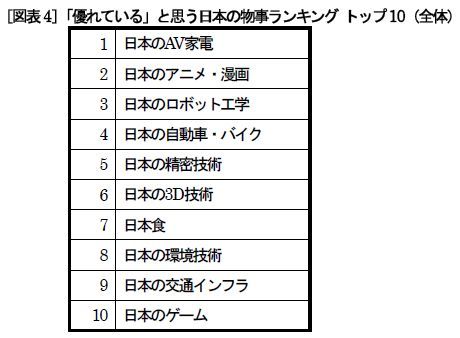
◇ What is considered "excellent" about Japan varies by region.ASEAN countries value Japanese technology; East Asia values Japanese food, anime/manga, and hot spring travel; Western countries value "Japanese gardens."
・Top-ranked items vary by country/region (and the penetration of Japanese culture). Generally, in ASEAN countries (excluding Singapore and Thailand, where Japanese culture is more prevalent), Japanese "technology" receives high ratings, while in East Asia (China, Hong Kong, South Korea, Taiwan + Singapore, Thailand), Japanese "food, anime/manga," and "hot spring trips" tend to be highly valued. In Western countries, while overall scores are generally lower, "Japanese gardens" tend to rank highly, which is a distinctive feature.
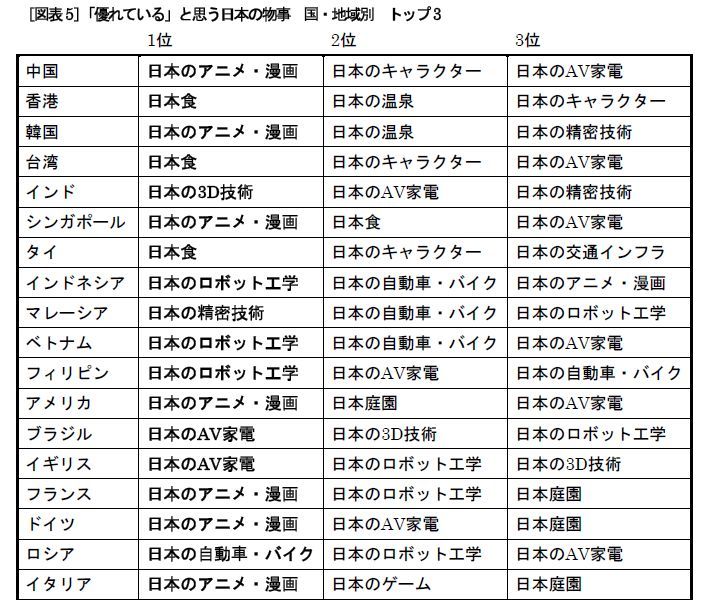
・Furthermore, "Japanese senior services, technology, and products" – unique to Japan as a nation with a high life expectancy – appear in the top 10 in several countries and regions, suggesting potential new business opportunities.
◇ "Made in JAPAN" is evolving into a more sustainable and beloved brand
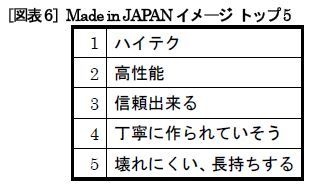
・The strongest associations with "Made in JAPAN" are "high-tech" and "high performance."
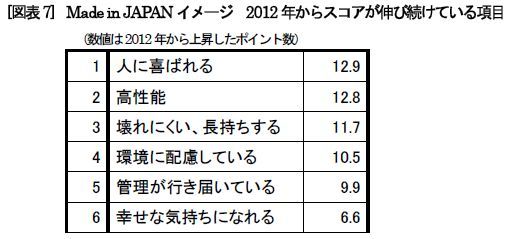
・Surveys over the past three years show consistently rising scores for attributes like "environmentally conscious," "durable and long-lasting," "makes people happy," and "brings a happy feeling." This indicates growing appreciation for values beyond mere function and performance, suggesting "Made in JAPAN" is evolving into a sustainable and beloved brand.
3. Interest and Intent in Japanese Food
◇Sushi is the most widely recognized Japanese food
・Sushi ranked top in awareness, experience, and intention for Japanese food.
・Awareness of "sushi" reached over 80%, and over 70% have actually eaten it, making it an extremely popular dish. In Taiwan specifically, about 90% of respondents reported having eaten it.
・The specific Japanese foods recognized and experienced varied by country/region. In France, known for its culinary culture, not only "sushi" but also "yakitori" had high experience scores.
◇ Sake is popular as a treat for oneself
・When asked about the purpose of using Japanese ingredients, "for home/daily use" was the most common response.
・However, sake stands out as the most frequently cited "treat for oneself," with this tendency particularly strong in ASEAN countries.
・The top three countries/regions with the most experience with sake are: 1st place Taiwan, 2nd place Hong Kong, and tied for 3rd place South Korea and Brazil, showing sake's reach spans the globe.
◇Vegetables show the highest purchase intent among Japanese ingredients
・Among Japanese ingredients, "vegetables" had the highest preference, particularly strong in India, Russia, and the USA.
・Additionally, "fruit" and "seafood" also showed high interest levels, with differences observed by country/region: "fruit" was popular in Hong Kong and India, while "seafood" was favored in Russia and Vietnam.
4. Plans/Intentions to Visit Japan
◇80% of respondents have plans/intent to visit Japan
・Regarding plans/intent to visit Japan (combining "planning to travel within the next year" and "no specific plans yet, but want to visit someday"), approximately 80% of the total respondents answered "yes," a 7.6-point increase from last year. Notably, the score increased by over 10 points in ASEAN countries.
◇Growing Intent to Visit Japan in ASEAN Countries
・While East Asian countries like Hong Kong, South Korea, Taiwan, and China dominate the rankings for previous Japan visit experience, the rankings for visit intention (the combined total of "planning to visit within the next year" and "want to visit someday, though no specific date is set") are led by six ASEAN countries. This suggests a potential shift in the composition of future visitors to Japan.
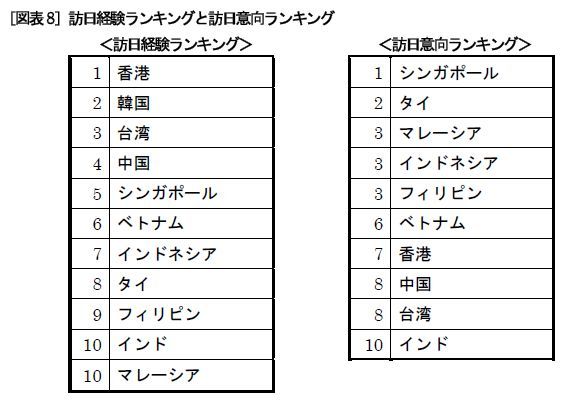
・Even in Brazil, located on the opposite side of the globe from Japan, over 70% of respondents have plans or intentions to visit Japan. Furthermore, in South Korea, where Japan's favorability rating was previously low, over 50% of respondents stated they "plan to visit within the next year."
<Overview of the Japan Brand Survey 2014>
・Purpose: To understand overseas consumers' perceptions and actual behavior regarding the overall "Japan Brand," including food, tourism, and Japanese products.
・Target Areas: 18 countries/regions
China (Beijing, Shanghai), Hong Kong, South Korea, Taiwan, India, Singapore, Thailand, Indonesia, Malaysia, Vietnam, Philippines, USA, Brazil, UK, France, Germany, Italy, Russia
・Survey Method: Online survey
・Respondent Criteria: Men and women aged 20–59 *Middle-income level and above
・Sample Size: 200 respondents per region, total 3,600 respondents
・Survey Period: April 4 (Fri) to 14 (Mon), 2014
<Reference: Target Regions for Japan Brand Survey 2012 and 2013>
◇Japan Brand Survey 2013 (conducted March 2013)
・16 Countries/Regions: China (Beijing, Shanghai), South Korea, Taiwan, India, Singapore, Thailand, Indonesia, Malaysia, Vietnam, Philippines, USA, UK, France, Germany, Russia, Australia
◇Japan Brand Survey 2012 (conducted in March 2012)
・15 countries/regions: China (Beijing, Shanghai), Hong Kong, South Korea, Taiwan, India, Singapore, Thailand, Malaysia, United States, United Kingdom, France, Germany, Russia, Australia, Canada
Dentsu Inc. News Release
http://www.dentsu.co.jp/news/release/2014/0602-003742.html
Was this article helpful?
Share this article


