
Note: This website was automatically translated, so some terms or nuances may not be completely accurate.
 <Analysis> Corporate Crisis Communication [3/3]
The Initial Response Holding the Key to Crisis Resolution, and Efforts During Normal Times

Omori Asahi

Personal data leaks, compliance violations, product accidents... Crises that can arise in business activities have become increasingly diverse and complex in recent years. Furthermore, the proliferation of social media has dramatically accelerated both the potential for crises to occur and the speed at which rumors spread. How should companies prevent imminent crises and prepare for the worst? And when problems do arise, how should they fulfill their accountability to society and the press? We asked three experts about the nature of "crisis communication" in light of recent social conditions.

Practical manuals and training that anticipate risks are essential
After 14 years as a journalist, Asahi Omori joined Dentsu Inc. Public Relations and has consistently focused on crisis communication. With extensive experience in media training for numerous companies, Omori emphasizes the critical importance of preparedness during normal times.
"First, identify risks and establish a crisis management framework. Then create a crisis management manual based on potential risk scenarios. Conduct media response training, including simulated emergency press conferences. This process inevitably reveals challenges. Use these insights to revisit and refine the framework and manual. This cumulative effort pays off in the initial response during an emergency."
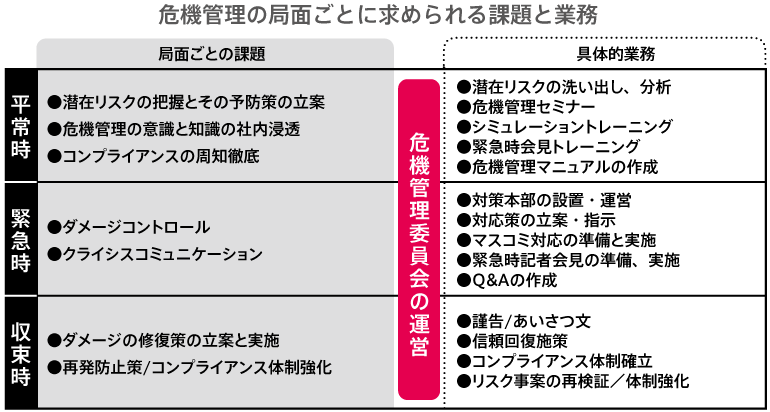
While the challenges and specific tasks differ across the three phases—normal times, emergencies, and resolution (see table below)—the initial response is the turning point that determines whether a crisis escalates or begins to resolve. The key to this lies in the preparations made during normal times.
For example, one aspect of initial emergency response is preparing for press conferences. It's not just about setting up the venue; you also need to prepare press materials like news releases about the incident. Sometimes, you have to create these materials in about an hour, says Mr. Omori.
"Unless you anticipate several potential risks during normal times and prepare templates to some extent, it's impossible to get everything ready in such a short time. If information disclosure lags behind, journalists will suspect intentional 'concealment'. The questioning becomes even more intense: 'Why was the disclosure delayed?'"
Developing a crisis management manual based on potential risk assessments, including templates for these materials, is essential. While more companies have manuals, Omori points out that many either gather dust on shelves or are overly detailed and difficult to understand. He therefore listed the following five points as "conditions for a good crisis management manual":
"While there are several types of crisis management manuals—such as ones for PR staff, risk managers, or compliance manuals for all employees—the fundamental requirement is that they must be easy for anyone to understand and highly usable. They must include as many diagrams as possible, like reporting route charts and initial response flowcharts, to enable quick, intuitive comprehension."
Developing a crisis management manual is arguably the most critical task among routine preparedness efforts. Its quality determines the success or failure of initial emergency responses. "Stumbling in the initial response means the effort and time required to restore trust will be far greater than the incident itself." These are weighty words from Mr. Omori, who once worked on the reporting side.
Requirements for a Good Crisis Management Manual
 Content must be grounded in the company's existing regulations
It must not be a manual filled with general theories, but rather one that takes the company's specific regulations as its fundamental premise and is consistent with them.
 It must identify and anticipate risks
Thoroughly identify all risks inherent to the company, assess their frequency and impact, and prepare risk management systems by anticipating worst-case scenarios.
 Clearly covers the four key points of crisis management communications
The four key points are: ① Risk Identification ② Structure and Roles ③ Initial Response Flow ④ TO DO. Include elements like reporting route diagrams to create an intuitively understandable structure.
 Provides templates for necessary materials
Include prepared examples of necessary materials like press releases, tailored for specific crises, enabling their rapid use during actual crisis response.
 Highly usable structure and format
Clearly organize key points for each section of the crisis management manual. Additionally, structure the content so that the essence of the information can be understood at a glance when immediate action is required during a crisis.
Was this article helpful?
Share this article


Newsletter registration is here
We select and publish important news every day
For inquiries about this article
Back Numbers

Author