
Note: This website was automatically translated, so some terms or nuances may not be completely accurate.
 Ad Tech Tokyo 2014 Official Session Report [1/3]
When do people change their attitudes and behaviors? What lies between impressions and clicks?

Ad Tech Tokyo 2014 Report
While the individual effectiveness of internet advertising is relatively easy to quantify, a longstanding challenge remains: unlike TV commercials, there is no established model for determining "how much investment is needed to achieve the desired effect." The AdTech Tokyo 2014 conference, held from September 16th to 18th, focused on this issue with a session titled "What Constitutes a Sound Value Metric for Online Advertising?" Speakers from diverse perspectives discussed the current state and future direction.
The Value of Impressions = The Value of Content
 |
Moderator: Mr. Ikeda, Video Research Ltd. |
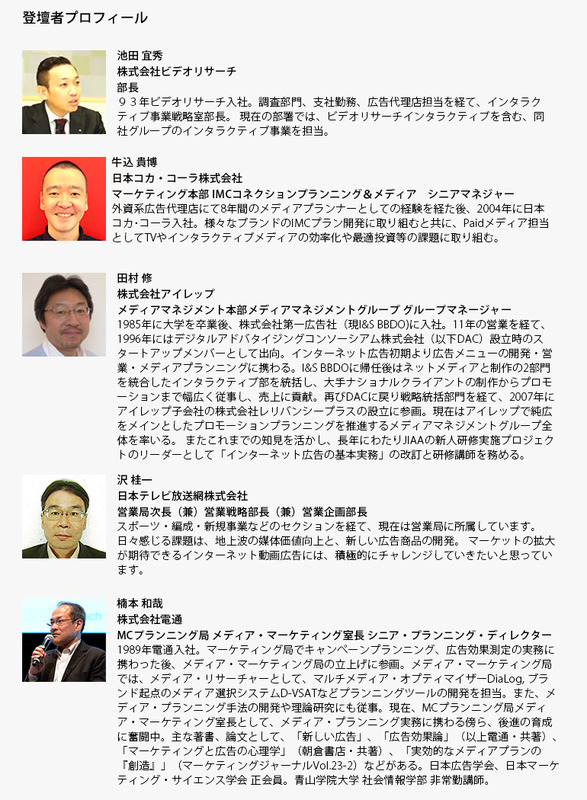
Ikeda: For this session, we have speakers from diverse perspectives: Mr. Ushigome from Coca-Cola Japan, promoting IMC (Integrated Marketing Communications) on behalf of the advertiser; Mr. Tamura from iREP, representing a dedicated online advertising agency; Mr. Kusumoto from Dentsu Inc., handling planning including mass media; and Mr. Sawa from Nippon TV, involved in this year's much-discussed project "delivering TV content online."
With major corporations adopting online advertising and its use shifting from purely transactional to branding purposes, discussions are emerging everywhere about how to view online advertising alongside mass media advertising and what constitutes appropriate value metrics. First, could Mr. Tamura from iREP, who is well-versed in online advertising, share his perspective on the current state?
 |
Irep's Mr. Tamura |
Tamura: As you pointed out, online advertising is now being discussed in terms of two categories: "branding-oriented" and "performance-oriented." However, I believe these two should fundamentally be considered as a unified whole. The disconnect between them is the challenge, and how to advance integrated planning is an area we are also beginning to tackle.
Performance-based ads focus on the cycle starting with "search/browsing behavior," leading to "clicks" and "conversions." However, before search, there's "interest, attitude, and behavioral change," and preceding that is the triggering "impression." Branding initiatives are often vaguely thought to target this stage, but considering human feelings and actions, they should all be connected, right?
Ikeda: So branding and performance are fundamentally connected, with impressions being the starting point of the cycle.
Tamura: I agree. Also, when considering the value of a single impression, people visit sites to view content, so it naturally correlates with the content's value. We must consider the value of a single impression with this in mind, and then further consider the value of a single click.
"TV × Digital" Effectiveness: Our Original Research
Ikeda: Mr. Kusumoto from Dentsu Inc., who handles cross-media planning for mass and digital, what are your thoughts, including changes in attitudes and behaviors?
 |
Mr. Kusumoto, Dentsu Inc. |
Kusumoto: Attribution analysis (measuring each media's contribution to a purchase) is challenging even for mass advertising. However, with TV commercials, based on past know-how, we have benchmarks like: "Investing this many GRPs will yield this level of awareness" or "This will trigger attitude change." You mentioned the value of a single impression earlier. It would be useful if that could be quantified, revealing the relationship between impressions and attitude change.
Ikeda: Mr. Ushigome, you work on IMC at Coca-Cola. How do you actually handle these metrics in your day-to-day work?
Ushigome: We measure advertising effectiveness using our own proprietary research method, which we call "IMC Tracking." We constantly track the total communication impact achieved, not just the individual effectiveness of TV commercials or online ads.
Ikeda: What does this survey entail specifically?
 |
Mr. Ushigome, Coca-Cola Japan |
Ushigome: We use Single Source Panel (a method that integrates media exposure and purchase data from the same individual) and 3PAS (third-party ad serving, which delivers ads via ad servers for measurement and optimization) to detect overlap between TV reach and digital reach (like ad networks and video ads), thereby estimating total reach. This method reveals, for example, that digital effectively complements segments TV cannot reach. We continue these investigations per campaign and per brand to build hybrid allocation models, aiming to maximize the investment efficiency of both TV and digital.
However, these are strictly our internal metrics, and I believe there is an absolute lack of common, objective industry standards. Particularly regarding discussions on how to increase conversions, optimizing for less than 1% seems less effective than focusing upstream on maximizing the untapped 99%. I feel it would be more impactful to consider maximizing that 99%. I hope publishers and advertising agencies will establish standards.
Building Brands Online
Ikeda: That's an area we research firms should also tackle. In the first half of last fiscal year, Video Research Ltd. conducted a recognition rate survey for rectangle ads (the rectangular ad spaces placed on the left and right sides of websites). The results showed that when ads appeared in a consistent size and location, approximately 30% of people remembered the ads after the campaign. Based on this, we're considering whether we can build a model to predict the recognition effectiveness of rectangle ads.
Of course, this alone might not be sufficient. However, if we could further clarify the part Mr. Tamura mentioned at the beginning—how impressions motivate subsequent actions—I believe it could change the breadth and depth of planning. What do you think, Mr. Kusumoto?
Kusumoto: For clients seeking performance, we meticulously calculate expected traffic to owned media and conversions. However, understanding the awareness stage would allow us to forecast more accurately based on objectives, including branding.
However, working on various cases has shown us that when running only online ads, clicks and conversions often struggle to increase. But when we run TV commercials for a limited time, we see a phenomenon where traffic surges to the website during that period, driving up conversions. Even with its broader targeting, TV still has a significant, consistent impact on building brand foundations.
Ikeda: Considering what Mr. Ushigome mentioned about "digital complementing TV's reach," how should we approach audiences who don't watch TV?
Kusumoto: I believe we need strategies within the online world that can build brand foundations comparable to TV commercials. If that means video ads, we must go as far as predicting the combined ROI of TV commercials and video ads. Otherwise, it becomes too cumbersome. That's a major challenge.
Content affinity enhances advertising effectiveness
Ikeda: Regarding the relationship between TV and the internet, this connects to the Nippon TV project Mr. Sawa is handling.
 |
Nippon TV's Mr. Sawa |
Sawa: That's right. Starting this January, we launched the "Nippon TV Anytime, Anywhere Campaign," streaming specific programs online for one week after their terrestrial broadcast. We also began handling video ads starting in July. While we're still new to the online world, especially advertising, there's a real sense of urgency that we can't survive in the future by sticking to old ways.
The biggest factor behind this initiative is that young people are no longer watching TV in real time. How to deliver content to them is a critical challenge.
Ikeda: After nearly a year of implementation, what has the situation been like?
Sawa: For example, among the programs we stream online is the variety show "Ariyoshi's Confession Show," currently airing on Sunday evenings. Surveys of online viewers showed a significant number responded, "I first learned about this program through the online stream." This confirmed we are reaching audiences who don't watch TV.
Building on this positive reception, we introduced advertising. However, we don't support clickable ads or similar programmatic formats, and I don't foresee us doing so in the future.
Ikeda: Why is that?
Sawa: We really want people to watch our content. We invest significant cost, passion, and time into creating it, so we don't want viewers to leave the viewing experience. Ushigome-san, isn't it the same with commercials?
Ushigome: As someone designing communication that involves clicking through to our owned site and guiding customers through their journey, I feel compelled to prioritize clicks. However, in the long term, if we can demonstrate that simply watching a commercial or video leads to brand awareness or campaign effectiveness, perhaps we won't need to focus so heavily on clicks.
Sawa: I hope that day comes soon. When things get quantified, we tend to chase only quantitative results, but we mustn't forget there's a real person on the other side.
Tamura: The world of online advertising has evolved to prioritize optimization over content precisely because effectiveness became quantifiable. I believe advertising effectiveness peaks when high-quality content exists and is paired with appropriate ads.
Ikeda: Thank you all for your insights. While we still need to explore ways to establish "sound value metrics," I believe we can make online advertising more effective by identifying intermediate indicators—from impressions to clicks—that factor in content affinity, and then leveraging those metrics.
Was this article helpful?
Share this article


Newsletter registration is here
We select and publish important news every day
For inquiries about this article
Author