
Note: This website was automatically translated, so some terms or nuances may not be completely accurate.
 Ad Tech Tokyo 2014 Official Session Report [2/3]
Analysis of Rising Stars, Second-Generation E-Commerce... The Convergence of CRM and Advertising Seen in the Latest Examples

Ad Tech Tokyo 2014 Report
The session "Direct Marketing: CRM Strategy" at AdTech Tokyo 2014 (September 16-18) featured panelists tackling CRM (Customer Relationship Management, building customer relationships using data) from distinct perspectives: distribution, marketing support, and academia. Moderator Daisuke Inoue of Unilever (at the time of the session) defined the purpose of CRM as "maximizing LTV (Lifetime Value, the long-term profit a customer generates)" based on prior discussions among the panelists.
(※All speaker titles reflect positions at the time of the event)
CRM is about determining "whose" LTV to maximize and "how" to maximize it.
 |
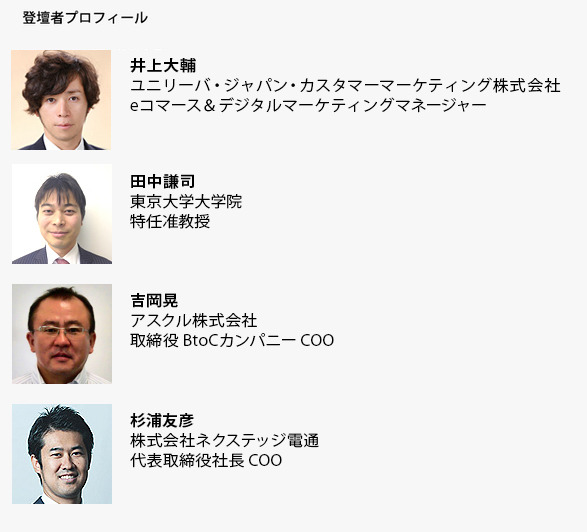
Moderator: Daisuke Inoue, Unilever |
Inoue: First, I'd like to share what the four of us discussed beforehand. What exactly is CRM? Generally, CRM brings to mind preferential measures for specific customers, like frequent shopper programs or mileage programs. However, measures targeting all of a company's customers are also possible, and ideally, there's also the One to One approach.
We define the purpose of CRM as "maximizing LTV" and define engaging in CRM as "considering whose LTV to maximize and how to do it." Regarding "whose," we can think along an axis ranging from the entire customer base (mass customers) to individual customers. Regarding "how," this includes discounts like points or coupons, as well as providing added value such as services for specific customers. While these could be seen as simple sales promotions, we determined that the key distinction lies in whether the initiative's purpose is LTV maximization.
By using these two dimensions as vertical and horizontal axes, we were able to create a valid framework. A major trend is the shift from mass-market discount approaches to individual customer-focused, value-added approaches. This trend accelerated significantly with the rise of e-commerce and the widespread adoption of CRM. CRM has evolved alongside technological advancements. Furthermore, marketers now have access to behavioral data. When examining CRM from both purchase data and behavioral data perspectives, how far have we progressed? Next, as part of our introductions, our three speakers will share case studies.
CRM Evolving Through the Integration of Purchase and Behavioral Data
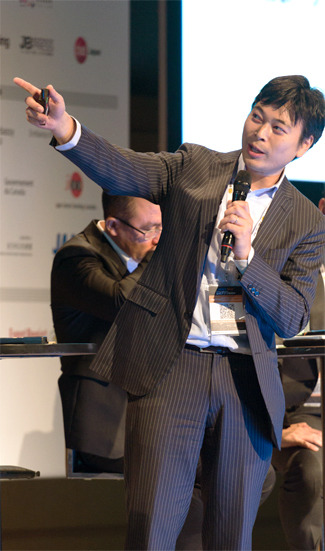 |
Mr. Tanaka, University of Tokyo Graduate School |
Tanaka: At the University of Tokyo, I specialize in research on demand forecasting, data mining, and large-scale data analysis. As a recent example, I'll introduce "analyzing client companies as if conducting a health checkup." Just as you check whether the heart is functioning properly and then assess muscle strength, we analyze customer purchases step by step: starting with foundational products, then the next tier, and so on.
Once we establish a certain level of cohesion, we can see what products customers tend to buy first and second, and which ones are more likely to become loyal customers. We named this analysis, which identifies customers with high growth potential based on their purchasing patterns, "Promotion Fish Analysis." The second approach is "Identifying Life Stages for Targeted Engagement." For example, when a child is born, the necessary products change by phase: first infant items, then toddler products, and finally elementary school supplies. Guidance tailored to these phases is highly effective. We perform analysis to identify these "promotion fish" along the timeline at an early stage.
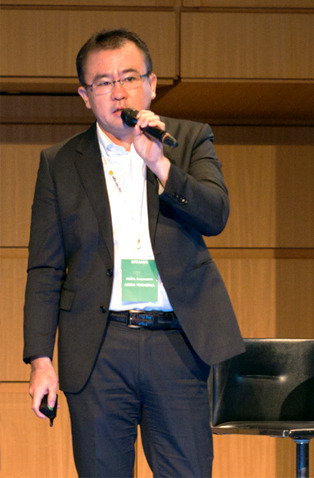 |
Askul's Yoshioka |
Yoshioka: I'm Yoshioka from ASKUL, responsible for the daily goods e-commerce platform "LOHACO." Our current focus is on the "beginning of second-generation e-commerce." If we consider those who purchase discretionary items like books, DVDs, and farm-direct products via e-commerce as the first generation, e-commerce is now increasingly entering households, with more people using it for daily necessities. We view this customer segment as the second generation. We believe this second generation will continue to grow significantly, driven by factors such as women's increased participation in the workforce, dual-income households leaving less time for shopping, and advancements in logistics.
Surprisingly, the core customer base is 60% female, aged 30 and above. They are overwhelmingly urban dwellers. They tend to be health-conscious, enjoy alcohol, have a sweet tooth, and love events. Specifically, we've defined four personas: "Mama Lohaco" (women aged 31-40), "Ms. Lohaco" (women aged 46-55 without children), "Papa Lohaco" (men aged 36-45), and "Mr. Lohaco" (men aged 46-60 without children). Based on this, we segment content delivery using behavioral data and approach similar demographics through lookalike targeting.
 |
Mr. Sugiura, Nextedge Dentsu Inc. |
Sugiura: At Nextedge Dentsu Inc., launched last May, we focus on client customer acquisition and maximizing LTV. With our current emphasis on online advertising, I strongly feel the "integration of CRM and advertising."
Email used to be central to CRM, but now email open rates are only 10-20%. However, CRM tools have emerged across various channels like LINE, Facebook, and the web. For example, in a skincare e-commerce case, comparing trial product purchasers approached via email + retargeting ads versus email alone showed the former group had a 38% higher full-size product purchase rate. Similarly, a sports e-commerce site approached dormant customers via Facebook Custom Audiences, achieving a 4% response rate and a 0.4% purchase conversion rate.
While customer data, segmentation, and one-to-one marketing have long been topics in the CRM world, the advertising world is now expanding its CRM scope too—tracking user responses via cookies and tags, designing DMPs (Data Management Platforms, which centralize data management and utilization)... However, the core remains unchanged: effectively segmenting users and delivering the right message at the right time. I believe that enhancing LTV through this approach will define next-generation data-driven marketing.
The key lies in designing the right scenarios.
Inoue: Moving forward, we'll discuss several challenges. First, the "barrier between the analytics team and the execution team." Mr. Yoshioka, what is the structure like at ASKUL?
Yoshioka: Even before we started e-commerce, back in the catalog mail-order days, the two teams were separate. But we brought them into one business division, and now analytics and merchandising functions exist within the same division.
Initially, there was a wall. It started to break down when we began bringing the analytics team to real-world settings like negotiations with manufacturers and joint sales-production meetings. Once they understood how their analysis could be applied, the collaboration really clicked.
Inoue: I see. As those proposing solutions to companies, Professor Tanaka and Mr. Sugiura, what are your thoughts?
Tanaka: While technological advances have expanded what we can "see," there's still a significant gap between that and what's actually feasible. We're mindful of that. One thing I can say is that bringing overly complex models often means they're unusable on the front lines.
Sugiura: As Mr. Yoshioka mentioned, I get the impression the analysis and execution teams have grown closer. On the other hand, there's still a wall between the systems department and the execution team, with issues like not being able to produce data because they can't secure the manpower. I think there's room for improvement here.
Inoue: The walls are coming down, but it remains a complex area. For CRM targeting the entire customer database, the "start small" approach often emphasized in test marketing is difficult. Starting simple might be one idea.
Now, the second challenge we've set is the theme of "under what conditions is providing economic benefits effective?" Discount strategies naturally lead to company fatigue, but how does this play out at LOHACO, which is linked with T Points?
Yoshioka: For instance, the ability to use T Points does help encourage first-time purchases to some extent, and discounts themselves are effective for new customers. However, for existing customers, if the purchase motivation is solely "because it's cheap," it's difficult to achieve sustained LTV growth. I feel it's better to focus on increasing satisfaction through other means.
Inoue: Finally, "CRM in the Big Data Era." As Mr. Sugiura mentioned, as CRM and advertising domains become seamless, it's now possible to prioritize specific segments from the outset.
Tanaka: Analyzing existing customers can sometimes predict whether new customers will become high-value ones.
Sugiura: Collecting behavioral data and tailoring messages has become quite cost-effective. Therefore, the key point is designing the right scenarios for customer engagement. Going forward, I believe the overall direction is to effectively combine third-party data to identify customers and design optimal approaches, thereby transforming the entire marketing function into CRM.
Inoue: I sense a trend where CRM is becoming marketing itself, with DMPs as the key. Thank you for today.
Was this article helpful?
Share this article


Newsletter registration is here
We select and publish important news every day
For inquiries about this article

Author