
Note: This website was automatically translated, so some terms or nuances may not be completely accurate.
 The schemer plots three times [3/13]
The center of everything is "people."

Satoshi Umeda
In this age of information overload, how can individuals or companies ensure their messages get noticed?
In the previous column, we used a private event like a birthday party as an example. This time, let's focus on how to apply this thinking to work.
To achieve this, the key lies in making the recipient strongly recognize that the information is relevant to them personally, rather than being aimed at an unspecified mass audience. The importance of what marketing terms call "targeting" has grown significantly.
However, the traditional concept of "targeting" – literally meaning "the target" or "the aim" – is no longer effective in getting people to listen to your message. Why? Because even if you fire your information directly at the target, they now have the option to ignore it.
Advertising is often likened to a love letter. Imagine if more of those love letters were simply read and ignored. Even if someone encounters the information, the moment they instantly decide it's irrelevant to them, it might as well not exist. The opposite of "like" isn't "dislike"; it's "disinterest" or "apathy."
Therefore, we must shift our mindset: instead of viewing the intended audience as targets, we must redefine them as partners. The goal is to build a connection between the brand (product or service) and the consumer, aiming for mutual affection. This is also the fundamental concept behind engagement (promise, connection, relationship).
Today, no business model exists where selling a product is the end goal. There's a growing emphasis on lifetime customer value—how much each individual consumer will purchase over their lifetime. Moreover, consumers who blindly accept corporate messaging, convenient for companies, are virtually nonexistent. People trust others' reviews and increasingly create their own.
It is now clear that consumers are no longer targets to be hit and forgotten; calling them partners who love your brand and help spread it is far more aligned with the times.
In other words, we must shift our perspective from viewing "customers" as a collective group to seeing them as individual "customers" – each unique.
We must focus on each individual's life: How can we solve the challenges they face? How can we make them feel good? How can we contribute to a better life? I believe the "people" behind the brand should be at the very center of everything.
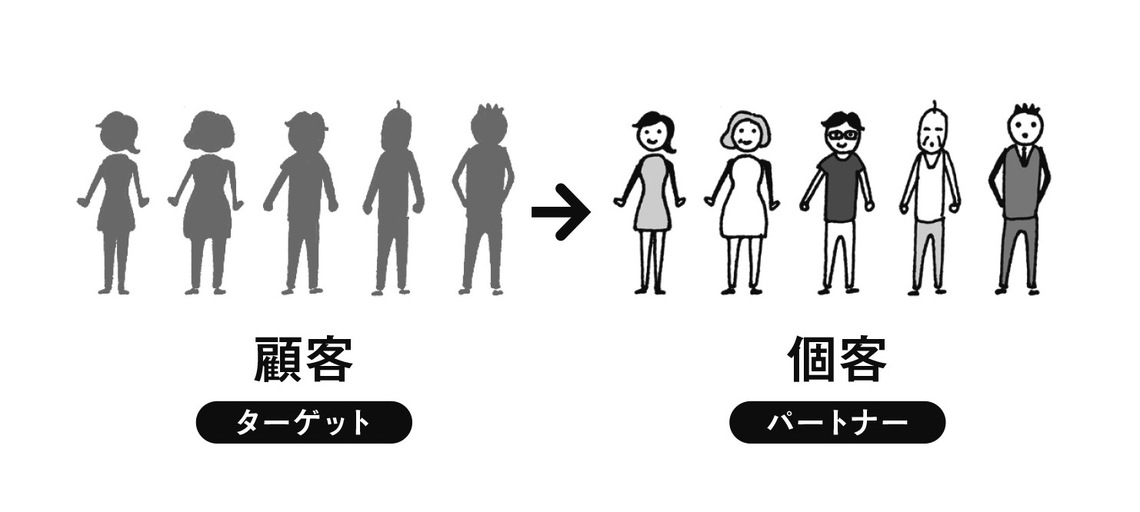
Accordingly, the way we send love letters has changed significantly.
The era when simply eloquently stating one's own appeal sufficed is over. Now, techniques are employed where the method and content of sending love letters are subtly adjusted based on the recipient's location and mood. This is the era of cross-media. When sending a love letter to their home, where they likely have time to read it slowly, send a longer, heartfelt one. At night, send a romantic email saying, "The moon is beautiful tonight." This combination of media and message as contact points has evolved to capture interest.
Then, in the era of "individual customers" and "engagement," the focus shifted beyond merely conveying one's feelings to achieving mutual affection. Hearing that someone has a cold, you quickly gather information about the type of cold to prepare appropriate medicine or remedies. To do this, you first need to obtain the information that they "have a cold." Viewed from a marketing perspective, this means you must pinpoint what the individual customer is struggling with and what they need right now.
It's not just about conveying information; it's about knowing the other person thoroughly to ensure the message is accurately received. That forms the foundation of strategic thinking.
Methods for gathering their information range widely, from consumer surveys to big data analysis. At the same time, your own gut feeling is also very important. What you must be careful about then is treating that gut feeling not as a conclusion, but as one hypothesis.

Was this article helpful?
Share this article


Newsletter registration is here
We select and publish important news every day
For inquiries about this article
Back Numbers


Author