
Note: This website was automatically translated, so some terms or nuances may not be completely accurate.
 The schemer plots three times [4/13]
The essence of scheming is "Oh, you got me!"

Satoshi Umeda
People constantly live their lives making predictions.
As I mentioned in a previous column, if you know someone is throwing you a birthday party, you expect they might have prepared gifts or a cake. Similarly, in business, those requesting work are likely making assumptions like, "This is probably what they need."
If someone asks you to propose solutions because product sales are poor, based on recent trends, they're likely thinking about leveraging social media like Facebook and Twitter to connect directly with consumers.
If you're commissioning new product development, it's not hard to anticipate suggestions like products featuring designs created in collaboration with renowned designers or products exclusively sold through the booming online retail market.
Personally, I believe proposals must exceed these expectations. While thoroughly examining every possible option might lead to a predictable outcome, a professional planner should prioritize generating ideas that surpass expectations as their primary goal.
What becomes crucial here is how you surpass expectations.
If it falls within expectations, it ends with "Yeah, that makes sense" or "I was thinking the same thing." Conversely, if it's completely unexpected, the reaction might be "No, that's not it" or "Do you even understand the challenge?"
The reaction you should aim for is "Wow, that's a fresh take!"
Simply shocking or surprising people is meaningless. However, business won't move forward with the obvious either. It's the "Oh, that's how it is!" that convinces while catching people off guard that becomes the force propelling things forward.
This "Oh, I see!" carries two meanings: the conviction of "I get it!" or "That's right!" and the surprise of "No way!" or "Wow!" More precisely, it's surprise built upon conviction. It's no exaggeration to say nearly all schemes are born from this combination.
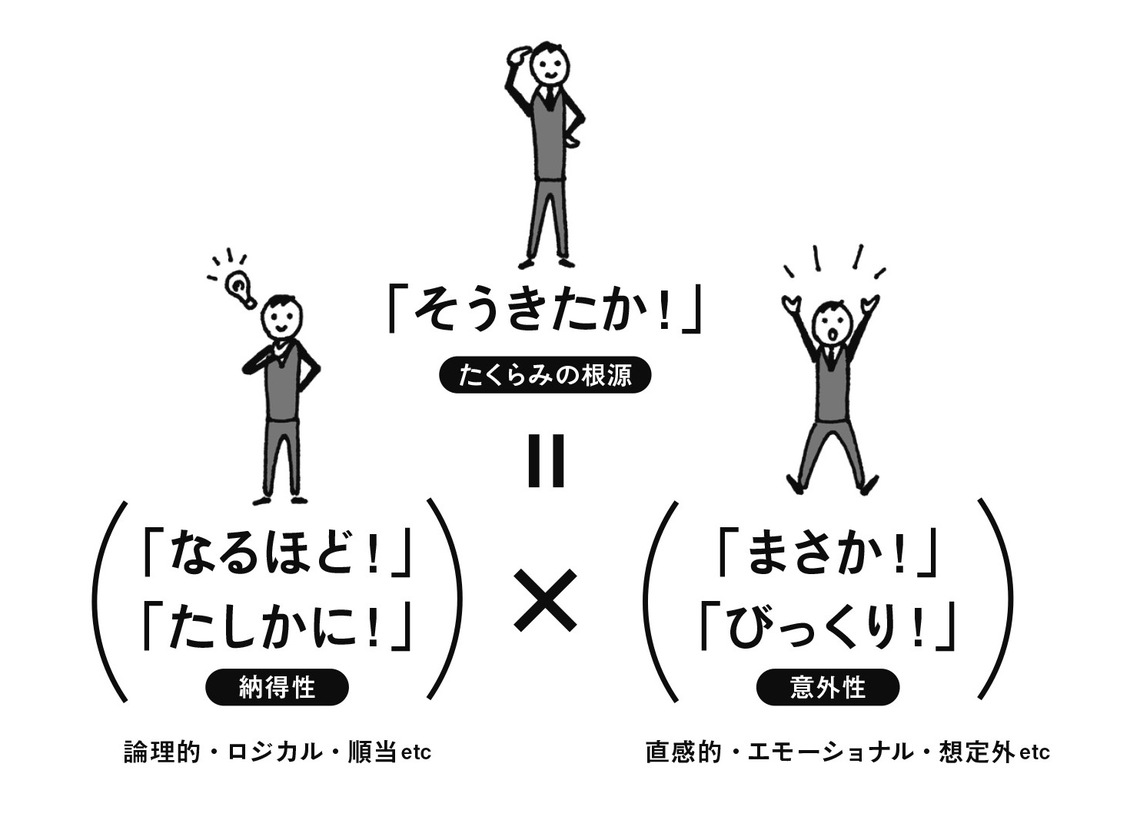
This leap to "Oh, that's how it is!" is called a jump, and it seems most often demanded in the creative domain. Certainly, it's the creatives, who govern expression, who most often embody this "Oh, that's how it is!" moment. But a marketing jump is also necessary for defining challenges and strategy, and a concept jump must exist before anything is translated into expression.
In that sense, I believe everyone involved in planning must scheme. No one can afford to rest comfortably in the realm of mere plausibility—where everyone agrees with "I see!" or "That makes sense!"—leaving no room for anyone to disagree.
Planning is about solving problems. And as mentioned in the first column, those problems are defined by the gap between the current state and the ideal state. We must strategize throughout the entire process.
Within this sequence, challenges emerge—ones that everyone vaguely sensed but couldn't articulate, latent issues that hadn't surfaced. The plans born from these challenges (products, communications, systems, etc.) transcend merely addressing consumer needs. They provide people with new values and emotions, creating fresh openings in increasingly commoditized markets.
Even for the projects you're currently working on, approaching planning with a perspective that sparks "Oh, that's how it works!" opens up the possibility of creating plans with entirely new angles.
Book now on sale! Details here

Was this article helpful?
Share this article


Newsletter registration is here
We select and publish important news every day
For inquiries about this article
Back Numbers
Author