
Note: This website was automatically translated, so some terms or nuances may not be completely accurate.
 The schemer plots three times [5/13]
The challenges are constantly being updated.

Satoshi Umeda
The world is changing moment by moment.
While human nature doesn't change drastically over a few years, living patterns and lifestyles can be dramatically transformed by the emergence of a single groundbreaking product or service.
Looking back, portable audio devices transformed music into something you could listen to anywhere you liked, fundamentally altering how people interacted with music. Music then shifted from being something you bought in stores to something you downloaded as data.
In recent years, the rise of social networking services (SNS) and free communication apps has made communication—like phone calls and emails, which previously required payment—free and more accessible.
Within this context, the challenges faced by products and services, and the value they must deliver, should naturally evolve. The ability to redefine these elements is increasingly becoming the key to solving problems. The reason is very simple: even if the physical nature of a product or service remains unchanged, as the world changes, its role and position inevitably must change.
In this column, I'd like to discuss the process of redefining challenges.
As mentioned in the first column, challenges can be defined as the gap between an ideal state and the current reality. What's important to note here is that previously established ideals or visions are gradually realized over time and updated to reflect the current reality. Naturally, challenges are updated accordingly.
In recent years, technological advances have caused the current state to change at a dizzying pace. Consequently, just grasping the current state often proves challenging, and envisioning the future tends to be neglected. It's not uncommon to see what was listed as a task reorganization simply become a list of problems currently occurring.
This is said with a sense of self-reflection...
Ultimately, what planners must do is discover and solve fundamental challenges. Without resetting a new vision appropriate for the times, neither accurate challenge identification nor effective solutions are possible.
Take the problem of "declining product sales," for example. The underlying issues are complex.
For a product in a newly emerging market, the reasons might be clear: increased competition, or rivals releasing products with superior performance. However, in today's world, reasons could include consumers increasingly using online shopping, leading to reduced sales at physical stores, or the market itself being replaced by a different product.
Consider the shift where paper maps in cars were replaced by car navigation systems, and then smartphones became sufficient—this trend might help clarify the point.
However, it's clear that the value of maps themselves hasn't disappeared. In fact, demand for maps has grown, albeit in different forms—so much so that some people now can't drive without a navigation system. While technological evolution lies at the core of this shift, it's more accurately driven by changes in people's behavior brought about by that evolution. Ultimately, you can't identify challenges without putting 'people' at the center of your thinking.
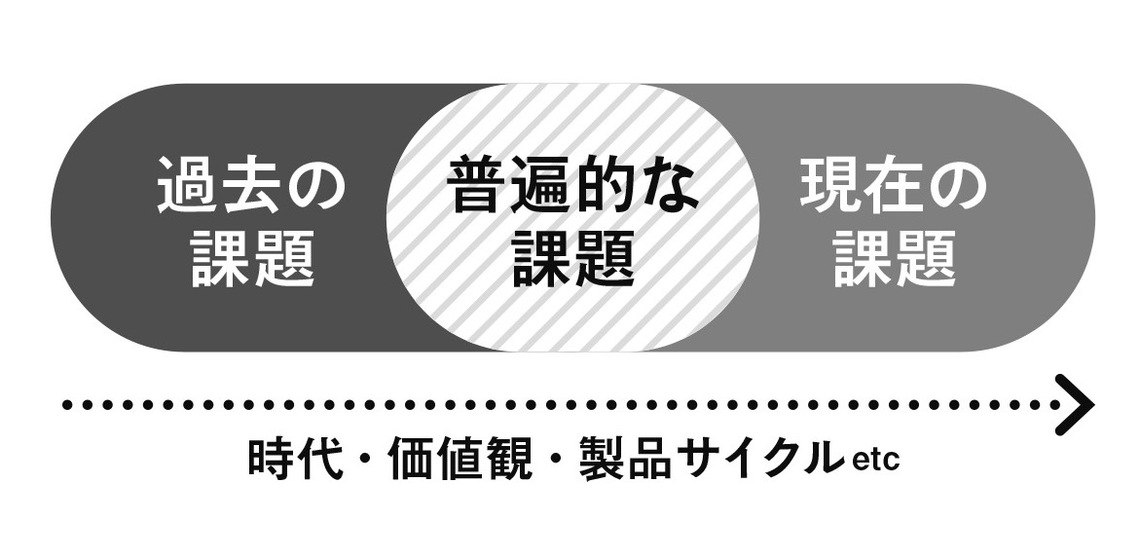
Using maps as an example, we can trace the evolution of challenges.
In the era when printed maps were still dominant, the challenge was "how to develop value-added maps that include back roads and traffic congestion information."
Today, however, while numerous map services exist, providers cannot create the maps themselves. This leads to a new challenge: "How to become the provider of accurate, up-to-date map information?"
Thinking this way allows map makers to pivot from a B2C (business-to-consumer) strategy to a B2B (business-to-business) one.
While I cited a market with significant shifts as an example, the situations in your own projects are also changing daily. Paying attention to these changes is crucial for accurate planning.
Book now available! Details here

Was this article helpful?
Share this article


Newsletter registration is here
We select and publish important news every day
For inquiries about this article
Back Numbers

Author