
Note: This website was automatically translated, so some terms or nuances may not be completely accurate.
 The schemer plots three times [6/13]
The Power to Translate Brand Value

Satoshi Umeda
In the previous column, we explained how the challenges faced by products and brands change with the times.
This time, I'd like to expand on how not only the challenges but the very existence and value of products themselves also change.
Providing Value Suited to the Times
Regarding a product's intrinsic value, it can often be naturally redefined by redefining its challenges.
Taking the map example from last time: companies that sold maps to individuals transformed into companies selling map information to businesses. This is synonymous with the corporate entity itself redefining its core value.
While the redefinition of a company's core value—beyond just its brand, products, or services—is ultimately decided by the company itself, it evolves in response to societal trends and consumer needs. Identifying the starting point for this evolution is also a crucial task for planners.
For example, frozen foods were born as a revolutionary product that preserved perishable foods for long periods through freezing. However, in today's world where dual-income households are becoming commonplace, their raison d'être has shifted to enabling families to eat together, no matter how busy life gets. Naturally, I don't think anyone foresaw the rise of single-serving meals or solitary dining when frozen foods first emerged in Japan in the early 1960s.
Similarly, portable audio devices have evolved from products for easily carrying and enjoying desired music to products that carry a certain space with you, enhancing your mood or concentration anytime. With the growing acceptance of nomadic work styles, they are beginning to take on the aspect of essential items that let you immerse yourself in your own world anytime, anywhere. It's well-known that professional athletes often listen to their favorite music right up until their performance to heighten their focus.
To take a recent example, mosquito coils have shifted their positioning. They are no longer just a means to escape the itch after a mosquito bite, but have become products that protect life by helping to fight the disease dengue fever.
The examples cited here can be rephrased as transforming the functional benefits of products or services into values aligned with their era.
This ability to transform value can be defined as the power of translation that connects products to value, making it easier to understand.
Even products or services that seem inorganic at first glance can shine brightly when planners give them new meaning and roles suited to the times. Furthermore, even products released in the past that have served their purpose can be reintroduced as new products by assigning them new roles.
The Key Going Forward: Translation into "Social Benefits"
Translating functional benefits—the performance of a product—into emotional benefits has been done extensively. This involves shifting the subject of the narrative from the company to the consumer, defining what value the brand can bring to people's lives.
Furthermore, in recent years, the importance of translating these benefits into social benefits seems to be growing. Simply put, this means viewing the brand from a broader perspective: why is this product or service necessary for society?
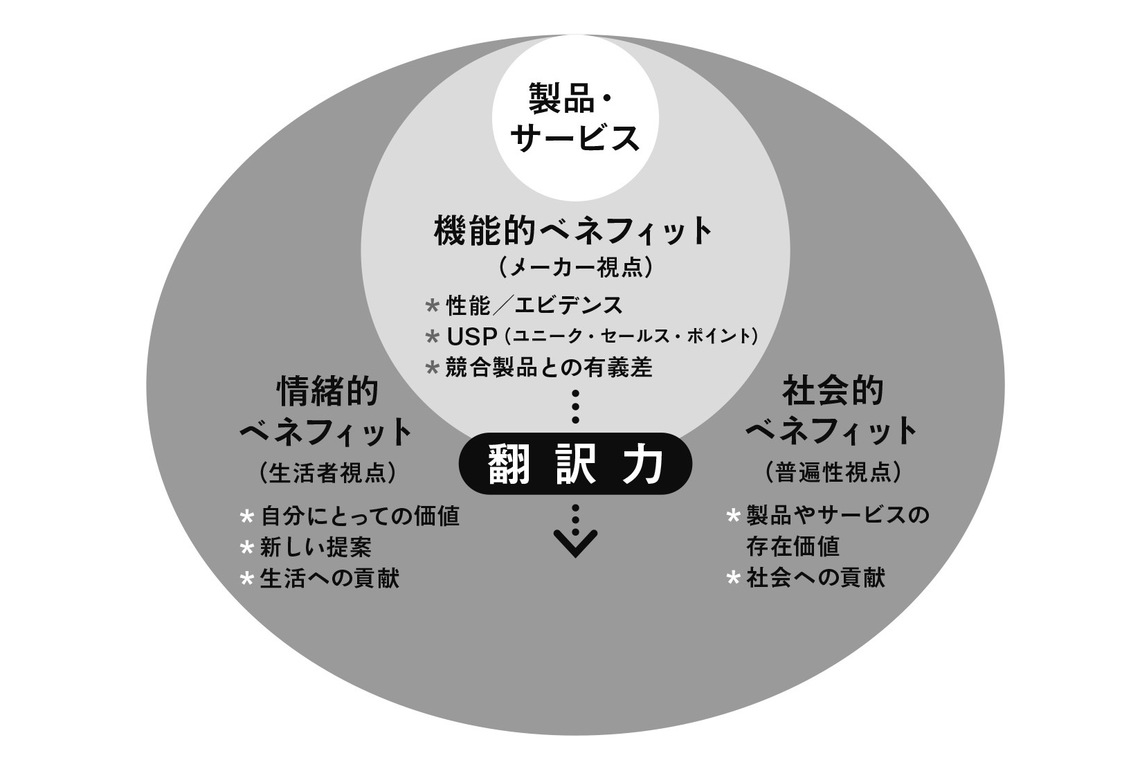
Using the earlier examples, defining frozen foods as a solution to the problem of single-person households or mosquito coils as products that protect lives represents this shift toward social benefit.
To discover this social benefit, it is particularly crucial to hold a strong and clear vision of what you aim to achieve. Above all, you must confront the present moment thoroughly. Conversely, simply maintaining a mindset of constantly redefining challenges and products expands the possibility of spotting that thread.
The world will continue to undergo various changes, and these changes are not always welcome or positive. However, precisely because of this, I believe the role of the planner is significant. To give new value to products and services, and to take steps together to improve the world. The power to redefine, which serves as the starting point for this, will become a weapon for the planner.
Book now on sale! Details here

Was this article helpful?
Share this article


Newsletter registration is here
We select and publish important news every day
For inquiries about this article
Back Numbers
Author