
Note: This website was automatically translated, so some terms or nuances may not be completely accurate.
 The schemer plots three times [7/13]
The Invisible Walls Blocking Ambition (Part 1)

Satoshi Umeda
As I wrote in the second column, everyone schemes in their private lives. Yet, many people don't scheme at work. What obstacles stand in the way?
We are surrounded by walls of emotion
Ideas are born from the interplay of theory and emotion, so they are often influenced by our feelings.
When heartbroken, we tend toward sentimental ideas; when feeling cheerful, wildly optimistic plans are more likely to emerge.
When you're not in the mood or stuck on a project, the best thing to do is step away from your desk and find a distraction. Take a stroll around town, watch a movie you've been wanting to see, look into something you've always been curious about... Taking a bath and just zoning out without thinking about anything can also be effective.
If it's just a mood thing, you might be able to handle it yourself by figuring out a way to correct it. But I'm convinced the real trouble lies in emotional barriers that can't be broken down by simply changing your mood.
"I have to think properly because it's work," "The presentation is in a few days, this is bad," "If I go this far with that client, will they get angry?"
These invisible emotional barriers are what block your plans.
The crucial step is first recognizing their existence. If you remain unaware, you'll constantly apply the brakes to your planning, making it difficult to develop strong proposals. However, once you recognize you're inside the wall and attempt to step outside it, you can begin to find fundamental solutions.
Awareness of Six Emotional Barriers
Below, I've categorized the walls I've encountered into six main types. Let's examine each one.
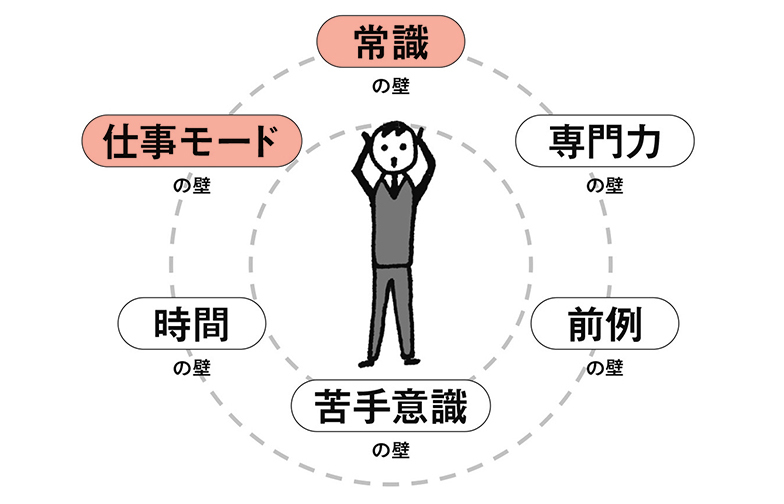

Human behavior is governed by the common sense we acquire as we grow up.
Common sense includes moral principles like not speaking ill of others or helping those in need, as well as preconceptions formed from personal experience—beliefs like "it must be this way" or "this is how it is." Naturally, the walls stem from these latter preconceptions.
This isn't to say preconceptions are inherently bad. The ability called judgment is also a kind of preconception, and correct preconceptions can be beneficial when planning.
On the other hand, preconceptions unconsciously narrow the scope of our thinking. They can lead us to insist, "This is how it must be!" or dismiss options with "That's impossible!"
When expanding a plan, it's effective to start by questioning that wall—by first viewing your own common sense as a preconception. Specifically, trying to think of the opposite of what you consider common sense is a good approach. Doing so naturally allows you to generate ideas that transcend your own common sense.

In our personal lives, we all naturally scheme and strategize. The biggest reason for this is likely the absence of that pressing feeling of "I have to come up with a plan." Freeing yourself from that work mode and thinking in your usual personal mode can make your ideas shine much brighter.
To achieve this, I recommend thoroughly reviewing materials and organizing the task in your own way, then setting aside everything except a pen and notebook or memo pad to think.
When planning a birthday party, you don't deliberately revisit the person's personality or profile sheet, right? Similarly, if you keep referring to materials while planning, you risk getting distracted by information and data. You'll start feeling compelled to ensure consistency with the materials, plunging you back into work mode.
Instead, internalize the information you deem important and go about your daily life. Doing this allows scattered pieces of information to connect, and what were once mere numbers and letters begin to take on meaning.
Next time, I'll continue explaining the other four barriers.
Book now available! Details here

Was this article helpful?
Share this article


Newsletter registration is here
We select and publish important news every day
For inquiries about this article
Back Numbers
Author