
Note: This website was automatically translated, so some terms or nuances may not be completely accurate.
 Everything About Wakamon [41/56]
The Fashion Trends of Today's Men Who Master the "Right Answer"

Kana Takeyama
Freelancer

With the announcement of popular fashion magazines ceasing publication and declining enrollment at fashion colleges, is there a sense that young people (especially men) have lost their passion for fashion lately? Are "mass-produced" college students proliferating?
We hear endless talk about young people turning away from this or that, and fashion is one such example. But is that really true? And why? Youth fashion has always reflected the spirit of its time. So, let's explore the mindset of today's young men by examining what contemporary youth fashion reveals about our era.
Are "Fashion Enthusiasts" a Minority?
In our research activities with young people, we often hear this from college students:
"Fashion? I'd be lying if I said I didn't care, but I don't spend a ton of money on it or try to stand out. I just don't have the cash to begin with. But looking clean is important, so I make sure to keep that up."
(21 years old, 4th-year university student)
"Most people are pretty similar. Sure, I have friends who absolutely love clothes, but few are really eccentric or spend a ton of money. We mostly buy good brands cheaply at outlets."
(21-year-old, 4th-year university student)
In this year's 'Youth Survey 2015', only 26.1% of male university students listed "fashion" as a favorite hobby. Less than 3 out of 10 self-identified as "fashion enthusiasts." (For comparison, fashion ranked #1 among female university students' favorite hobbies at 67.3%. Girls have always loved fashion, no matter the era.)
However, just because it's not a particular passion doesn't mean they don't care.
When talking with other college students, I got responses like this:
"I do pay attention to my clothes and hairstyle. I think it's necessary, like personal grooming, or just common sense. Basically, I don't want to be disliked (laughs)."
(20 years old, third-year university student) Head out to shopping spots, entertainment districts, or areas around universities where students gather, and look around. You'll see they do look "proper." They might have trendy items, look clean, or have their hair neatly styled with products. It's not that they "love" it, but they care enough not to stand out negatively. This has become the mainstream approach to fashion for today's young men.
NG Outfits You Can Find by Googling
Everyone looks "put together" = grooming standards have risen, the average has gone up. Or rather, it could be said that amid the flood of "correct" and "NG" information available with a simple search, their ability to avoid "Oh no, not that!" outfit combinations has improved. In other words, it's the power to "not mess up."
This "not messing up" ability is likely fueled by the sheer volume of information available.
Searching yields mountains of fashion articles like "This Summer's Must-Haves!" or "Avoid These at All Costs." For example, a Google search on my computer for "college student NG outfits men" returned 123,000 hits (as of June 1, 2015). The groundwork for avoiding fashion faux pas is firmly in place.
Amidst this massive volume of information, patterns inevitably emerge. Within this landscape, the process of "finding your own style" is largely skipped over; to some extent, simply following the "examples" gets the job done.
In the '2015 Youth Survey', the top-ranked "character they want to be seen as" is the "savvy character". This desire to be safe, reliable, and savvy is clearly reflected in their fashion consciousness too.
Both outwardly and inwardly. A "sense of one's place" that avoids strain.
By mastering the art of avoiding fashion faux pas, the number of "uncool" moments has decreased, but so has the potential for "surprise." Compared to the heyday of street fashion in the late 90s to early 2000s, a phenomenon that could be called homogenization is indeed occurring. Alongside reduced spending, a weakening passion for fashion, and changes in purchasing environments where anyone can get the same items anywhere, the lack of a "wave" of surprising trends has contributed to what is often described as a decline in fashion enthusiasm.
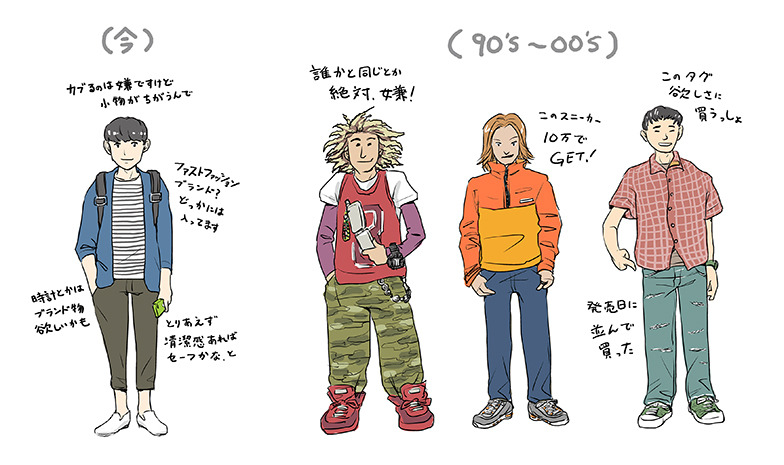
Fashion's "movements" have always been born from deviation.
In other words, turning the "unacceptable" into the "acceptable" creates that wave. But now, we live in an era where you can search for both acceptable and unacceptable. Everyone skillfully avoids controversy, wearing the "correct" look.
Young people today are fundamentally driven by "good quality at low prices," honest about their desire for cost performance. Unlike the brand-first mentality seen during the late 90s boom of Ura-Hara brands or the heyday of high-fashion luxury labels, their consumption style is based on buying affordable clothes that look good, purchased from easily accessible stores – rather than high-priced items emphasizing brand names.
We also asked Kinuko Iwasa, Editor-in-Chief of MEN'S NON-NO, about recent youth fashion.
"Compared to the 90s, which they're often compared to, the sheer volume of information available has increased dramatically. Consequently, their overall discernment has sharpened, allowing them to choose affordable yet quality items. It's only natural that things are different compared to the 'consumption above all!' era. Nowadays, financial disparities exist, and with more consumption choices available, fashion is no longer something people feel particularly compelled to obsess over. The fervor to spend big money on 'brand names!' has definitely cooled compared to a decade ago, and the aspiration for big fashion houses has also diminished. Fast fashion is rising. More people now name fast fashion brands when asked about their favorite labels. Lately, there's an overall trend toward 'simple' and 'unpretentious,' and I feel it's fitting within that."
In the '2015 Youth Survey', a whopping 88.2% of male university students answered 'Yes' to the statement: "In 10 years, I will be living within my means." This clearly shows a growing awareness of living within one's means. This mindset of 'not overreaching, but being smart' is directly reflected in how they approach fashion.
Neither standing out nor blending in, but fitting in
Fashion used to be the ultimate expression of individuality.
However, with the rise of social media, the tools for self-expression have multiplied, and fashion's role as a means of self-expression has diminished. Today, fashion is less about presenting a bold "This is who I am!" statement and more about blending in and being accepted—it's become one of the ways we communicate.
"When something I'm wearing or carrying becomes a topic of conversation or gets complimented, I think, 'Yes! That makes me happy!' But I don't deliberately try to stand out," says a university student, revealing their true feelings.
It's not about wanting to be edgy; it's about figuring out how to get along with everyone. While they want to avoid being "completely the same = unoriginal," they also don't want to stand out by openly displaying their preferences. They don't want to be singled out and criticized. It's about smoothing communication with those around them, about not being shunned.
This unconscious consideration among today's young men is directly reflected in their fashion choices.
What kind of young people are around you?

【Wakamon Profile】
Dentsu Inc. Youth Research Department (nicknamed Wakamon) is a planning team that engages with the real lives and mindsets of young people, primarily high school and college students. We explore hints to brighten and invigorate the near future, starting from their "now." By anticipating the future through their insights, we realize new businesses that foster better relationships between young people and society. Currently, 14 project members are based across our Tokyo headquarters, Kansai branch, and Chubu branch. We also share updates on the Wakamon Facebook page.
Was this article helpful?
Share this article


Newsletter registration is here
We select and publish important news every day
For inquiries about this article
Back Numbers


Author
Kana Takeyama
Freelancer