Note: This website was automatically translated, so some terms or nuances may not be completely accurate.
 Active Learning: What About This? Report [14/33]
A pencil for writing well. A pen for thinking well.
The "Active Learning: What About This?" Research Institute launched at DENTSU SOKEN INC. We plan to propose ideas about active learning from various angles. This column will introduce methods, concepts, and individuals that could be useful for making learning more active.
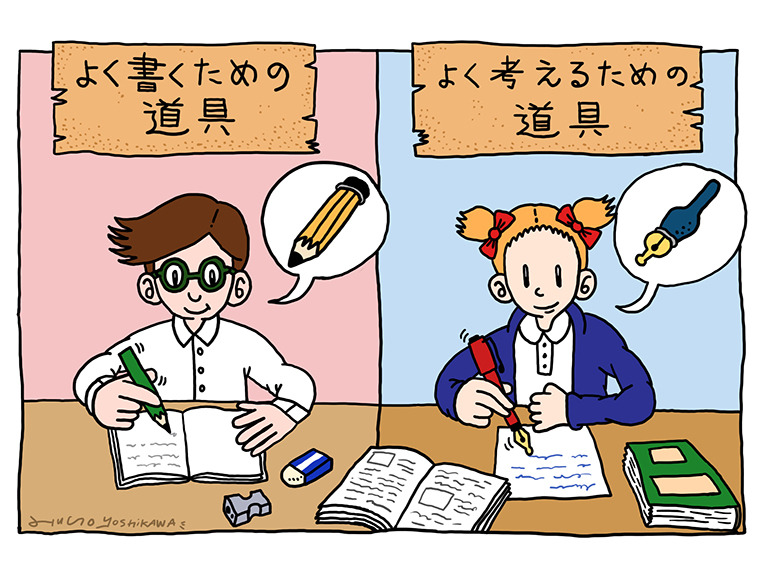
I was shocked when I transferred to a school in England. In Russia, everyone used pens, but here everyone was writing with pencils! Wait, those are the pencils we use for drawing in art class! For math diagrams, maybe, but they were writing sentences with them. Sentences! I found it utterly baffling.
I brought pens as a matter of course, but the teacher immediately told me to use a pencil. For a while, though, I resisted and hesitated to write with a pencil. I could accept it for rough drafts, but writing the final version in pencil? I just couldn't accept it. It didn't feel like I was writing my own opinions. It felt like writing something without a solid opinion, and that uneasy feeling lingered.
But then one day, I realized something. There's an eraser on top of the pencil, isn't there? This means I can erase. Meaning, I can rewrite. Meaning, it's okay to relax. From that point on, I could write smoothly.
In Russian schools, you always use a pen for writing. In my time, it was ballpoint pens. My parents' generation used fountain pens. The color was strictly blue. Black was unacceptable, and red was reserved for teachers. Pencils were the quiet, unassuming ones, sleeping in pencil cases, only coming out for art class and for drawing shapes in math.
So why use pens? There's probably a reason. Simply put, once you write with a pen, it's final. You can't change what you've written. Actually, this is the most crucial point.
Take writing an essay, for example. With a pencil, you'd probably think a bit and start writing right away. If you thought, "Hmm, that doesn't quite feel right," you could just erase it and try again. But with a pen, you have to think very carefully first. What to write. How to write it. Spelling. Layout. Pacing. Sometimes, you might even write a rough draft first. That's when you might use a pencil. Only when you've imagined every detail down to the last point do you finally pick up the pen to write the final draft.
What you write becomes your opinion, permanently etched on the paper, impossible to erase. So, your opinions become more solid, and above all, you're left with a beautiful, well-thought-out piece of writing. In other words, it becomes writing that embodies the essence of "thinking carefully."
Why did I start going to such lengths? The reason lies in the grading system. Beyond content, the writing itself is evaluated. Grammar and spelling are obvious factors, but the neatness of handwriting and line breaks are also scrutinized. Mistakes mean point deductions, of course. With only a five-point grading scale, dropping even one point is a significant blow. So, I have no choice but to rewrite.The entire piece. Rewriting several pages demands considerable time and concentration, so you naturally want to avoid it. For homework, you might spend hours rewriting multiple times, filling an entire notebook, but during a test, you could run out of time.
So, you naturally learn to think carefully before writing. Whether you use a pencil to make writing easier or a pen to make thinking easier, the writing tool actually determines the process.
This time, I compared a pencil and a blue ballpoint pen, but what if I changed the pen color, or tried markers or fountain pens? Furthermore, with the rise of digital tools making typing more common, how does writing on a tablet differ from writing on paper? There's much debate about introducing digital tools into education. Is analog better, or is digital better?
The truth is, neither is inherently correct; changing the tool changes the output. How that output changes, and what the child writing learns from that process, is actually the most profound aspect.
Was this article helpful?
Share this article


Newsletter registration is here
We select and publish important news every day
For inquiries about this article
Back Numbers

Author

Kirillova Nadezhda
Dentsu Inc.
第7マーケティング局
Creative Director