Note: This website was automatically translated, so some terms or nuances may not be completely accurate.
 FC Imabari's Challenge [2/2]
Experiments with the Okada Method: From Soccer to Regional Revitalization and Environmental Education.
Okada Takeshi
Imabari Yume Sports Co., Ltd.
Nobutaka Hayashi
Dentsu Inc.
※Part 1 of the series is here.
Former Japan national soccer team coach Takeshi Okada chose Imabari City in Ehime Prefecture, Shikoku, as the stage for his new challenge. He acquired a 51% stake in "Imabari. Yume Sports," the operating company of the local club "FC Imabari." Rather than as a coach, he is now pursuing team strengthening and promotion as an owner-manager. He has spent over a year engaging with the local government, media, and sponsor companies.
We spoke with Mr. Okada, who continues to challenge soccer from a broad perspective encompassing regional revitalization, education, and international exchange, about the new relationship between society/business and sports. Interviewer: Nobutaka Hayashi, Director, Dentsu Marketing Solutions Bureau.
The New Stadium Becomes "Legend"
Hayashi: There was a banner right in front of the Imabari City Hall, wasn't there? It said "Must Promote! FC Imabari Aim for JFL Promotion!" in huge letters. I was surprised.
Okada: Unfortunately, we couldn't achieve promotion from the regional league to the JFL last year. That's why it says "Must Promote" instead of "Must Win." Thankfully, Imabari City is giving us their full support.
When I started FC Imabari, my major goal was "to build a club capable of winning the J1 League in 10 years." With that vision in mind, we're first building the "IMABARI Stadium," a dedicated stadium with a capacity of over 5,000 people, which is the promotion standard for the JFL. We secured a construction site within the city and just started building this May. Completion is scheduled for next summer.
*Reference: FC Imabari News Release
Hayashi: I saw the construction site being prepared. It's surrounded by mountains on three sides. The backstand side faces the sea, and you won't build spectator seats there, right?
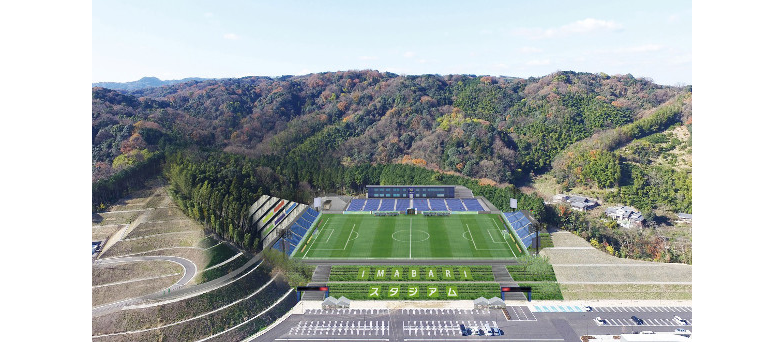
Okada: From the stadium, you'll have a sweeping view of Imabari city and the sea. I truly believe this stadium will one day become a "legend."
Next year, we'll compete in the JFL at this completed stadium. Then, seven years later, we plan to promote to J3 and build yet another new stadium with a capacity of 15,000.
The first step is "IMABARI Stadium." For Imabari citizens who watch games here, it will create a "legend" – "I saw JFL games there. I've been supporting them since then."
When you observe European soccer culture, you always find small, old stadiums that hold only about 5,000 people. Those are the "Legend Stadiums" where the club's first steps were taken. Japan lacks such places. You can't create them without building a team from the regional leagues up.
What I want to do in Imabari is build that kind of local culture from the ground up.
Hayashi: So the fans grow alongside the team, too.
Okada: Until our dedicated stadium was built, we played home games at Imabari City's "Sakurai Seaside Fureai Plaza Soccer Field." There was always this regular customer from a yakitori restaurant who would come. He sewed together many small supporter flags to make a huge one and cheered passionately.
It's incredibly heartwarming to see more local people supporting FC Imabari. Seeing everyone's faces, they're truly vibrant. There are "smiles" there.
Hayashi: So what Mr. Okada is doing in Imabari is sowing the seeds of "smiles," as you mentioned last time, and truly cultivating "invisible capital."
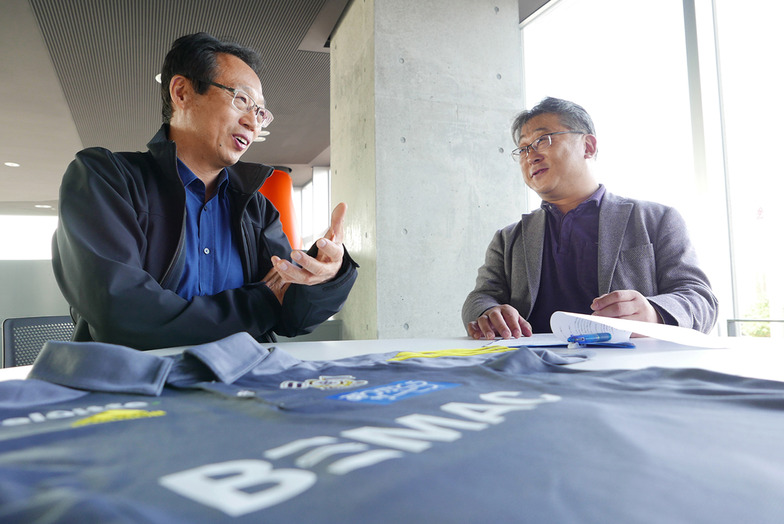
From soccer to environmental education. Questioning the meaning of life and connecting it to the future.
Okada: Actually, what we state in our corporate philosophy at "Imabari. Dream Sports" has nothing to do with soccer at all.
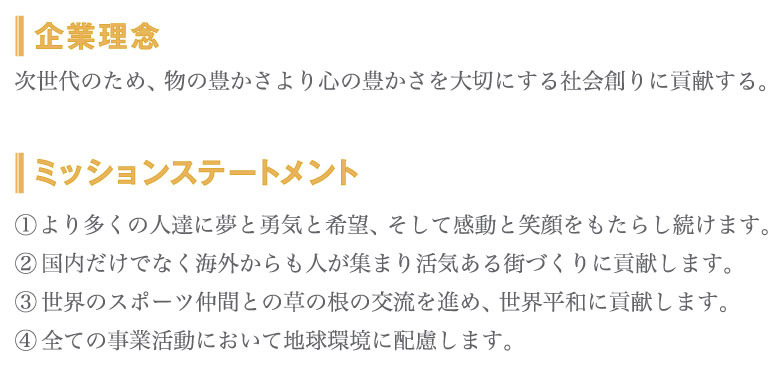
Imabari Dream Sports Corporate Philosophy and Mission Statement
Hayashi: Dreams and hopes, valuing richness of heart over material wealth—it's precisely about that invisible capital.
Okada: While conveying these values through soccer is our main activity, we also do various other things like outdoor experience classes. These are activities that connect to the fundamental human question: "Why do we live?"
Hayashi: You also do environmental education, right?
Okada: Yes. At the Furano Nature School, which forms the foundation of our environmental education program, there is the "4.6 Billion Years: Path of the Earth." This path spans 460 meters, representing the 4.6 billion-year history of our planet. There is a stone monument there engraved with a Native American saying: "The Earth is borrowed from our descendants." The message is: "The Earth is not something inherited from our ancestors; it is borrowed from the children who will live in the future. Therefore, we must not destroy, pollute, or harm it."
Yet, we who are supposed to be civilized people are preoccupied with "today's stock prices" or "the current economy." While the fundamental purpose of life is "to pass on life," humans only think about the present. Our environmental education aims to change that. This philosophy connects to our outdoor experience classes and even the management of our soccer club.
Hayashi: I see. That's a wonderful initiative extending beyond the realm of a soccer club. I hear you have various other projects in the works as well.
Okada: In the "Bali Challenge University" program, where I serve as president, we'll hold a workshop this summer themed "If you were the owner of FC Imabari, what kind of multi-purpose stadium would you build?"
Also, one of our shareholders is a company called "LDH," which has the dance & vocal unit EXILE among its artists. They hold dance training camps, and EXILE member ÜSA proposed a collaborative event combining beach soccer, music, and dance. Through these non-soccer activities, we're increasing the "exchange population" and spreading more smiles.
Hayashi: So with sponsors, you share values around "creating a better future" and "building a better society." As a result, the soccer team gets stronger, more people connect with it, and the sponsors' businesses also improve.
Okada: Japan's economy and society currently feel stagnant. We can't pass the baton to the next generation if things stay this way. Responsible people who sense this crisis should be able to properly share our values.
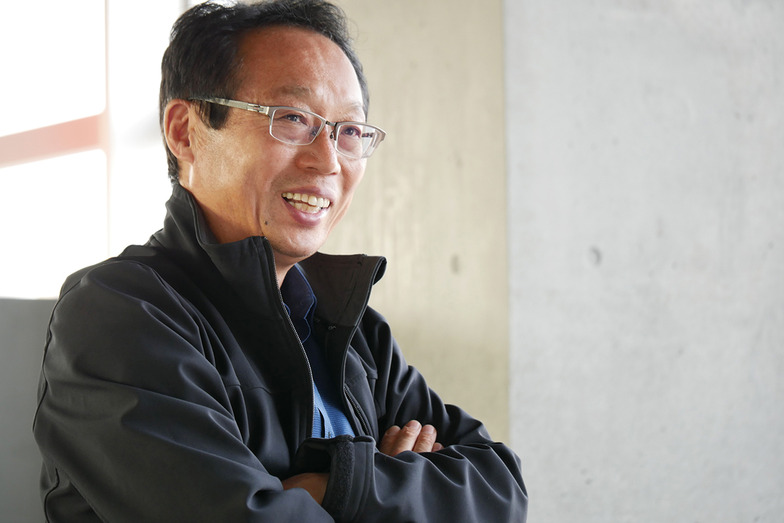
You can only break the mold if you know the mold
Hayashi: Another aspect of your current activities that interests me is the "Okada Method." I understand it's the idea that for Japanese and Asian players to succeed globally, they must consciously focus on "form" (kata) from the developmental stage. This philosophy seems applicable beyond soccer, to nurturing the next generation and education in general.
Okada: I don't know if the "Okada Method" is the right answer at this point. I hear opinions like "We should apply the Okada Method to the Japanese national team," but that's too risky to implement yet.
That's why I'm doing it in Imabari. If it fails, I'll just go bankrupt and that's the end of it. But intuitively, I feel it can work, so I'm pursuing it.
Japanese players are often said to follow instructions well but struggle with anything beyond that. So now, the old way of drilling them is rejected, and people say, "We need to give them more freedom." But I want to ask: what has changed for Japanese players because of that?
Hayashi: So you're saying that focusing on "freedom" as a keyword prevents the development of talent that can compete globally?
Okada: There's a concept called "Shu-Ha-Ri." First, you must master the fundamentals. Then, breaking away from them is essential in development. True freedom doesn't breed free thinking. Only after mastering the fundamentals can breaking them lead to surprising innovations. In that sense, it might apply beyond soccer too.
Hayashi: That's the essence of the "Okada Method," isn't it?
Okada: In soccer development, we often let kids play freely when they're young and only teach tactics around high school age. I think that's backwards. While it's important for kids to experience enjoyment, you must first teach them the fundamental techniques. Then, around age 16, you let them play freely.
I want to take the risk myself to see how effective the "Okada Method" is in a club built this way. That's why I became the owner of FC Imabari.
Hayashi: Are you seeing results?
Okada: It will probably take ten years to see results. We have to start from the very beginning, teaching the kids how to play soccer.
Break the "Form" of Sponsors Too
Okada: What I want to emphasize one last time is this: while it's great for companies to achieve record profits and see their stock prices rise, that's not what people live for.
The role of sports and culture is to offer society hope and dreams, to deliver something bright. That's something economic and business experts can't do. This is where the meaning of supporting sports comes in.
Hayashi: Hearing you speak, I realized that the relationship between sponsors and sports also has long-established "patterns," and breaking those is crucial.
Dentsu Inc. is also paying close attention to FC Imabari's initiatives. We want to reexamine the relationship between sports and companies and discover new value. We must seek out new value for companies that cannot be measured by advertising media or sales promotion alone.
For inquiries regarding FC Imabari, please contact fcimabari@dentsu.co.jp (c/o Dentsu Inc. Sports Bureau).
Was this article helpful?
Share this article


Newsletter registration is here
We select and publish important news every day
For inquiries about this article
Author
Okada Takeshi
Imabari Yume Sports Co., Ltd.
Chairman and CEO
Nobutaka Hayashi
Dentsu Inc.
Executive Officer