
Note: This website was automatically translated, so some terms or nuances may not be completely accurate.
 Experience Design in the IoT Era [1/5]
Experience is shifting from "place" to "time."

Takashi Asaoka
Delight Design Co., Ltd.
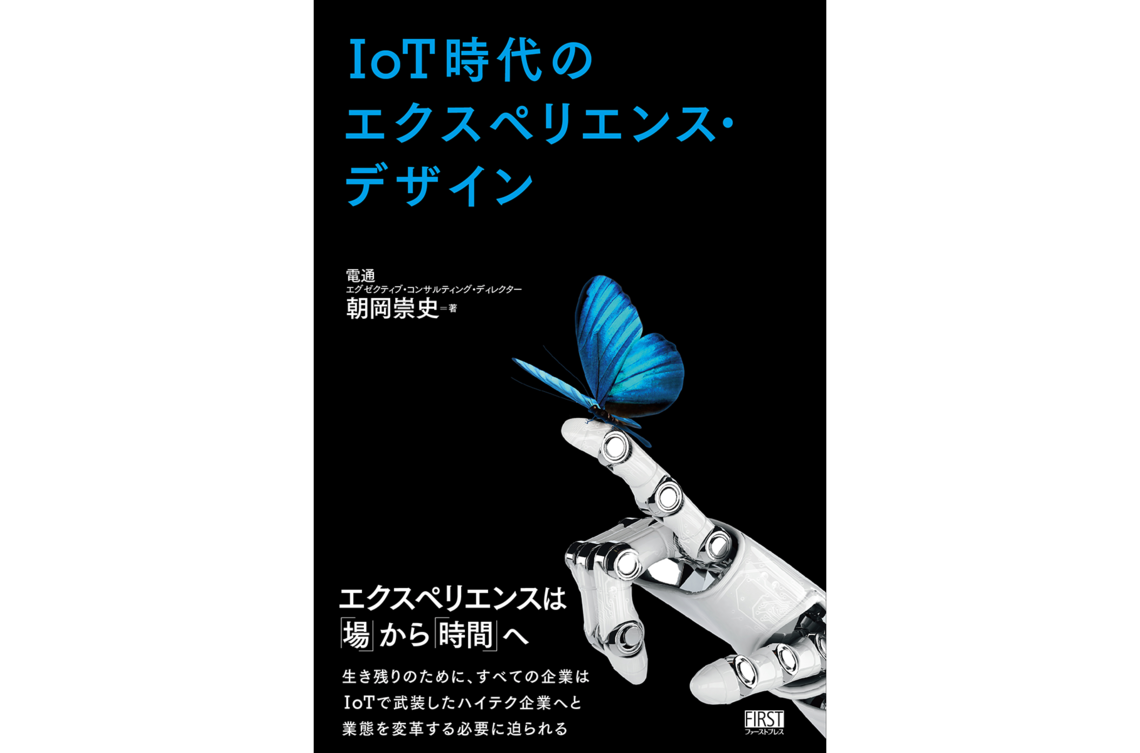
There is no doubt that "IoT" (Internet of Things) and "AI" (Artificial Intelligence) are now among the top search terms. However, while IoT and AI are often discussed from a technology or science perspective out of mere curiosity, serious business-oriented discussions about their impact on corporate operations and marketing are surprisingly rare.
From the perspective of an experience design expert, I boldly tackled this theme in my book Experience Design in the IoT Era (First Press), published on May 18th.
Predicting and Improving Experiences in the Near Future
To state the conclusion upfront: As IoT becomes more pervasive, not only existing service industries but all manufacturing sectors will be forced to transform into new forms of service businesses. This is because the common business premise going forward will be a state where customers and companies remain connected over long periods through data.
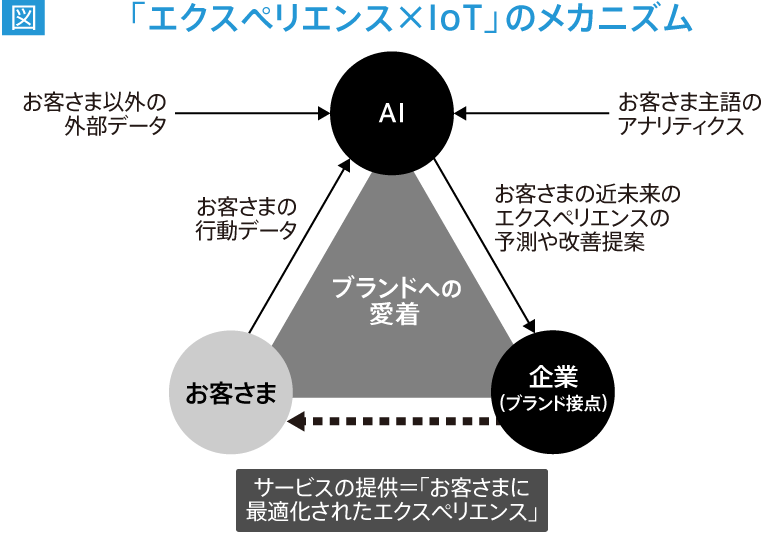
In other words, from the company's perspective, as shown in the diagram below, the core of the services they provide will likely become the continuous prediction and improvement of near-future experiences (brand experiences) through AI-driven big data utilization and customer-centric analytics.
Experience is expected to shift from "place" to "time."
A clear example of this is the "autonomous driving" service. While the exterior of autonomous vehicles currently looks very similar to commercially available cars, they are actually packed with cutting-edge technology in unseen areas that enables this innovation.
Autonomous vehicles centrally manage data through numerous sensors that function as human senses (multi-functional cameras, 360-degree surround-view camera systems, long-range surveillance radar, etc.). This data is sent via the internet to AI, where analytics (thinking, integration, analysis) occur, including external data beyond just the customer. The results are instantly fed back to the autonomous vehicle. This means the driver is constantly freed from the risk of unexpected traffic jams or accidents, allowing them to enjoy a comfortable and safe autonomous driving experience.
Moreover, since the AI has learning capabilities, the accuracy of predicting and suggesting autonomous driving experiences (theoretically) improves over time.
The Key to Corporate Survival: Customer Service That Doesn't Rely Solely on AI
While IoT-era experiences may seem like a rosy future vision, what will actually unfold?
At contact points (brand touchpoints) where companies provide customers with near-future predictions and improvement suggestions as services, we anticipate a situation where pain points (opportunities for customers to become frustrated or disappointed) frequently occur, conversely lowering the quality of the experience.
We'll touch on the reasons for this later, but ironically, the IoT era will demand that companies stay attuned to shifts in customer sentiment more than ever before.
Only companies with the discernment to optimize experiences—by actively designing them rather than delegating customer service entirely to AI—will likely build lasting "affectionate" relationships with customers and ultimately survive as winners in the IoT era.
Simultaneously, companies specializing in advertising and design should not overlook the potential for a comeback here.
Achieving Rich Experiences Through a Thorough Customer Perspective
We stand at a pivotal moment where the fundamental rules of competition between companies are shifting dramatically. The common challenges faced by companies in advanced economies—homogenization and maturation of products and services—cannot be easily resolved by merely adopting IoT technology. Rather, corporate leaders should adopt a backcasting mindset, standing firmly in the customer's shoes and considering how to leverage this disruptive innovation to deliver rich experiences.
In this era of rapid change, the fundamental truth remains unchanged: only those who grasp the essence of change and reshape the rules of the game will survive as winners.
We will be serializing several installments about the book "Experience Design in the IoT Era" in the coming weeks.
Stay tuned.
Was this article helpful?
Share this article


Newsletter registration is here
We select and publish important news every day
For inquiries about this article
Author
Takashi Asaoka
Delight Design Co., Ltd.