
Note: This website was automatically translated, so some terms or nuances may not be completely accurate.
 Experience Design in the IoT Era [2/5]
"Experience 4.0" The Convergence of Experience and Big Data

Takashi Asaoka
Delight Design Co., Ltd.
This time, we will explore the evolution of experience design, focusing particularly on the relationship between digital technology and experience.
In Part 1 of this series, we explained that as IoT becomes fully integrated into corporate business, companies and customers will maintain long-term connections mediated by data. Furthermore, the analysis (analytics) of this behavioral data using AI (artificial intelligence) to continuously "predict and propose improvements for near-future experiences" will become a core element of the services companies provide.
The convergence of experience and digital has generated "new value and habits."
The crucial point here is that IoT and AI are merely "tools." What companies must truly confront is how to design rich experiences (brand experiences) that keep customers feeling attached to the company (brand), based on the premise of utilizing IoT and AI. The best way to escape the trap of homogenization and maturity, both now and in the future, is to continuously refine the experiences provided.
Now, while both IoT and AI are ongoing digital technologies, we must not forget that digital, when combined with experience, creates "new value and habits," disrupting and leveling traditional analog experiences.
Letter × Digital became email; CD stores × Digital became iTunes and Spotify; neighborhood gossip × Digital became Twitter and Facebook; massive shopping malls × Digital became Amazon... the list goes on and on.
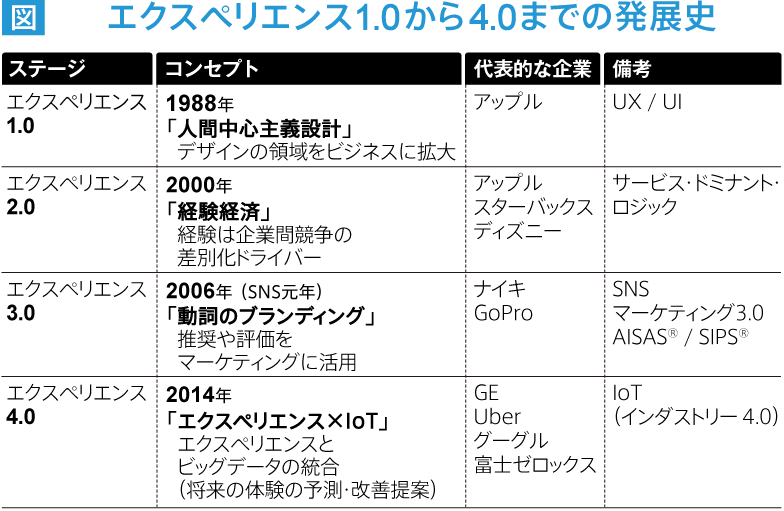
Carefully observing this history of change and organizing its essence chronologically reveals four major stages from the first encounter between digital and experience about 20 years ago to the present. Numbering them from oldest to newest as Experience 1.0, 2.0... allows us to organize them as follows:
- Experience 1.0: 1988– Design domain expands into business
- Experience 2.0: 2000– Experiences become a differentiation driver in inter-company competition
- Experience 3.0: 2006– Leveraging the power of recommendations and reviews in marketing
- Experience 4.0: 2014– Integration of experience and big data
The diagram below summarizes the concepts, representative successful companies, and the ideas and marketing theories born in each stage. Isn't it immediately apparent that the impact of experience on corporate business management has progressively reached a "fortissimo" state (a state of gradually deepening involvement) as the experience stage advances?
Experience 4.0: Shifting from the "Place" to the "Time" Axis
A closer examination of the diagram reveals three further critical insights.
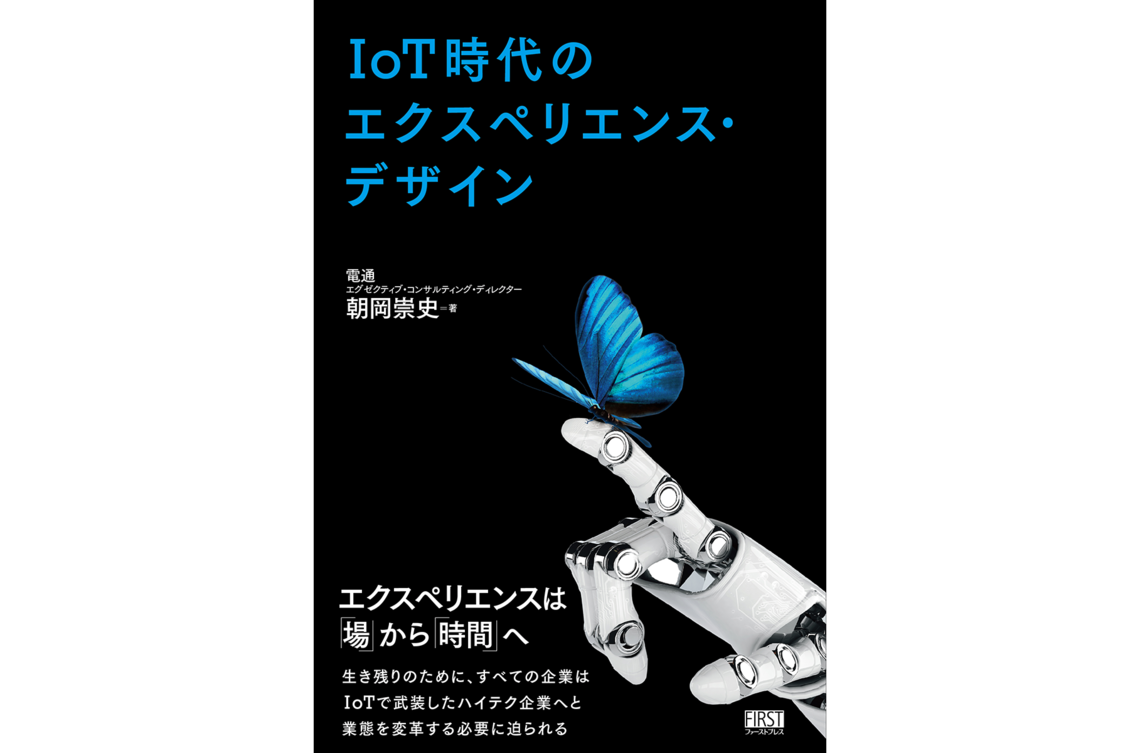
First, while Experiences 1.0 through 3.0 occurred within a limited "space," Experience 4.0 unfolds along a prolonged "time" axis. This aligns with one of the key arguments in my book, Experience Design in the IoT Era.
Consider the brand slogans of successful companies since Experience 2.0: Starbucks' "The Third Place" (providing a third place beyond the office or home) and Disney's "Where Dreams Come True" (a place where dreams come true).
In Experience 4.0, the experiential value a company (brand) commits to should evolve into forms like "time with ◯◯" or "a life with ◯◯."
The second point is that the concepts and marketing theories born in each stage not only remain relevant in the Marketing 4.0 stage but, when combined with new digital technologies, become the driving force behind the continuous creation of groundbreaking experiences.
The concept of "UX/UI" is widely applied not only to PCs but also in areas like smartphones and gaming. Furthermore, the theoretical framework of "Service-Dominant Logic" could be said to have foreshadowed the emergence of the "sharing economy" – exemplified today by services like car-sharing, Uber (private car ride-sharing), and Airbnb (private lodging services) – over a decade ago.
The third point is its direct relevance to corporate business management. Despite the fact that Experience 3.0 began over a decade ago, it remains an undeniable reality that many traditional large corporations have not only failed to fully adapt to this trend but now find themselves forced to rush into addressing Experience 4.0.
This suggests that many large corporations are now compelled to pursue two activities simultaneously (with dual focus): first, shifting the corporate perspective to a customer-centric one and overhauling the entire marketing process; and second, committing to predicting customers' near future and proposing improvements (experience design) based on IoT implementation.
While this may present headaches for corporate executives regarding resource allocation and the level of employee understanding and maturity, survival demands immediate action without delay.
Competitive advantage in the IoT era lies in "speed of learning."
In this era of rapid change, only those who change the rules of the game win in inter-company competition. The approach here prioritizes speed. As Web Dentsu Inc. has repeatedly stated, "Lean Startup" will become the fundamental strategy for future implementation. We encourage you to refer to those articles as well.
In an era where experience becomes the cornerstone of corporate business management, the competitive advantage between companies lies in none other than the "speed of learning."
Was this article helpful?
Share this article


Newsletter registration is here
We select and publish important news every day
For inquiries about this article
Author
Takashi Asaoka
Delight Design Co., Ltd.