
Note: This website was automatically translated, so some terms or nuances may not be completely accurate.
 Experience Design in the IoT Era [3/5]
"Industry Words and Near-Future Roadmap" ---The Changing Definitions of "Industry" and "Competition"

Takashi Asaoka
Delight Design Co., Ltd.
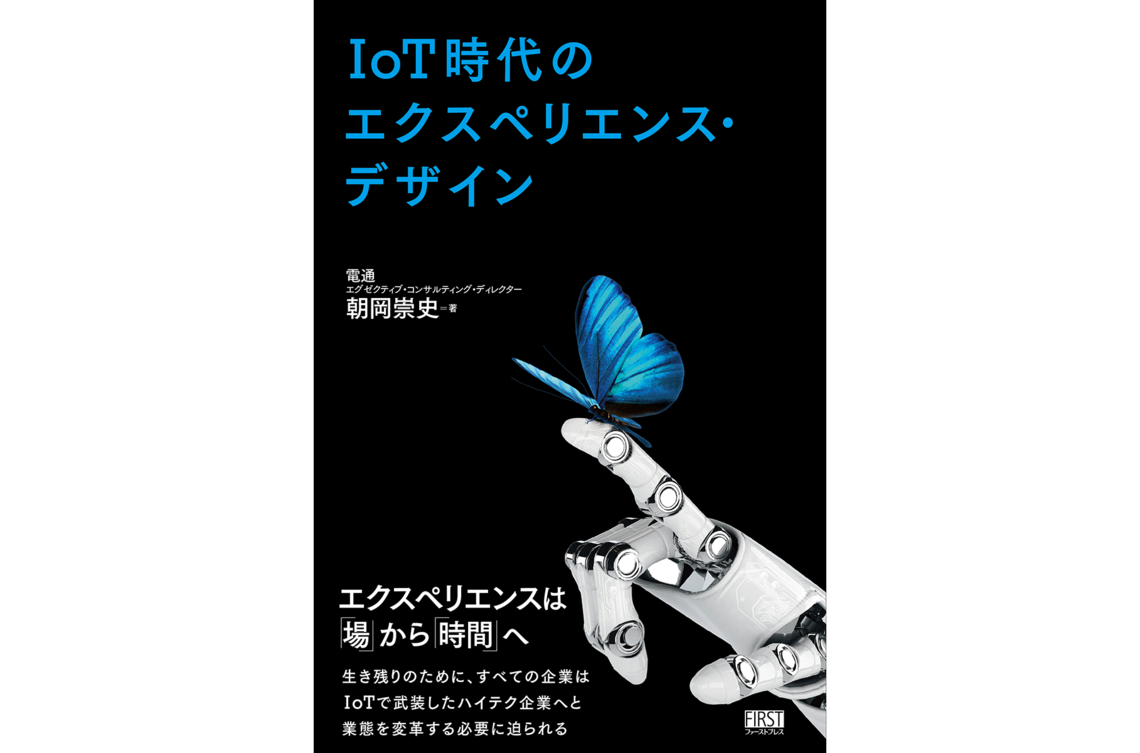
With the adoption of IoT, "Experience 4.0" merges experience with big data analytics, transforming all manufacturing industries into a new type of service industry. Companies must define their near-future "livelihood" from a medium-to-long-term perspective and create a "Near-Future Roadmap" (strategic scenario).
What is a "livelihood word"?
At Dentsu Inc.'s Experience Team, we call the state a company reaches when it overcomes "disruptive innovation," successfully creates experiences customers have never had before, and establishes a unique business model, the "livelihood word." Originally, "livelihood" (なりわい) means one's "occupation" or "bread and butter," signifying the very source of a company's revenue.
The "livelihood word" is the customer-centric translation of the goal described in the company-centric language of a company's mid-to-long-term business strategy. At the Experience 4.0 stage, the "livelihood word" is defined by the company itself, based on deep consideration of the substance of the experiences it provides, integrating the operational use of experience and big data, and in a form that is as easy as possible for customers to understand.
Draw the Near-Future Roadmap Using Backcasting
What should our company's "livelihood" look like after overcoming disruptive innovation? Can our company even survive this wave? The deeper the success of a large corporation today, the more profound this concern likely is for its executives. Here are two critical proposals for those involved in corporate management and marketing activities:
First, establish a clear goal image for the experience your company provides, and anchor this as your "core business word" at the heart of your management and business strategy. Second, to ensure this "core business word" doesn't become a pipe dream, backcast from the goal to identify necessary actions and create a clear "Near Future Roadmap."
Often, the more reputable the large corporation, the more inclined it is to proceed extremely cautiously using a forecast-based approach, carefully assessing customer needs, competitor movements, and its own technological capabilities and available resources. Unfortunately, this approach not only fails to keep pace with the speed at which "disruptive innovation" driven by Experience × IoT is advancing, but also inevitably leads to significant energy loss when considering the twists and turns likely to occur due to various factors.
The strategy to adopt is to aim for the realization of "livelihood words" as the goal, using a backcasting approach, as illustrated in the diagram below.
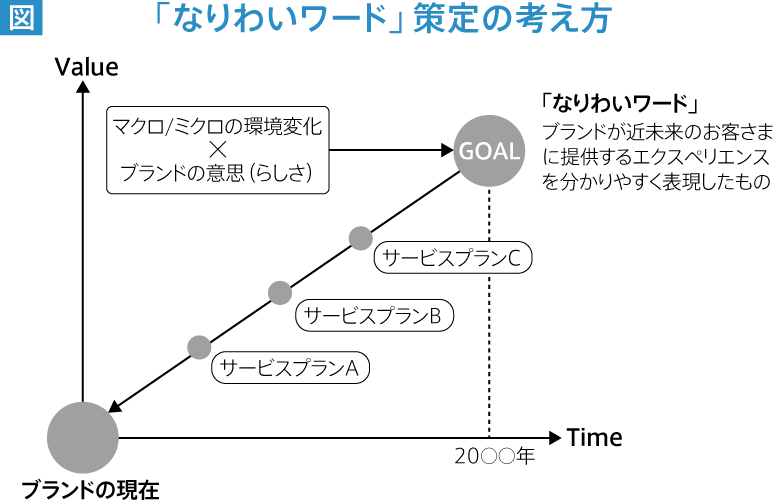
Regarding methods for creating "livelihood words," there is the "Future Experience Innovation Program" developed by the Dentsu Inc. team.
Creating "livelihood words" is an extremely important project that determines the future (growth potential) of a company's business. It should be advanced by gathering internal wisdom, selecting a cross-organizational task force team, and building consensus through workshop-style sessions.
The project progression consists of four steps: "Form the task force team," "Conduct macro and micro environmental analysis from a future perspective," "Analyze brand identity and determine the company's direction," and "Compile the livelihood words and create a near-future roadmap." For specific methodologies and procedures, I would be grateful if you could refer to my book, 'Experience Design in the IoT Era'.
The concepts of "industry" and "competition" will also change
At the same time, it is important to note that defining the "livelihood words" and conceptualizing the experiences a company provides from the customer's perspective also changes the traditional concepts of "industry" and "competition."
For example, let's examine the "livelihood" arena of "autonomous driving services that guarantee safety and security."
Not only IT giants like Google and Apple, or renowned "automakers" from Japan, the US, and Europe, but also venture "electric vehicle manufacturers" like Tesla, "automotive parts manufacturers" like Continental and Bosch, and "electronics manufacturers" like Hitachi are fiercely competing. They form a broad "industry" centered on "autonomous driving services" and are locked in a battle for dominance as "competitors."
Considering the scale and speed of development investments in cutting-edge technologies, M&A, and corporate alliances, it's clear that even "automobile manufacturers" – whose core business offers the highest synergy with this field – hold no optimistic outlook on this fierce competition.
On the new "business" playing field, a company's original origins (what industry it came from) become almost meaningless over time. Victory or defeat will be decided solely by the quality of the experience that company (brand) creates, while strongly conscious of its new "competitors."
Needless to say, it is none other than the company's (brand's) "customers" who make that judgment.
Was this article helpful?
Share this article


Newsletter registration is here
We select and publish important news every day
For inquiries about this article
Back Numbers
Author
Takashi Asaoka
Delight Design Co., Ltd.