
Note: This website was automatically translated, so some terms or nuances may not be completely accurate.
 Experience Design in the IoT Era [4/5]
Experience Optimization (Optimization) ---Resolving the "pain points" arising from direct interaction with AI The Four "S"s
Takashi Asaoka
Delight Design Co., Ltd.
The goal of marketing in the Experience 4.0 world is for service (brand) providers to establish a division of roles and a specialized work system between AI-driven "knowledge" accumulation and human "consciousness" capabilities, after discerning the characteristics of each. Furthermore, it involves fine-tuning to enrich the experience. This activity is not a one-time effort; it continues perpetually as long as the company (brand) provides services.
An era demanding corporate creativity is approaching
The role of humans within companies in Experience 4.0 is to continuously optimize the experience at customer touchpoints, centered on "new ideas and value" that AI cannot generate.
Translating this to inter-company competition means a company's competitive advantage will be determined by its ability to design experiences—in other words, its "creativity." Right-brain thinking and the breakthrough power of ideas will become the drivers of corporate differentiation.
Let's consider what constitutes "new ideas and value" unique to humans.
So, what are these uniquely human "new ideas and values" that AI cannot replicate?
I particularly focus on four "S" concepts: "Sense," "Serendipity," "Sustainability," and "Security."
"Sense" means thoughtful responsiveness. It involves sensing the subtleties of customer emotions and facilitating smooth communication between the computer and the customer. Humans inherently possess a fundamental desire to receive external information in a way that aligns with their own values, sensibilities, and aesthetic sense. This is why we feel frustration when faced with over-interference or, conversely, when timely advice is lacking when we need it. In communities like Japan, with its unwritten culture of "reading the air," the tendency to seek "Sense" becomes even stronger.
"Serendipity" means stumbling upon unexpected luck or discovering something unforeseen. I believe serendipity represents the most essential value of the digital society. Readers have likely experienced this: finding information online that proves far more useful than anticipated, or discovering an unexpected bargain while browsing an e-commerce site.
Serendipity never arises solely from logical data analysis or repetitive learning. If there is a chance to seize it, the will to obtain it is paramount. Louis Pasteur, the 19th-century biochemist and bacteriologist famed for inventing vaccines, left behind the adage: "In the realm of observation, chance favors only the prepared mind." In other words, serendipity doesn't happen unless you set out on the journey. One could also consider serendipity a reward for human active curiosity.
"Sustainability" is an English term meaning "capable of being sustained" or "maintained over the long term." It is interpreted as efforts to make the world sustainable from three perspectives: environmental, social, and economic. From a corporate standpoint, it means that a company not only continues to generate profits through its business activities but also maintains the potential for future business continuity by fulfilling its social responsibilities.
Pursuing the concept of "sustainability" ultimately leads back to the "Nariwai Word" concept discussed in Session 3: what kind of experience a company wants to provide its customers in the near future. In Experience 4.0, all industries become service industries. The goal for companies will no longer be simply selling their services, but rather how customers feel after the sale.
It is foreseeable that there will be cases where a company's short-term sales and customer happiness are not necessarily compatible. This is an area that must be overcome through "new ideas and value propositions unique to humans."
Regarding "security," it's essential to consider what customers need from their perspective. While information security is fundamental, themes like "traffic safety" featured in autonomous driving services and the increasingly newsworthy "food safety" (food security) are directly linked to customer "trust" and thus closely tied to experience.
A major problem lies in the fact that the mechanisms supporting security for "information," "food," and "transportation" are black boxes invisible to customers. While it is fundamental for companies to guarantee various forms of "security," it is equally important to conduct grassroots awareness campaigns about these issues, similar to the public health and traffic safety education campaigns during the high-growth era. Simultaneously, efforts must be made to visualize these mechanisms as much as possible, ensuring customers truly understand and accept them. When security-related issues occur, they carve deep pain points into the customer experience. Ultimately, it is the company itself that suffers fatal damage.
The Relationship Between the Four "S"s and "Humanity's 16 Basic Needs"
Meanwhile, Steven Reiss, Professor of Psychology and Psychiatry at Ohio State University, claims that humans have "16 Basic Human Needs" based on research involving over 6,000 subjects (Know What You Truly Want: The Ultimate Self-Discovery Through 16 Needs Profiles, Kadokawa Shoten, translated by Setsuko Miyata, 2006).
Figure 1 classifies Reese's "16 Basic Needs" into a 2×4=8-cell matrix based on Active/Passive, Physiological Perspective, Economic Perspective, Sociological Perspective, and Cognitive Psychological Perspective, linking them to the four "S"s.
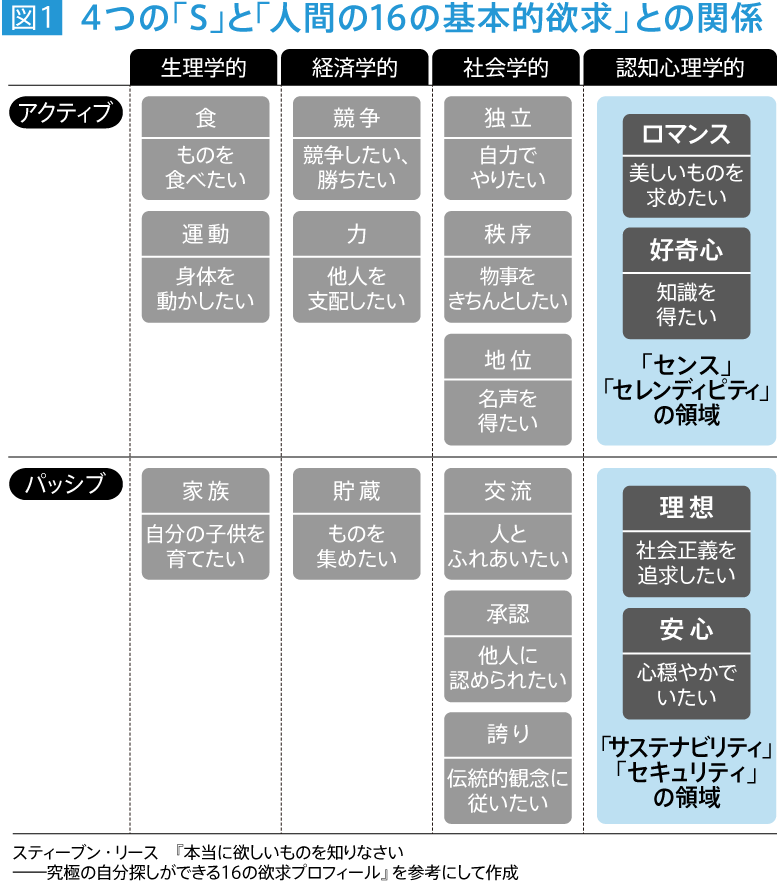
Organizing them this way makes it immediately clear: "Romance" (desire for beauty), strongly related to "Sense" and "Serendipity," and "Curiosity" (desire for knowledge) belong in the Cognitive Psychology × Active cell. "Idealism" (desire to pursue social justice), strongly related to "Sustainability" and "Security," and "Security" (desire for peace of mind) belong to the cell directly below, Cognitive Psychology × Passive.
This suggests that while AI may be able to satisfy physiological and economic desires through repeated learning, its ability becomes questionable when it comes to sociological desires, and it is highly likely that it cannot cover cognitive psychological desires.
This offers hints for business model transformation in the advertising and design industries.
Based on the four "S" concepts for experience optimization and the "Experience × IoT" mechanism discussed in Part 1, Figure 2 reorganizes the ideal relationship between customers, AI, and companies.
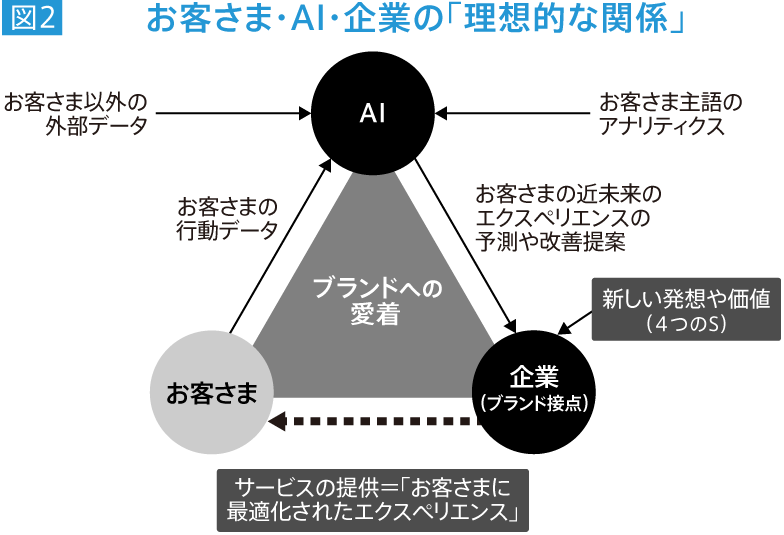
By skillfully managing the four "S"s – "Sense," "Serendipity," "Sustainability," and "Security" – at every brand touchpoint and optimizing the experience, companies can cultivate "affection" with their customers.
One final point: Crafting rich experiences by skillfully blending these four "S" elements demands exceptionally high creative capability. While companies can certainly tackle this internally by establishing specialized departments like a Chief Experience Officer (CXO) or an Experience Promotion Division, it's also plausible that new specialized groups, highly skilled in customer insights and creativity, will emerge. As mass communication declines, the path forward for the advertising and design industries may well lie in the realm of experience design.
Was this article helpful?
Share this article


Newsletter registration is here
We select and publish important news every day
For inquiries about this article
Back Numbers
Author
Takashi Asaoka
Delight Design Co., Ltd.