
Note: This website was automatically translated, so some terms or nuances may not be completely accurate.
 The "Specialized Talent" That Will Transform Your Company [6/7]
Learning from "Hobonichi": How to Empower Individuals and Scale Organizations (Part 1)
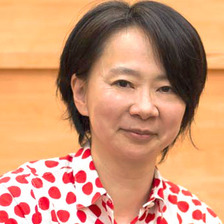
Makiko Shinoda
Tokyo Shigesato Itoi Office
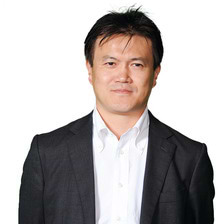
Junichi Kanno
Across many areas of corporate activity, it has become commonplace to recruit specialized talent externally for business growth and transformation, as cultivating such expertise internally can be challenging. In this series, we visit individuals active at the forefront of various fields to gather insights on developing and utilizing specialized talent. This time, we spoke with Makiko Shinoda, Director and CFO of Tokyo Itoi Shigesato Office, which operates the "Hobonichi Itoi Newspaper," celebrating its 18th anniversary on June 6th. What is the secret to expanding the organization's scale while ensuring each staff member, referred to as a "crew member," works with vitality?

What are the characteristics of Hobonichi's business?
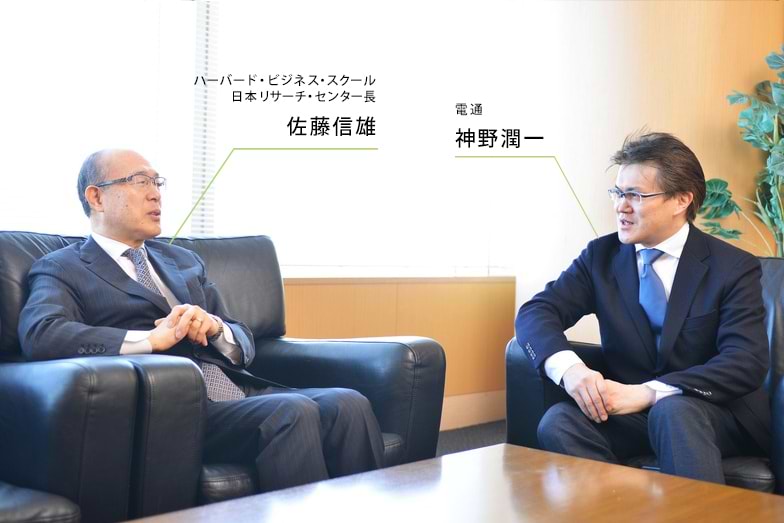
Kanno: Actually, Ms. Shinoda and I were classmates in business school. After returning to Japan, she worked at McKinsey, then moved to Novartis Pharma, and later joined Nestlé following a business unit acquisition. I was surprised to hear she then joined the Itoi Office.
Since you often appear in media discussing management, organization, and career paths, I'd love to hear about that too. But today, as the head of the management division at "Hobonichi" – an organization where each individual works freely while maintaining a strong collective identity – please tell us what you focus on in your daily work. How many years have you been with the company now?
Shinoda: I joined in October 2008, so this is my eighth year. While my title is CFO, as the head of the management division, I also oversee HR and recruitment.
Originally, I joined the Long-Term Credit Bank of Japan right after graduation. I moved from what you might call a quintessentially Japanese company to a foreign firm, and now to a small Japanese owner-managed company. As a result, I've ended up experiencing quite a variety of workplaces.
Kanno: When you mention "Hobonichi," it's famous not only for its website but also for its popular original products. I assume the planner you're carrying today is the " Hobonichi Techo " (laughs), but what about that shirt?
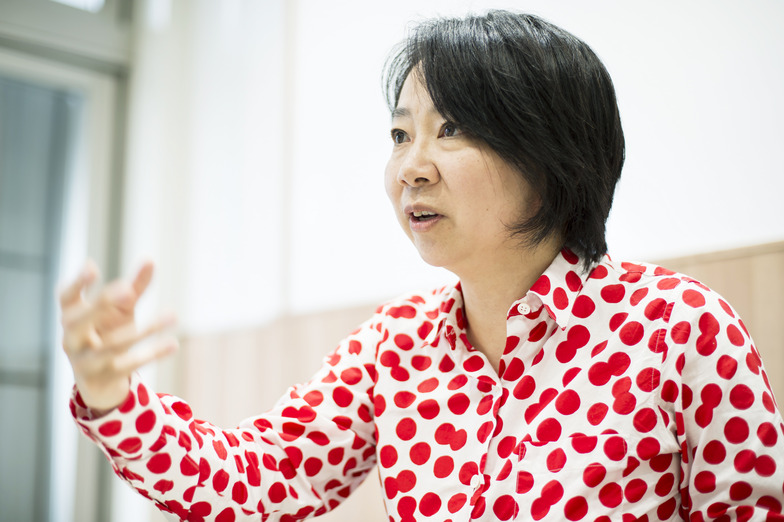
Shinoda: Yes, it's the "Mizutama Shirt" from the " hobonichi + a. " brand, created with illustrator Ayumi Ohashi.

Kanno: You operate across a wide range of businesses, from media to developing and selling original products. On the other hand, maintaining Hobonichi's strengths—its diversity and vibrant feel—while expanding business scale and building organizational structure seems like a difficult challenge, as they can be contradictory. Could you tell us how you view Hobonichi's business and organization?
Shinoda: Hobonichi's business model involves creating a "space" where people want to visit by publishing original content on our web media, and then selling original products within that space. In other words, it's a pure B2C business conducted online. Precisely because of this structure, I don't think it necessarily requires a traditional pyramid-shaped organizational structure.
What I mean is, since it's a web-based business, everyone in the company—not just the responsible staff—can instantly see how much our content or products are being read or sold right now. We also have a single email address for inquiries and feedback, so there's no way for the responsible staff to hide anything. Furthermore, in recent years, we can also see reader reactions in real time on social media. We work in an environment where the results of our work are immediately visible, and they're seen not just by colleagues but by the world.
Another defining feature is that it's a B2C business. In B2C, everything about us—our beliefs as creators of content and products, even the very nature of our organization—transmits to the recipient with an almost frightening clarity. Conversely, this becomes a kind of intangible flavor or personality that doesn't show up in metrics, yet brings people joy. That's the nature of this work.
Project Management Methods Practiced at Hobo Nikkan Itoi Shinbun
Kanno: Among various B2C businesses out there, the distance to customers is exceptionally close.
Shinoda: That's right. The reactions of our readers and product users motivate our work and become the source of our next ideas. This type of business suits a flat organizational structure where crew members who directly receive end-user feedback can then proceed with the next project. In that sense, I think the necessary organizational setup and operations differ significantly from other BtoC businesses, such as those selling through wholesalers.
Kanno: I recall reading an article describing Hobo Nikkan as a place where "the person who proposes an idea becomes the 'owner' and driver of that project, with everyone around them contributing ideas and support." Currently, you operate without strict role division, where the person who proposes an idea takes full responsibility end-to-end, right?
Shinoda: We're really hanging in there on that front (laughs). I'm not entirely sure how long we can keep it up.
Kanno: Normally, even if a staff member proposes an idea, the person responsible would be someone in a leadership role, like a director, right? If instead, even a newcomer can become a project owner, doesn't that lead to differences in the quality of work?
Shinoda: If no one else is involved, that would definitely be the case. There's naturally a gap between someone with 18 years at the company and someone with just three months, from project management skills to understanding Hobonichi and understanding the audience.
But fundamentally, whether it's our content or products, we aim to provide "things that bring joy and move hearts in daily life." That means our ideas come from everyday experiences, the sensations and discoveries within them. In that sense, regardless of skill or tenure, we're all equal as people living those lives.
Building on that foundation, everyone collaborates to maintain quality in our operations. Consider this hypothetical example: someone in administration with no planning or design skills, but who loves cooking as a homemaker. While taking various classes, they think, "It would be great if there were content from this cooking instructor." They share this idea with others, and if multiple people like it, that idea has gained "customers."
Then, that person takes that fact and consults with someone skilled in planning. If the plan is deemed viable, they'll expand on it, saying, "This is how we can make it happen." In this case, the actual ownership of the plan shifts to the planning person at that point, but the originator remains involved as the initial customer. They serve as a constant test user within the project, preserving the purity of the original motivation.
Kanno: I see. So the originator's role is to preserve the purity of the motivation, separate from ensuring the quality of the work. Is there a specific mechanism to make this process run smoothly?
Shinoda: There's a basic step of getting internal feedback before reaching a certain level of completion, but even before that, there's constant cross-functional oversight. Our company does a random seat draw every four months. Plus, we have a communal lunch every Tuesday where everyone eats together. These random opportunities to chat with different people mean we naturally understand what everyone else is working on.
This makes it easier for both individuals and the team to notice early on if "this project might be missing something?" or for interpretations like "this is what this means, right?" to come up in everyday conversation. So, even when less experienced people are in charge, it's rare for something to deviate significantly from the intended direction before it's noticed.
What kind of organization can keep generating ideas?
Kanno: It's wonderful that anyone, regardless of department, has the potential to realize what they want to do. However, doesn't that kind of flexibility and flatness become difficult to maintain as the organization grows larger?
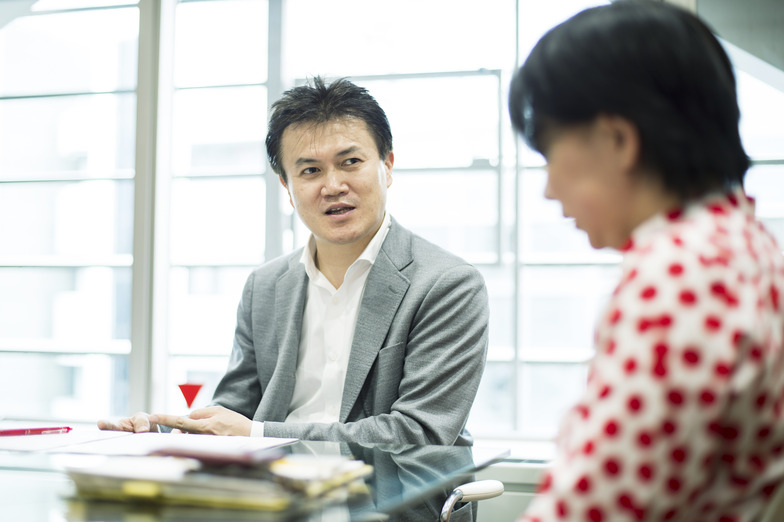
Shinoda: It certainly isn't easy. But while I can't speak to the flexibility of roles, there is a model for scaling an organization while maintaining flatness: Recruit's media business. I heard that back then, the coupon magazine "Hot Pepper" was produced regionally. A single salesperson handled everything from planning and taking orders to creating articles, and sometimes even followed up on billing. The entire workflow handled by one person was bundled under, for example, the Hiroshima Hot Pepper Editorial Department.
This was replicated across all regions nationwide. It's a flat organizational structure where an individual's role mirrors the entire organization. The ability for one person to handle all the functions necessary to deliver value to the customer is a unique characteristic of media businesses. They leveraged this while scaling both the business and the organization. While their business model is completely different from ours, I believe the fundamental organizational structure is similar: it's a media business, and the individual's role mirrors the whole.
In contrast, consider traditional manufacturing businesses and their structures. Compared to media businesses, manufacturing must rapidly achieve scale to generate profits. To do this, they divide the organization by function—R&D, manufacturing, sales, after-sales service—enhancing each function's expertise to grow the whole quickly.
Dividing the organization by function places an enormous burden on top management to integrate these parts. Employees below the top level only understand a very small part of the various functions required to deliver value to the customer. To integrate such businesses and organizations, tools like top-down command structures, rules and regulations, and budget management frameworks become necessary... that's my understanding.
Kamiya: Having worked at a manufacturer, you probably have that firsthand experience.
Shinoda: Yes, I was at the bottom of the hierarchy in a European global manufacturing company. Rules and orders came pouring down from above every single day. Back then, that was the only management style I knew. But as I gained experience at Itoi Office, I came to understand that different businesses require different approaches to organizational management, different tools, and different expectations for their people.
This might be stretching the point a bit, but I believe businesses where the value lies in moving users' hearts through ideas aren't limited to media or B2C like ours. Professional firms are like that too, and even appliance manufacturers probably are.
Take Balmuda, a Japanese appliance maker whose toaster is hugely popular. We featured Itoi in a dialogue with Balmuda's president on "Hobonichi" and sold their products through our mail order. But Balmuda isn't selling technology itself. The true value lies in the concept: "What kind of life would bring joy?" They develop technology to realize that. Ideas that move hearts are the source of intrinsic value. Businesses rich in ideas delight customers and also become more attractive workplaces from the employees' perspective.
Furthermore, it's not true that ideas from senior management are always good while those from staff level are always bad. Creating a dedicated department just for generating ideas also doesn't make much sense. Realizing ideas requires mobilizing every function of the business. Even if the company tries to implement ideas from specific roles or departments, moving a functionally divided organization is quite difficult. In this way, running an idea-rich business doesn't always mesh well with traditional organizational structures, and I imagine companies are all experimenting and learning.
Kamiya: What you just said is incredibly insightful. I often speak with many manufacturers myself, and I feel this is a challenge they all face. We're in an era where manufacturers won't survive unless their fundamental role shifts from simply making things to creating the "nice-to-haves" within people's lives. It's also about prioritizing the customer perspective.
The Secret to How Hobo-Nichi Balances Authenticity and Diversity
Kanno: When I was involved in launching a new business, I had some insights about organizational size and rules. A company that started with about 40 people grew to around 200 in about three years. When it was 40 people, to put it bluntly, we didn't really need written rules; we operated like a family, held together by "common sense." Around 80 people, you start wanting rules. By 200, it felt like we had become a proper company organization (laughs). I had this sense that as we created rules, the company was shedding its private organization skin to become a public one.
At "Hobonichi," it's also characteristic how you liken the organization to a ship and refer to staff as "crew members." How many crew members are there in total now?
Shinoda: Including part-timers, about 80 people. Even in areas where rules weren't needed before, situations are starting to arise where we realize, "Yeah, we really need a rule here." It feels like growing pains.
Even so, if we're going to invest the same energy, I'd rather direct management efforts toward instilling the underlying principles and why they matter, rather than just creating rules and enforcing them. Since our business creates value only when content directly connects with its audience, if individuals don't truly understand the principles and make judgments based on them—not just superficially—we'd quickly become unsustainable.
Kamiya: Merely creating rules and enforcing them won't build a truly cohesive organization. The depth of understanding of core principles might be one checkpoint for expanding while maintaining individuality. What approaches are you taking to ensure these principles are truly internalized?
Shinoda: Itoi's communication plays a major role. The most important is the "Wednesday Meeting," where Itoi speaks for one to one and a half hours each week to the crew about what he's thinking at that time.
Kanno: Really? An hour every week must be quite demanding, isn't it?
Shinoda: Yes. There are times when Itoi has a lot he wants to share with everyone, and other times when he doesn't. Sometimes, you can actually see him looking a bit down the day before (laughs). He himself says the most exhausting part of being president is the Wednesday Meeting.
But at the same time, he says this is the work he values most. It's the place where he continuously shows employees how much he's grown as president over the week. Through this, everyone learns the way of thinking at Itoi Office.
Additionally, there's Itoi's daily column "Today's Darling," published exclusively on Hobonichi for one day only. While it's aimed at readers, for employees, it means the president's messages span 365 days a year, 18 years' worth. In that sense, it's the source of Hobonichi's cohesion. Even someone with incredible creative talent probably couldn't endure it if they didn't resonate with Itoi's messages.
Kanno: I see. That clears up a question I had while listening to you talk about how projects are run earlier. Everyone freely generates ideas based on their own consumer perspective, yet the individual projects don't become disjointed. They cultivate a perspective on what constitutes "Hobonichi-ness" or what is appropriate for Hobonichi to release to the world. That's certainly not unrelated to these efforts.
In the second part, we'll continue exploring Itoi's approach to "verbalization," delving broadly into evaluation criteria and hiring practices at Hobonichi.
Was this article helpful?
Share this article


Newsletter registration is here
We select and publish important news every day
For inquiries about this article
Back Numbers
Author
Makiko Shinoda
Tokyo Shigesato Itoi Office
Director and Chief Financial Officer