
Note: This website was automatically translated, so some terms or nuances may not be completely accurate.
 ADWASIA 2017 Report [5/6]
How did the J.League achieve its revival? Key figures reveal the driving force behind digital transformation.

Advertising Week Asia 2017
Advertising Week, the marketing and communications festival that made its Asian debut last year, returned to Tokyo this year as Advertising Week Asia 2017. From May 29 to June 1, Tokyo Midtown hosted four days of events centered around broad themes like brands, media, and technology, gathering top executives and CMO-level leaders from around the world. Partner companies and organizations increased from 50 last year to 64, with approximately 13,000 attendees.
On July 20, 2016, J.League news dominated the front page of the Nikkei newspaper. The league had signed a 10-year broadcasting rights contract with the UK sports live streaming service DAZN, starting in 2017. The contract value was approximately ¥210 billion, translating to about ¥20 billion annually, more than doubling the J.League's yearly revenue. Mitsuru Murai, who became J.League Chairman in 2014, stated, "Overseas internet streaming companies were paying attention to the J.League's movements." Murai, who elevated the J.League's profile, revealed his strategy.

Two Key Approaches: Player Development and Branding
Launched in 1993, the J.League now operates three tiers from J1 to J3, expanding its reach to 54 clubs nationwide. However, recent years saw a decline in attendance and interest across the board. Comparing 2008 and 2012, interest levels dropped for all genders and age groups. Interest among men, previously around 40%, fell to the 30% range, presenting a serious crisis.
Mr. Murai assumed the role of Chairman at this critical juncture. While he had played soccer in high school, his subsequent career was long with Recruit Holdings, where he served as President of Recruit Agent and Executive Officer of Recruit Holdings. Concurrently, he became a J.League Director in 2008.

"When I became Chairman in January 2014, we were caught in a downward spiral: sponsorship and broadcasting rights revenue kept falling, top players were moving to overseas leagues, and attendance was declining. Low revenue meant we couldn't invest in the future. If this continued, we risked eventually losing the ability to even produce players for overseas leagues."
To assess the situation and turn this downward spiral into an upward one, Murai focused the J.League's reforms on two key areas. First, developing players who would carry the league's future and enhancing the J.League's appeal. Second, widely communicating that appeal and building the league's brand.
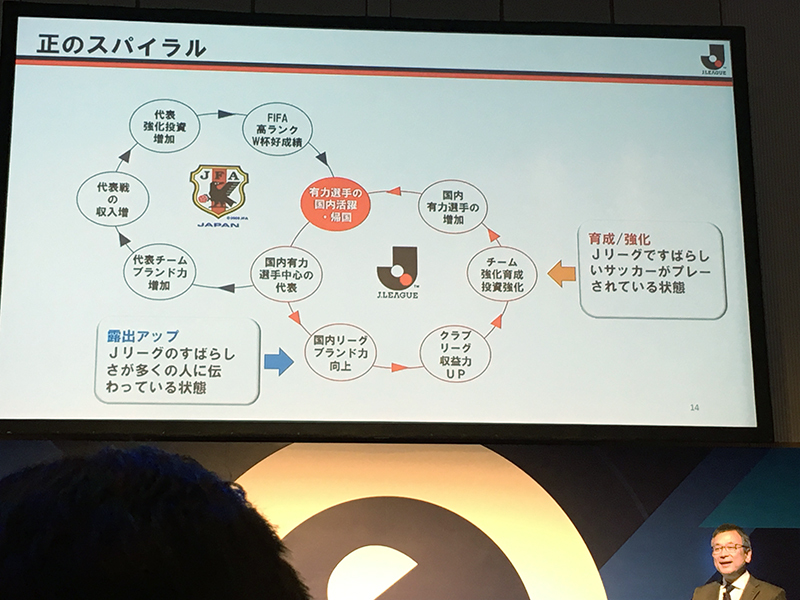
So, what specific measures would implement these goals? Murai held numerous all-night meetings with executives and established the following five strategic directions:
1. Attractive Football (including development and strengthening)
2. Utilizing digital technology (including increased exposure)
3. Regional revitalization centered around the stadium
4. Asian strategy
5. Cultivating management talent
The "J.League × Captain Tsubasa" YouTube video generated a huge response
Regarding digital technology utilization in particular, Mr. Murai reflects, "Amidst the highly diverse management challenges faced by over 50 clubs, digitalization was arguably the only common challenge."
After becoming Chairman, Murai visited every club nationwide. He met with mayors at each location and even visited pubs where supporters gathered to listen to their perspectives. He discovered that not a single club had a dedicated digital engineer. This meant, for example, that to improve a club's search engine ranking through SEO, they had to rely on their parent company. Even if they wanted to strengthen e-commerce security for safe ticket sales and merchandise sales, despite the need, they lacked the means to do so. Even as new technologies emerged constantly on social media and apps, clubs were stretched thin just managing weekly matches and couldn't adopt them.
"So, here's our proposal. The league headquarters will handle all the backend design. Then, wouldn't it be great if all 54 clubs could easily utilize the data, upload photos and videos, and enhance communication?" Remarkably, all stakeholders unanimously approved it.
First, they invested their "hard-earned money" to promote the introduction of a "tracking system" in the stadiums of the 18 J1 League clubs. Using missile tracking technology, it tracks the movements of all players, the ball, and the referee during matches, enabling the collection of various data, including players' running distance and speed. This was implemented starting from the 2015 season, with live tracking beginning for every match.
This naturally has a significant impact on player development and strengthening. "While it's a tough time for players because every movement is visualized through data, in the business world, it's standard practice to run PDCA cycles based on facts. Now, the same is possible in soccer."
A key factor behind the bold investment in digital was this event. Starting in March 2014, shortly after taking office, as part of branding efforts, multiple "J.League × Captain Tsubasa" videos were uploaded to YouTube. These featured J.League players recreating techniques from the manga "Captain Tsubasa." The videos became unexpectedly popular, and fans began uploading their own videos imitating the techniques.
※ "J.League × Captain Tsubasa" #2: Counter-Kick Speed Cannon. It garnered approximately 4 million views in one week.
"We realized that even a simple idea and easy-to-use tools like a handheld camera, when uploaded to media, could generate such a huge response. This video became a driving force behind our decision to dramatically accelerate digital investment in our three-year plan starting in 2016."
Around the same time, in November 2015, they partnered with Yahoo. As a partner in the digital communication domain, they primarily collaborate on promoting PR initiatives via the internet. Furthermore, in April 2017, they partnered with Rakuten for their online retail business, seeking cooperation in logistics and delivery.
Stadium as a Disaster Prevention Hub
Another theme that has significantly developed since Mr. Murai's appointment is regional revitalization centered around the stadium. Specifically, this involves giving the stadium entertainment value and assigning it the role of a regional disaster prevention base. The Suita City Soccer Stadium, home to Gamba Osaka, opened fully in 2016. It pursues advanced entertainment features, such as using Panasonic technology to project mapping onto the pitch during halftime. Furthermore, it generates its own power via solar panels and has ample toilet facilities, a critical issue during emergencies. This was facilitated by funding the entire ¥14 billion construction cost—without any taxpayer money—through private donations and Toto lottery grants.

"Japan faces a declining birthrate and aging population, leading to fewer car drivers. This necessitates urban hubs accessible by train, featuring integrated shopping malls and other amenities. We believe that working with local governments and citizens to revitalize the region, not just focusing on raising the level of soccer competition, will lead to the future revitalization of the J.League."
Opening data to local entrepreneurs and marketers
So, what results have these initiatives yielded so far? Regarding enhancing the J.League's appeal through player development, multiple metrics like total goals and shots per match have improved. "What particularly pleased me was the 20% increase in comeback wins. The 7% rise in goals scored in the final 15 minutes reflects teams fighting until the very end."
Furthermore, the significant increase in sessions on the J.League website, along with reach and impressions on Facebook, Twitter, and other platforms, clearly indicates that efforts to communicate the league's appeal are succeeding.
These improvements are clearly reflected in actual attendance figures. After stagnating around 9 million for a long time, attendance reached 10 million in 2015 and further increased to 10.33 million in 2016, showing an upward trend.
Then came the deal with DAZN mentioned at the outset. "The UK-based Perform Group, which operates DAZN, thoroughly analyzed and concluded that the Japanese are unparalleled sports enthusiasts," said Mr. Murai. "Considering the future shift to multi-device usage, digital platforms enabling anytime, anywhere viewing are a perfect match for live sports streaming." This represents the first time such significant investment has been made in Japan's sports industry. The plan is to leverage global attention to ultimately expand league operations.
Finally, Murai outlined two future strategies. The first is the "Smart Stadium Initiative." By digitizing stadiums, data collected will be provided free of charge to local entrepreneurs and marketers, fostering innovation and industrial development. The second is leveraging Japan's strength to establish Asia as the third major hub for football. Currently, partnerships are underway with leagues in 10 Asian countries, including Thailand and Vietnam, facilitating player and coach exchanges and supporter interactions. "We want to cooperate to achieve self-funding, raise the level of Asian football, and encourage active investment from outside," Murai stated in his outlook.
Was this article helpful?
Share this article


Newsletter registration is here
We select and publish important news every day
For inquiries about this article
Back Numbers

Author