Note: This website was automatically translated, so some terms or nuances may not be completely accurate.
 DMC Lab Selection: A Book for Thinking Ahead [73/88]
A single book allowed me to relive the founding story of Nike.
It's said that in a lifetime, a person walks about 274 million steps.
That distance is roughly equivalent to circling the Earth once.
Will this grand journey end as a tedious commute?
Or transform it into something that enriches life as a sport?
Today, we introduce a story of someone who believed sports enrich life and dedicated his life to shoes. A $50 loan from his father eventually grew into a $30 billion corporation...
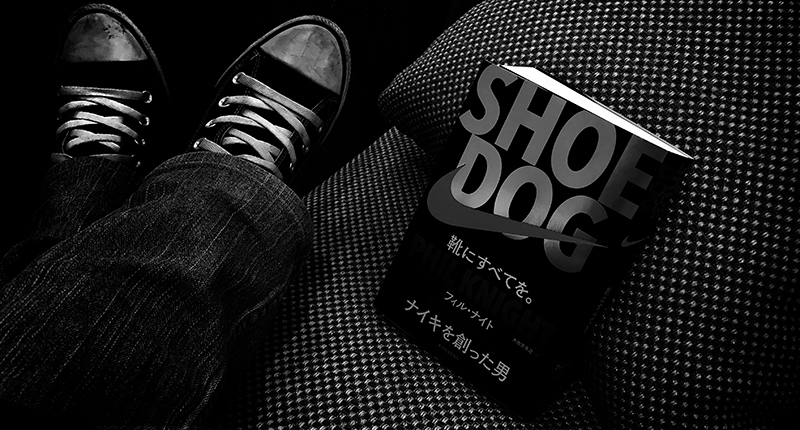
This is the autobiography of Nike founder Phil Knight, "SHOE DOG" (published by Toyo Keizai Inc.).
A brutally honest founding story with a cast of colorful characters
This book, in a word, is "unflinchingly honest."
Has any other entrepreneur ever written a book detailing such embarrassing past experiences?
The story spans from 1962 to Nike's IPO in 1980.
You might imagine it's filled with cool, smart, glittering stories about developing iconic shoes... but it's nothing like that (though it does include anecdotes like the origin of the logo).
He sets out on a round-the-world trip to see beyond America, only to get hooked on surfing in Hawaii, the first stop, and nearly abandon the journey. He gets bored easily.
After starting his business, he barged into Onitsuka Tiger for negotiations, persuaded his track coach and future co-founder Bill Bowerman, dealt with growing staff and increasing misbehavior, constantly wrestled with funding issues, couldn't even pay himself properly, so he ran the company while working as an accountant – it was one chaotic situation after another.
He started teaching at a university, fell head over heels for a student and got engaged, only to face employee betrayal and lawsuits. Just as he recovered with overwhelming support from Nissho Iwai, he was suspected of fraud and investigated by the FBI. He somehow weathered it all, went public, and developed a new shoe with high hopes—only for it to fail. Then came the sharp yen-dollar rate fluctuations, soaring labor costs, and disputes with the U.S. government...
It's packed with events. The level of detail is astonishing—how he remembers it all.
All the struggles, agonies, failures, and even the embarrassing moments are chronicled exactly as they happened.
It all started with a single report written for a college assignment.
Phil Knight was taking an entrepreneurship class during his final year of college.
One particular assignment was given.
Being a runner himself, he chose "Japanese Running Shoes" as his topic.
This was a time when Japanese cameras were beginning to make their mark in a market previously dominated by German brands.
He spent weeks on it, poring over books on import/export and entrepreneurship at the library, arguing how much potential Japanese running shoes had.
This experience was the beginning of it all.
It would later lead to the business model of importing Japan's Onitsuka Tiger and selling them in America.
Just 50 years ago, running was incredibly uncool.
In fact, in 1965, running wasn't even considered a sport. It was looked down upon, regardless of its popularity. (...) No one had ever heard of running for joy, running for exercise, running to increase endorphins, or running to live better and longer. (P107)
It's hard to believe now, but back then, there were no runners.
If you tried to run on the road, drivers would taunt you, telling you to "ride a horse," and throw beer and soda cans at you. It was a difficult time. Or rather, it was terrible.
Even in those days, he delivered truly wonderful shoes for athletes.
He fought hard without wavering in his convictions.
Since writing a review is tough, here's a quote that really gets me fired up
This book isn't about learning Phil Knight's business know-how.
The feeling after reading it is closer to watching a movie.
You relive his life as if you were him.
It would be rude to pull specific events out of the story and introduce them.
Even with movies, you don't want spoilers, right? Neither do I.
Here, I've selected words he weaves together—concise yet imbued with his outlook on life.
You'll surely want to read the book.
I believed in running. I thought if everyone ran a few miles every day, the world would be a better place. I believed that wearing these shoes would make running even better. I wanted to share this feeling with people who understood my conviction.
Belief. Belief is unshakable. (P80)
Among all his jobs, selling shoes was his true calling.
It offered an unshakable conviction and the pure joy of sharing and spreading that belief.
I always wanted to live in the present. I wanted to focus on one truly important job. If life was all work and no play, I wanted to make work my play. (Omitted) What I want is the same as everyone else. That is, to be my true self 24 hours a day. (P169)
He decided to quit his side job and focus solely on shoes at age 30.
You can feel his characteristic honesty—that he could only live a life true to himself.
Someone once said business is war without bullets, and I couldn't agree more. (P129)
Not about not losing, but about winning. He never compromised.
It's about throwing yourself into the grand drama of being human. Not just living, but helping others live more fulfilling lives. (P500)
His philosophy, asserting that business isn't about making money, shines through.
Mr. Onitsuka told Bowerman that the idea for the Tiger's unique sole came to him while eating sushi. Seeing the underside of an octopus leg on a wooden plate, he thought suction cups like these might be effective for flat running shoes. (Excerpt)
He learned inspiration springs from everyday things. Food, objects around the house—hints are scattered everywhere. (p. 122)
In fact, the waffle sole that supported early Nike was inspired by the waffle maker Mrs. Bowerman used for breakfast.
I love the attitude of seeking to add beauty to every part of life, from tea ceremonies to small chests of drawers. I love the radio announcements each morning telling you which cherry blossoms at which street corners are at their peak. (P190)
The year was 1968. This is a passage describing the wonders of Japan, written during a visit for negotiations.
His unique perspective is utterly charming and distinctive.
And finally, the phrase that stayed with me the most:
I want to tell everyone: Believe in yourself. And stick to your convictions. Not convictions decided by others. Convictions you decide for yourself. (P544)
Not beliefs decided by others, but beliefs you decide for yourself.
A powerful message for our modern world, where we're so concerned about what others think.
This story, set up to 1980, is packed with hints for navigating the times ahead.
【Dentsu Inc. Modern Communication Lab】
Was this article helpful?
Share this article


Newsletter registration is here
We select and publish important news every day
For inquiries about this article
Back Numbers
Author
Takuya Fujita
Dentsu Inc.
Creative Planning Division 3