
Note: This website was automatically translated, so some terms or nuances may not be completely accurate.
 Why Businesses Without Dialogue Fail [6/6]
Creating business from a place connected to your true self's intentions
Hiroyuki Egami
Dentsu International Information Services, Inc. (ISID)
This series of columns has finally reached its final installment. We have touched upon dialogue with various stakeholders, including customers, organizations, and society. And the concluding theme is "Dialogue with the Inner Self."
This column is structured in three parts:
■Are you your true self within the company?
■What kind of "I" is building our business?
■Creating business from "dialogue with your inner self"
Are you your true self within the company?
In my work as a consultant, I often facilitate dialogue in business settings. These settings vary—within companies, within industries, and even multi-stakeholder dialogues across industries.
At the outset, I always share a fundamental ground rule: "Please set aside your titles and positions and engage in dialogue as equals, as individuals." When multiple companies participate, I sometimes deliberately request, "Please exchange business cards only after the event concludes." Without this, conversations inevitably become formal, title-based exchanges, making genuine human connection difficult.
Yet, upon reflection, I find it rather strange that I make such a request. Do we truly need to establish this premise to engage in dialogue as individuals? If so, what exactly are we when we speak in everyday business settings?
Perhaps the "me" speaking within companies and organizations in daily life isn't my true self at all. Maybe I'm just playing a role that isn't my real self within the organization, like an actor on the stage of business reciting lines from a script handed to them.

What kind of "me" is creating our business?
What kind of "me" is building our business? Is it the "me" playing a role, or the "me" connected to my true intentions? If business is being created disconnected from our true selves, it might be nothing more than a world where we're performing on a stage set by someone else. It's a business built from a place disconnected from our essence.
Such a business simultaneously creates a world disconnected from colleagues, customers, and shareholders—a world where dialogue doesn't exist, a world where the company and society are divided. Businesses created this way lack a sense of purpose or vision—something more important than profit.
I believe that in business, too, the integration of one's true self—one's essence—with one's professional role is paramount.
Some may question whether companies and society can function efficiently and rationally if each person simply does whatever they want. If you feel this way, I urge you to ask yourself: Is the business created by that efficient, rational functioning truly what you want?
Creating Business from "Dialogue with the Inner Self"
In the business world too, every product and service that takes shape originates from the intentions within people. In a capitalist world, it is undeniable that business, not government agencies or NPOs, is the central force exerting the greatest social impact and sustaining the society we pass on to the next generation. Precisely because of this, it is vital that we connect with our own intentions and embody them in the business world.
Peter Senge, Director of the Center for Organizational Learning at MIT Sloan School of Management, coined the term "self-mastery" in his renowned book The Fifth Discipline to describe the activities that produce the outcomes we truly desire in life—the future we wish to create, the things or actions we aspire to bring into being.
He argues that the starting point for business should be the words that emerge when we continually ask ourselves, "Who am I, and what should I do?" When a leader does this, it becomes their "management philosophy" or "business principles." Innovation then arises from the dialogue between people who share this intent.
Until now, we've conducted business by running PDCA cycles within a world largely set by others, one that was somewhat predictable. Today's VUCA era, however, means the future is unpredictable precisely because it is uncertain.
Put another way, this means we have entered an era where we can design the future from points connected to our own intentions. Isn't it truly exciting to think that such an era has arrived right here, right now?
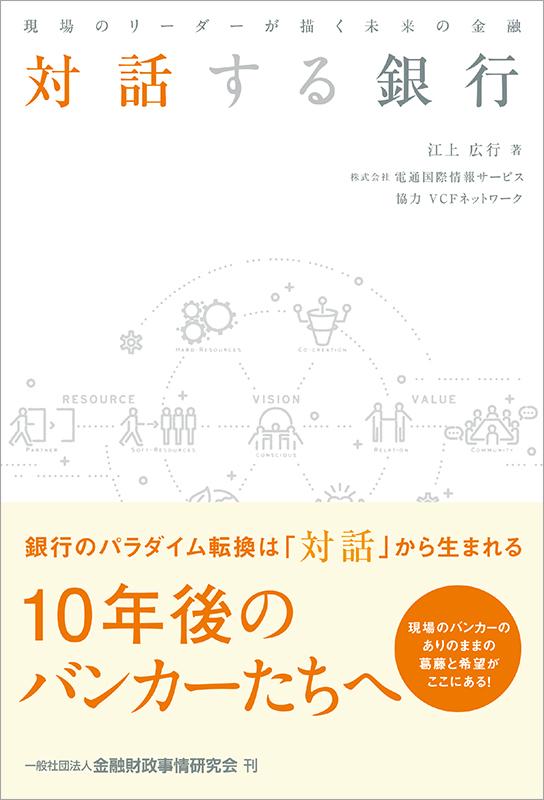
The author of this column, Hiroyuki Egami, depicts how a paradigm shift in the financial industry is emerging from "dialogue" in his book published in July, 'The Dialogue Bank: Future Finance as Envisioned by Frontline Leaders'. The themes explored in these "dialogues" are diverse, including "leadership," "decentralized management," and "the essence of money." Even if you're not in the financial industry, I highly recommend picking up a copy.
Was this article helpful?
Share this article


Newsletter registration is here
We select and publish important news every day
For inquiries about this article
Back Numbers

Author
Hiroyuki Egami
Dentsu International Information Services, Inc. (ISID)
Financial Solutions Division Financial Business Strategy Department VCF Group
Marketing Professional