
Note: This website was automatically translated, so some terms or nuances may not be completely accurate.
 9.America in Years 11 to 15: Leadership in an Age Without Charts [7/7]
Beyond Work Style Reform.

Kimié Morishita
Hello, everyone!
This time, I'd like to talk about the 10 months I spent in Arizona, which became the center of my life in America. Starting from scratch in an unfamiliar place, preparing everything yourself, then working at a company you'd never visited and where you'd never spoken to anyone—that's not something that happens often in life. Yes, besides meeting the leaders I've introduced so far, I spent most of the year working at a tech company where I had absolutely no personal connections.
This company is a major corporation with bases in about 50 countries, including the US and Japan, employing 100,000 people. Half of them, 50,000, are based in the US. The city I was in, Chandler, Arizona, was the second-largest hub in the US, with over 10,000 employees spread across two vast campuses. What stood out most there was the deeply ingrained "diversity" and "inclusion" in daily life. These two terms are often used together lately, but what exactly do they mean? First, let me share three examples.

The mysterious three-letter acronym "WFH" flying around the workplace
At this company, baffling three-letter acronyms fly around daily. Among semiconductor tech terms, "WFH" pops up often. It stands for Work From Home, aka telecommuting. "She's WFH today." It can be as short as a few hours, and the reasons vary.
・"My child isn't feeling well"
・"I want to leave work early to avoid evening traffic jams"
・"I have a conference call early in the morning, so I'm joining from home"
・"... (mumble)"
It's commonplace for employees not to be at the office in this company. To begin with,
・There's a company-owned aircraft (Air Shuttle) for domestic travel between other locations
・There are an excessive number of empty seats, or rather, booths (used by overseas employees on short-term stays)
・Even team members work in different regions, so it's hard to know what everyone's up to
・There are few opportunities to physically gather (meetings are online. The scene of everyone staring at their computers in their booths, muttering to themselves, is a bit eerie)
・There's no official work registration (it's a mystery when work officially starts and ends)
Because of this, WFH is fine if your boss approves. But are you really working at home?
What matters more than "working a set number of hours at the office every day" is "delivering results." The location, method, timing, and style of work are quite flexible.
Gender-neutral restrooms have appeared in the workplace
One day, an announcement arrived. An email stated that an "All Gender Restroom" had been installed on campus. "Who would use this?" Of course, everyone is welcome. Since the campus is so large you need a car to get between buildings, I thought, "It must be far away," but actually, they're scattered all over the place. There was one on the first floor of the building where I work too.
I went downstairs during lunch and saw an "All Gender" sign where the women's restroom had been until last week. Inside, it was exactly the same as the women's restroom... not a single thing different. Ah, I see. It makes sense – using the existing women's restroom is certainly quicker and more practical than building a new one from scratch. I thought I might be startled to see a man in there, but in reality, all kinds of people use it.
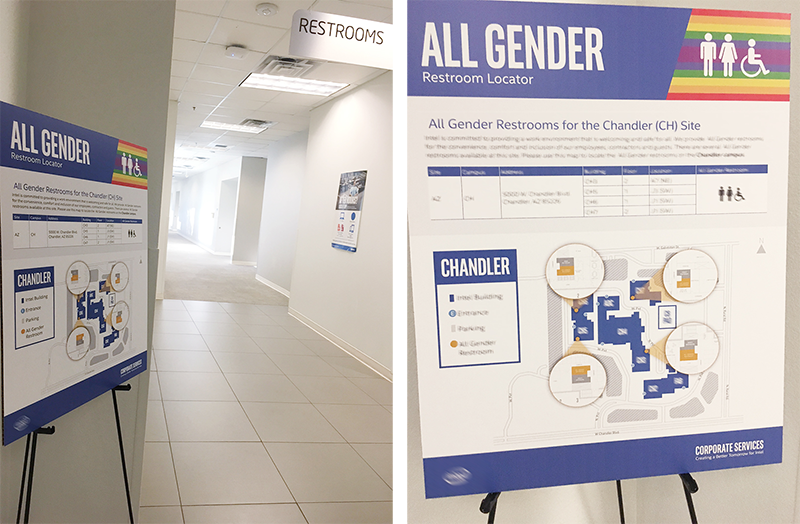
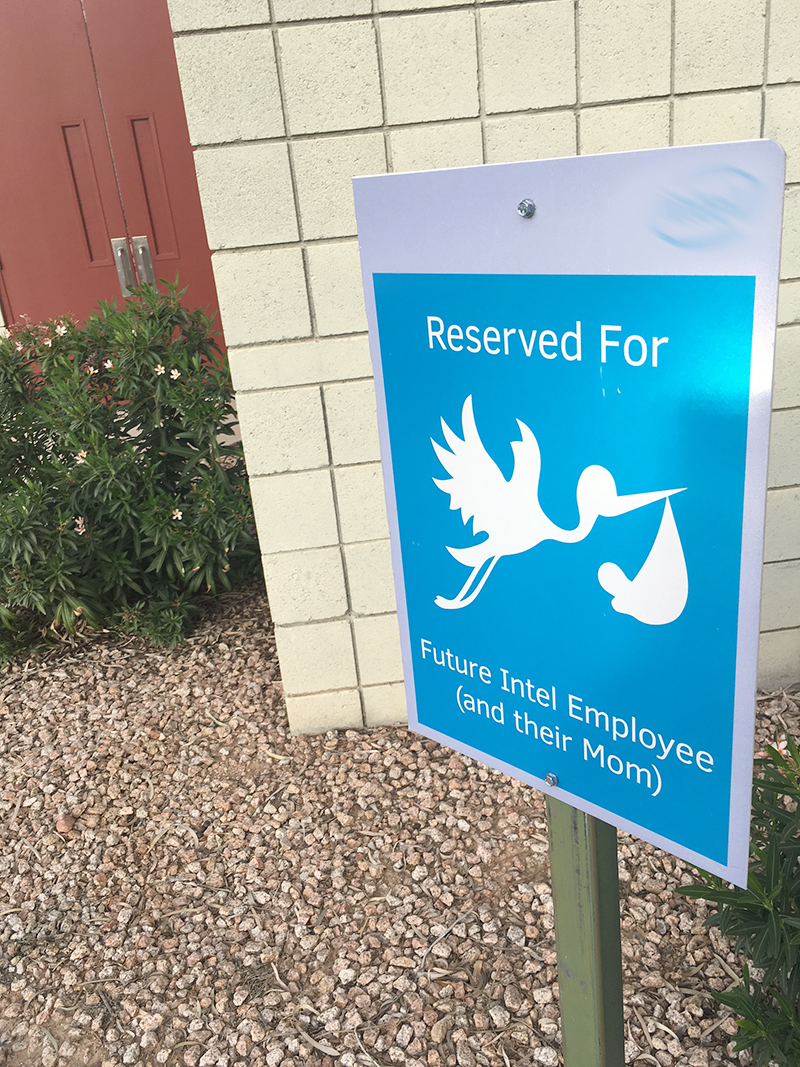
Besides the restrooms, signs for disabled parking and Baby & Mom parking are posted at each building entrance. The stork delivering a baby illustration reads "For Future Employees (and Their Moms)". On this vast campus where it takes over 15 minutes to walk from the far corner to my building, the spots near each building entrance are prime parking. Pregnant women are especially cherished!
What is the purpose of these measures? Are they based on so-called "humanitarianism"?
Digital education for Hispanic women
Another day. A colleague invited me to try employee volunteering. It's part of the company's diversity education initiative, a project to spark interest in STEM※1 fields among minority girls (this time, 200 Hispanic girls in total!). Gabriela, a Hispanic female employee, is overseeing it.
※1 STEM: Science, Technology, Engineering, and Mathematics. While it's a buzzword lately, 63% of the U.S. STEM workforce is still predominantly white men and Asian men. Add white women to that, and the imbalance reaches 83%. With computer science-related jobs expected to surge in the near future, projections indicate that U.S. college graduates alone will only meet about 30% of the demand. Regardless of individual differences like race or gender, there is a need to rapidly cultivate talented individuals and expand the target population. Efforts to develop STEM talent, particularly among underrepresented minorities who currently have low participation rates, are being intensified.
On the day of the event, high school girls arrived early by school bus, looking nervous. Gabriela eased everyone's tension and divided them into 12 teams. I was assigned to guide one team alone. Leading them cautiously through the unfamiliar campus to avoid getting lost... In one classroom, they rode handmade electric wheelchairs and used prosthetic arms to retrieve items from shelves. In another, they learned coding through games. This is interesting. In another classroom, they tackled science experiments. Girls whose foreheads bore deep vertical wrinkles that said "What do we do?" and "I'm not good at this" gradually widened their eyes, leaning forward excitedly. "Huh? How do we do this?" "Whoa, failed again! But I figured out how!" came the cheers.
There were also sessions where hardworking Gabriela and other female mentors shared their life stories. Many grew up in poor families where no one, including relatives, had a college degree, yet they built careers in STEM fields. "Many still face the same circumstances, but don't think you can't do anything. Pursuing STEM means you could become an engineer or create products that help everyone. Most importantly, you create your own options. If you're interested today, don't forget this path."
What surprised me at this event was discovering that even in the 21st century, a significant number of people in the United States—not emerging nations—still belong to groups where "if I go to college, I'll be the first in my family to do so." It was a day of sheer astonishment at the reality that even in America, where diverse races and ethnicities are at least ostensibly equal, such vast differences in awareness and educational levels still exist, making this kind of support necessary. 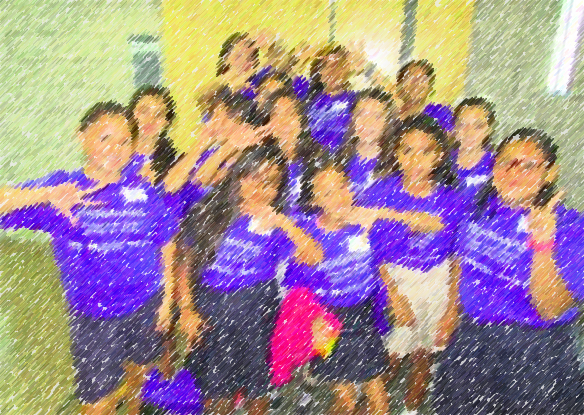
Why We Focus on "Diversity" and "Inclusion"
Why does the company I work for do this?
Going back two and a half years, it actually set a goal for equal employment. Specifically, "to match the proportion of American women, African Americans, Hispanics, and Native American employees to the general labor market by 2020." The target groups also included people with disabilities, veterans, and LGBTQ※2.
※2 LGBTQ: An umbrella term for sexual minorities. It includes lesbian, gay, bisexual, and transgender individuals, and recently added "Q" (Queer/Questioning: people unsure or unclear about their gender or sexual orientation, or those who don't fit the traditional LGBT definitions).
As mentioned at the beginning, "Diversity" and "Inclusion." Diversity means recognizing differences in race, skin color, gender, nationality, age, background, religion, culture, physical characteristics, sexual orientation... and accepting diverse talent. Inclusion takes it a step further, meaning a state where diverse individuals are truly accepted, respecting each other's differences and performing to their full potential as themselves. Is this simple? No, it's incredibly difficult.
So, what is this company doing? First, naturally, they have a Chief Diversity & Inclusion Officer. Since setting the aforementioned goals in 2015, they allocated $300 million in funding for initiatives through 2020! Beyond hiring women and minority employees, they also mandated training for over 10,000 managers worldwide to ensure employees feel comfortable and stay long-term. They also launched a counseling service*3 for regular employees unsure about their future career paths.
※3 Since its introduction in 2016, over 6,000 employees have used the service. Reportedly, 90% of those who utilized it remained with the company and are still working there today.
Unique commitments extend to suppliers too. By 2020, the company pledged to spend over $1 billion annually with businesses owned by women, minorities, people with disabilities, veterans, and LGBTQ individuals! It also vowed to oppose any discriminatory legislation or policies, whether at the state or federal level.
The challenge lies in the company's traditional talent base: highly educated engineers, mathematicians, and aspiring scientists. Founded in the 1960s, it's a veteran tech company with high employee retention, meaning its workforce has historically been predominantly white males. Recently, Asian males have joined this group, making the current workforce primarily white, Asian, and male.
Yes, this field faces an overwhelming talent shortage. The aforementioned education initiatives for Hispanic girls are part of a long-term, visionary effort by this leading company to cultivate STEM talent through every possible means and broaden the pool of potential candidates. It's not just about anyone. Precisely because of this, they are committed to nurturing talent not only internally but also through collaboration with partners, government, schools, and every relevant stakeholder to maximize the potential of the limited talent pool.
What Japanese Companies Need to Survive
In this way, life and work in America taught me daily about the "atmosphere" of American society and the international community, far beyond my assigned projects. While there are setbacks, understand that countries, organizations, groups, and individuals that refuse to embrace diversity become targets of criticism. In a world accelerating mobility and diverse lifestyles, recognize the need for reasonable work arrangements. Global corporations' commitment to diversity and inclusion is no half-hearted effort; it's now insufficient to merely create and deliver good products and services. How and with whom they are created and delivered reflects the very essence of the company.
Turning to us, Japanese companies. Over the past year, I've often recalled a specific episode. During the acquisition of UK-based Aegis, whenever we welcomed Aegis employees to headquarters for meetings with executives, the reaction was always the same. It was... "Weird." This wasn't about the executives themselves. It was because the executives introduced were almost invariably "Japanese men in their 50s or older wearing dark suits." Where were the others?
Foreigners, women, Hindu or Muslim employees, LGBTQ colleagues, the very senior, part-timers, colleagues with disabilities, people working remotely, those balancing childcare or caregiving. Alongside their attributes, people with diverse perspectives and lifestyles surround us. I want to work on projects with such people. I want to exchange more opinions. Whether part-time, remote, or returning from childcare leave, it's good for diverse people to participate. It's not about conforming to a uniform work style, but about having opportunities for raises, promotions, and advancement for those who sincerely engage with their work and deliver results. Haven't you ever thought that?
Beyond work-style reform lies this: embracing diverse ways of working. When we do, diverse talents sharing our vision will naturally come to us.
Couldn't we continue creating Japan Quality products and services worldwide alongside such talent...? The enduring strength of Japanese companies, passed down through generations, lies in their "attitude" of relentless improvement toward products and services (though we might need to align more with global needs and speed here...) and their "vision" to enrich people's lives through daily refinement. To scale this up, perhaps we need to change.
By the time those Hispanic high school girls start working, will something have changed? Or rather, will we have been changed? Gender-neutral restrooms, mom parking spaces, remote work. Starting with small steps... perhaps it's not as difficult as it seems (or am I oversimplifying?).
Was this article helpful?
Share this article


Newsletter registration is here
We select and publish important news every day
For inquiries about this article
Back Numbers

Author