Note: This website was automatically translated, so some terms or nuances may not be completely accurate.
 Let's bring "farming" to the table [4/4]
The surprising reality of Japan's organic food consumer base?
In 2017, the organic industry saw a major event that could shake the world. Whole Foods Market, often called America's most beloved organic supermarket, was acquired by Amazon.
According to the Organic Trade Association (OTA), the U.S. organic food market reached $39.7 billion in 2016, growing 11% year-over-year. The news of Amazon's acquisition of Whole Foods is likely to accelerate this growth.
Could this signal change for Japan's organic food market, which is said to account for less than 1% of the overall food market?
Want to know about Japan's organic market?
To discuss changes in Japan's organic food market, market data is essential. In particular, "consumer behavior and awareness surveys" are indispensable for capturing signs of change.
Dentsu Inc. CDC, in collaboration with Organic Village Japan, planned the publication of the 'Organic White Paper'. In October 2016, they conducted a survey targeting 10,000 consumers.
By categorizing consumers into "H (high)" tier, "M (middle)" tier, and "L (low)" tier based on their monthly organic food purchase amount, and examining the consumption patterns of each tier, interesting results emerged.
■※Consumer Classification
H Tier: Monthly purchase amount of ¥15,000 or more
M Tier: Monthly purchase amount of ¥5,000 or more to less than ¥15,000
L Tier: Monthly purchase amount under ¥5,000
Reading the following four topics will likely make us realize we know far less about the organic food market than we thought. This is where the author sees significant potential for growth in the organic food market.
[Reality 1] Men in their 60s are the most frequent buyers.
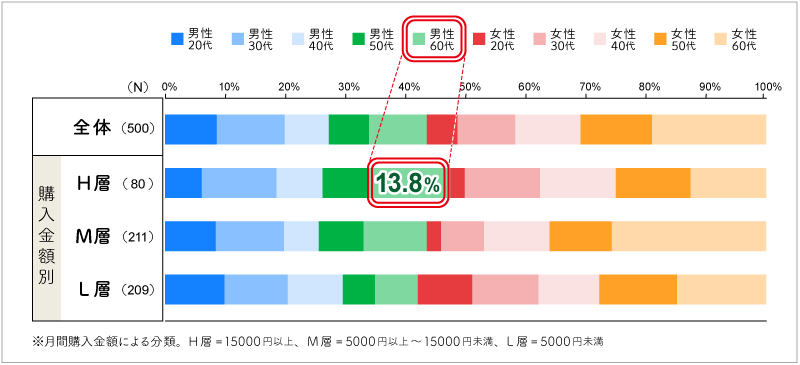
The white paper shows that men actually hold a non-negligible share across all H, M, and L segments. In the H segment, which has the highest monthly purchase amount, the scores are nearly evenly split between men and women. Notably, men in their 60s (13.8%) have a larger share than women in their 60s (12.5%) and represent the largest share within the entire H segment.
[Reality 2] As purchase amounts increase, purchase motivations also change.
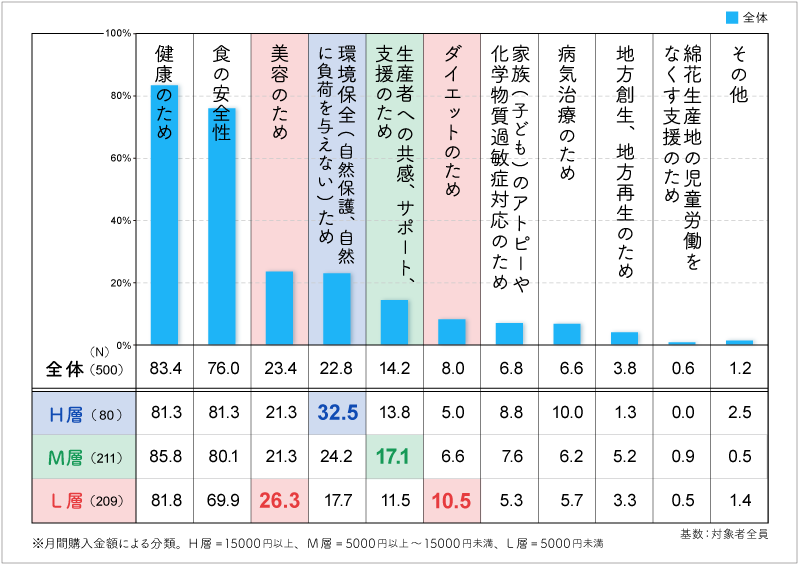
Regarding purchase motivation, all H, M, and L tiers prioritize "health" and "safety." However, beyond these, the H tier shows a higher emphasis on "environmental conservation" (32.5%) compared to other tiers. The M tier highlights "supporting producers" (17.1%), while the L tier emphasizes "beauty" (26.3%) and "dieting" (10.5%), each showing distinct characteristics.
This result seems to reflect a "distance of altruism." As purchase amounts increase, the "distance" shifts from oneself (beauty, dieting) to others, specifically producers → the planet. It could be said that altruism extends to a greater distance.
[Reality 3] After vegetables, consumers want to switch soy products to organic.
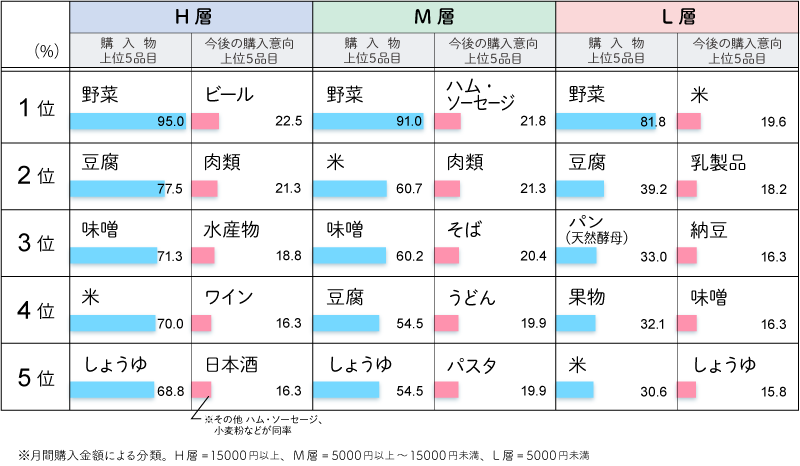
【L-tier】Primarily purchase vegetables.
→ Future purchase intentions rank "rice, natto, miso, soy sauce" highly
【M-tier】Purchase rice, natto, miso, soy sauce, and other soy products in addition to vegetables.
→ Future purchase intentions : "Noodles (udon, soba, pasta) and meat products" rank high
【H Segment】Vegetables + soy products rank high. Noodles and meat products also increase beyond 6th place.
→ Future purchase intentions prioritize "alcohol (beer, sake, wine) and seafood."
As purchase amounts increase, there's a noticeable shift in purchased items: vegetables → soy products → noodles/meat. This suggests a sequential pattern in consumers' adoption of organic ingredients.
This suggests that even within organic foods, noodles and meat may be easier to position as value-added products compared to vegetables. While it's not something we hear about often, perhaps "ramen made with organic tonkotsu-flavored noodles" could become popular.
[Reality 4] They purchase after obtaining information.
![[オーガニック食品購入先]](https://cdn.dentsu-ho-dev.com/5f9c856b-23d8-4fe7-8a31-eb0bef555fde/content_table-nou04_4a.png)
![[オーガニック食品情報入手先]](https://cdn.dentsu-ho-dev.com/702bf802-12f7-4f83-9d32-f0b9e37caaef/content_table-nou04_4b.png)
【L Segment】 Most purchases occur at supermarkets, and information about organic foods is also primarily obtained there.
【M Segment】Home delivery (co-op) purchases increase. As an information source, "word-of-mouth from friends and acquaintances" is relatively more influential. Additionally, "notices from home delivery providers" are becoming more common.
【H Segment】P urchases at "supermarkets" decrease, while purchases from "home delivery services other than co-ops," "natural food stores," "department stores," and "specialty shops" increase. Primary information sources include "notices from home delivery providers" and "shop staff."
A tendency to obtain information closer to the point of purchase, such as "in-store displays and explanations" or "explanations from shop staff," is observed across all segments. Perhaps interesting in-store displays or convincing explanations from sales staff contribute to purchase motivation.
It seems organic food is purchased less as a "product" and more as part of an experience.
Predicting the Future of Japan's Organic Food Market
To truly forecast the future of the organic food market, year-over-year comparisons would be more reliable. However, the 2016 survey is positioned as a "preliminary survey," and there is no comparative data available yet. Therefore, I have taken the liberty of predicting the future of the organic food market.
Globally, the health consciousness driving the organic food market in developed countries shows no signs of weakening and will likely continue to demonstrate strong growth. Domestic consumers, sensitive to overseas trends, should also be stimulated by this growth.
Furthermore, as Japan's population declines, "agricultural exports" will come into focus. The 2020 Tokyo Olympics and Paralympics present an excellent opportunity to promote domestic agricultural products. When appealing to foreigners, the fact that ingredients are organic will be a positive factor.
Amidst these trends, Japan's organic food market, which started from a small base, should see steady growth in sales figures for several years. At the same time, however, questions about the "added value" of organic food will likely intensify.
Currently, organic food strongly positions "safety and security" as its selling point (i.e., added value). However, as the market expands, consumer sentiment is expected to grow that "safety and security are fundamentally societal infrastructure and should be universal, standard values." In other words, safety and security will become a "given premise," and this sentiment will push down the prices of organic food.
Furthermore, increased demand will necessitate higher agricultural production and more efficient distribution. The growing demand for "organic processed foods," still relatively rare today, will also require distribution efficiency. This efficiency will further lower organic food prices, boost demand, and increase the variety of organic products available at retail.
From the producer's perspective, however, organic food production is labor-intensive. This labor increases production costs, making falling organic food prices a challenging situation for producers. Yet, if "the informatization of agriculture" through AI and IoT can reduce labor and risk, a production system resilient to price declines could be realized.
This will make organic food more affordable and mainstream. We will enter an era where organic ingredients are the norm.
Can Japan, aiming to become a tourism-oriented nation, meet the demands of foreign visitors?
I believe "foreign tourists" will be key to making organic food commonplace in Japan, as predicted in this future scenario. The question is what ingredients Japan, aiming to become a tourism-based nation, will use to "welcome" the nearly 30 million foreign tourists expected annually.
Foreign tourists visiting Japan tend to be from higher-income brackets. Many high-income individuals are health-conscious and likely prefer organic ingredients when dining. More chefs and restaurants will likely want to offer organic ingredients to welcome these tourists.
If these chefs and restaurants cannot source organic ingredients domestically, they will have to rely on imports. If domestic producers hesitate to shift to organic production, the market for imported organic ingredients could experience rapid growth.
We also asked Takashi Yamaguchi, Editor-in-Chief of " ORGANIC VISION," who has long observed the organic food market, to predict the future of Japan's domestic organic market.
"The connection between Japan's organic food market and foreign visitors isn't just about hospitality from the Japanese market. Conversely, we'll likely see growing demand for organic food from foreign visitors themselves. At Olympic training camps, we might even see overseas teams insisting on sourcing only organic ingredients."
Predictions are being made in various quarters that the period around the Olympics and Paralympics will significantly change Japanese awareness through extensive international exchange. Editor-in-Chief Yamaguchi suggests a shift in awareness regarding "organic food" will also occur.
"Through Olympic exchanges with other nations, Japanese people will realize that consuming organic ingredients is commonplace worldwide. They will likely recognize the current low level and lag in Japan's awareness regarding production, distribution, and consumption. While Japan's organic food market is undoubtedly growing, its scale remains far too small. Ideally, we should begin organic food production with a global perspective even before the Olympics."
...As this is the first column of the new year, I've attempted to forecast the future of Japan's domestic organic market. By continuing to publish the Organic White Paper and comparing consumer awareness over time, signs of market change should become clearer. The 2017 edition of the White Paper will be released in April. Stay tuned.
Was this article helpful?
Share this article


Newsletter registration is here
We select and publish important news every day
For inquiries about this article
Back Numbers

Author

Yoshiaki Sugimura
Dentsu Inc.
CDC
Business Development Director
Joined Dentsu Inc. in 1998. Currently belongs to the CDC Future Business Tech Team at headquarters. Focusing on business development ideas, he challenges initiatives that solve social issues by leveraging various cutting-edge technologies ranging from IT to biotechnology.