
Note: This website was automatically translated, so some terms or nuances may not be completely accurate.
 Dentsu Inc. Blockchain Community is on the move! [1/2]
Dentsu Inc.'s Challenge: Blockchain 3.0

Toshiaki Hasamura
Dentsu Inc.
<Table of Contents>
▼Blockchain is a social transformation affecting all modern people
▼What Makes "Programs Running on Blockchain" Revolutionary?
▼Blockchain 3.0 Also Refers to Applications Beyond Finance
▼What Can Blockchain × Dentsu Inc. Achieve?
Blockchain is a social transformation affecting all modern people
"Why is Dentsu Inc. pursuing blockchain?"
Many people seem to have this question. Come to think of it, when I was planning FINOLAB Inc. in 2015, I also received many questions asking, "Why is Dentsu Inc. tackling the FinTech revolution?"
I understand the common thread is the question: "Why is Dentsu Inc. involved in finance?" My answer has always been the same:
"Neither FinTech nor blockchain are limited to the financial sector. They represent a social transformation affecting all modern people. "
This answer carries two meanings.
First, the FinTech revolution is not a "revolution of financial institutions," but rather "a phenomenon where the boundaries between the financial industry and other industries are rapidly dissolving through digitalization." Non-financial institutions and startups are acquiring financial functions one after another, armed with the latest technologies, merging them with non-financial industries, creating new services, and driving social transformation.
Second, the various technologies honed within finance—a colossal industry underpinning modern society—are now being increasingly applied outside the financial realm. Blockchain is precisely the prime example of such technology.
Looking back, FINOLAB Inc.'s very first tenant company was a leading Japanese blockchain startup, and even then, blockchain adoption in 'non-financial industries' was actively underway. Many of the recent cutting-edge blockchain use cases among FINOLAB Inc.'s members also originate in 'non-financial industries.'
What makes "programs running on blockchain" groundbreaking?
Recently, the term "Blockchain 3.0" is frequently heard. While definitions vary across articles and books, my understanding is as follows:
[Blockchain 1.0] Technology created for "cryptocurrency"
Blockchain was invented and introduced to the world by an individual using the pseudonym "Satoshi Nakamoto" as the foundational technology enabling Bitcoin. It is a technology that records transactions—such as who sent what amount to whom and when—in a tamper-proof manner.
This "blockchain as the infrastructure technology for cryptocurrency" is what is referred to as Blockchain 1.0.
Fundamentally created to enable cryptocurrency, it appears no other functions were planned. Of course, even this alone can be called a monumental invention.
[Blockchain 2.0] Technology to Record Transactions Beyond "Currency" on the Blockchain
While cryptocurrency was realized through blockchain, breaking down its elements reveals two key characteristics: "difficult to hack" and "requiring no trusted third-party administrator." Hacking invites external data tampering, while administrator misconduct invites internal data tampering. Blockchain achieves a state where tampering is effectively impossible due to these characteristics.
Blockchain 2.0 represents the movement to apply these two characteristics to things beyond currency.
People who realized blockchain could be used when there is "data (*) or transactions that need to prove they haven't been tampered with" began applying it to "notarization," "registration," "ownership records," "elections (voting)," and "traceability." A famous Blockchain 2.0 network is " NEM," referred to as the "Smart Asset Blockchain."
(Note: Technically, it's not the data itself that is recorded on the blockchain, but rather a numerical value called a hash value, which indicates that the data has not been tampered with.)
【Blockchain 3.0】Technology to record and execute programs on the blockchain
Some people realized that it would be even more useful not only to record "data or transactions that need to be proven tamper-proof" on the blockchain, but also to record and execute "programs that need to be proven tamper-proof."
What is often called Blockchain 3.0 refers to this capability to record and execute "programs that run on the blockchain." Ethereum is the most famous example.
What does it mean for a program to exist on the blockchain? It means "since it is tamper-proof, it is expected to always execute exactly as originally intended."
For example, consider an industry wanting to use a program to streamline operations. If one specific company manages that program, competitors become uneasy. They worry, "What if the managing company alters the program's content or output to suit its own interests?" This concern arises regardless of which company manages it.
By instead recording and executing the program on a blockchain managed collectively by all companies in that industry, the risk of someone arbitrarily tampering with it can be mitigated.
Blockchain 3.0 also refers to its application in non-financial domains.
Programs running on this blockchain are often called "smart contracts in the narrow sense." "Smart contract" itself means a contract that executes without human intervention. A primitive example is a vending machine. In the Ethereum context, programs running on the Ethereum blockchain are called "smart contracts."
Applications created using smart contracts in the narrow sense include the increasingly common "Dapps" (Decentralized Applications).
A well-known example of a Dapp already in practical use is a "DEX" (Decentralized Exchange). This means a "cryptocurrency exchange without an administrator." For example, "if you send 1 Bitcoin to a DEX, it will exchange it for another currency based on the current rate, following a predefined algorithm."
Let's outline the advantages of DEXs. With exchanges managed by a company, end-users must trust that company and deposit their assets. However, exchanges that betrayed that trust have existed in the past. DEXs, lacking a central administrator, are considered to reduce the risk of having to trust a manager.
Neutrino, sponsored by Dentsu Inc., is Japan's first blockchain 3.0 development hub specializing in smart contracts and Dapps.
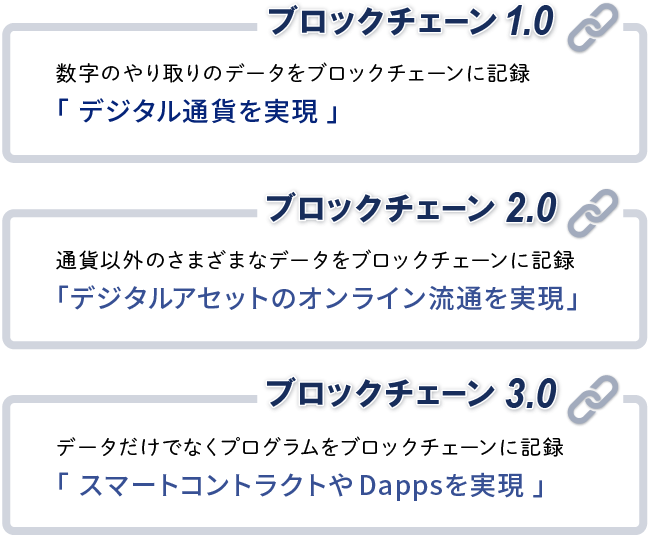
Writing it this way might make blockchain seem like it expanded chronologically from 1.0 → 2.0 → 3.0, but that's not actually the case. While 1.0 is the origin, the mechanisms for 2.0 and 3.0 were conceived roughly simultaneously and development progressed.
1.It's not that 2.0 is superior to 0, or 3.0 is superior to 2.0. Each has its strengths and weaknesses, and they should be chosen based on the specific use case.
In terms of security robustness, specifically "tamper-proof" properties, I believe Bitcoin, the original blockchain, excels. When handling digital assets other than currency, NEM feels more polished and user-friendly, with a well-established suite of applications and libraries.
Ethereum, synonymous with smart contracts, currently still requires programming as a prerequisite, making it quite a high barrier to entry. We can expect more convenient applications and libraries to emerge in the future.
Even Bitcoin, the original blockchain, continues to see new technologies developed, with progress being made in supporting features referred to as 2.0 and 3.0.
From a functional perspective, 1.0 was a financial infrastructure technology designed to "enable cryptocurrency." However, the capabilities of 2.0 and 3.0 are highly valuable even for "non-financial industries." Particularly with 3.0, which enables smart contracts, the specific implementation of its programming could potentially realize various business models that were previously difficult to achieve.
Therefore, Blockchain 3.0 is sometimes used as a term encompassing elements of 2.0 to refer to "the utilization of blockchain in non-financial industries." This connects to the answer to the question posed at the beginning: "Why is Dentsu Inc. pursuing blockchain?"
If it were merely "technology enabling cryptocurrency," Dentsu Inc.'s scope and significance for engaging would likely be limited. However, the capabilities enabled by 2.0 and 3.0 hold substantial potential to reshape society as foundational infrastructure for a new information society.
This is why Dentsu Inc., and indeed various other players, are engaging with blockchain.
What can blockchain and Dentsu Inc. achieve together?
The crucial agenda then becomes envisioning the new societal landscape and business models enabled by blockchain. However, few people currently have a clear picture of this. While some visionaries likely see it distinctly, that vision—probably because it represents a discontinuous leap from the present—may seem wildly unconventional and struggle to gain widespread acceptance.
A common analogy drawn is whether anyone could have imagined the state of society in 2018 back during the dawn of the internet, roughly 20-25 years ago.
Back then, the internet still relied on wired analog lines, images took tens of seconds to load, and communication costs were enormous. Email and bulletin boards were convenient, so they were starting to gain some traction, but hardly anyone could have imagined smartphones, e-commerce, SNS, and the like would become so widespread and radically transform lifestyles.
It doesn't feel like it will take 20 years, but looking back later, I suspect people will say, "Around 2018 was the dawn of blockchain and a turning point for society."
Blockchain itself is an infrastructure technology in the IT field, categorized as "middleware" alongside systems that manage databases and servers. It doesn't directly provide any services to people; it's purely a technology that supports applications delivering those services.
Therefore, rather than thinking "what services can be built with this infrastructure?", we believed the necessary mindset was "what innovations can be created by integrating blockchain with existing businesses and operations." With this in mind, we launched the Dentsu Inc. Blockchain Community (DBCC) on March 1, 2018.
Dentsu Inc. Launches Cross-Functional Organization to Advance Business Applications of Blockchain Technology
http://www.dentsu.co.jp/news/release/2018/0228-009477.html
DBCC aims to foster loose collaboration among Dentsu Inc. employees who are actively committed to driving business initiatives within their respective departments. The goal is to integrate blockchain's potential into their domains, share information and networks, and accelerate individual efforts.
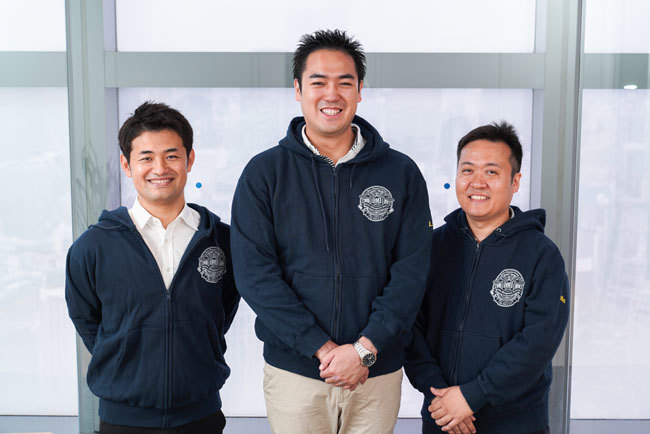
The meeting between Wataru Kishimoto from Dentsu Inc. Media Services / Radio,TV Division, Ryota Murayama from Dentsu Digital Inc., and myself, Renmura, led to the establishment of DBCC.
Next time, we'll cover the background of the community's launch and the areas where blockchain is being utilized within Dentsu Inc.
Was this article helpful?
Share this article


Newsletter registration is here
We select and publish important news every day
For inquiries about this article
Author
Toshiaki Hasamura
Dentsu Inc.
Business Development & Activation Division