Note: This website was automatically translated, so some terms or nuances may not be completely accurate.
 1+1=∞ Collaborative Marketing [6/6]
The Meaning of Collaboration
This marks the final installment. As a general overview of collaborative marketing, I'd like to share my current thoughts in a somewhat rambling manner.
How much are people willing to pay for "buzz"?
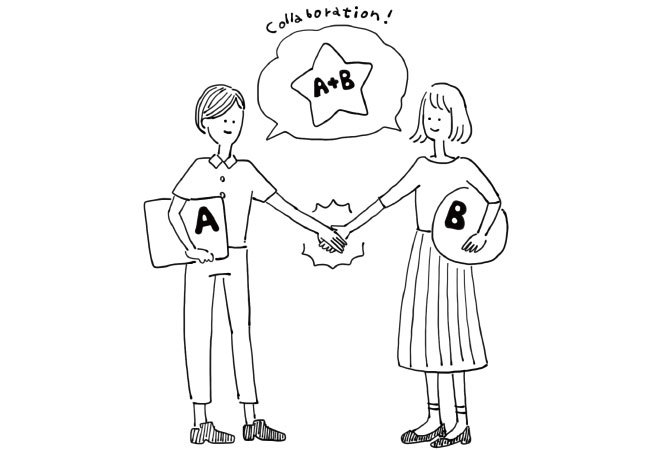
As you know, collaborations are a method that easily generates buzz. Buzz means active information sharing and exchange is happening in the world. If it's a collaboration between two brands or products, you get twice the fans. The likelihood that the person you're talking to knows the brand increases, making information spread more easily.
Recently, there's a demand not just for a product's inherent value, but also for "mechanisms that make it easy to become a topic of conversation." This demand isn't limited to the manufacturer side; it also comes from the consumer side, who are constantly seeking topics.
Of course, big-ticket news like "I went to Hawaii!" or "I bought a car!" generates huge buzz on its own. Conversely, emotionally charged topics like "I made a bad purchase during the sale" also spark lively conversation.
Following the same logic, we're increasingly seeing a phenomenon where the relationship between purchase and information sharing is reversed. People buy products that provide conversation topics, even if they don't necessarily need the product itself, purely for the sake of sharing information. This represents a shift in purchasing behavior and product development away from the traditional flow.
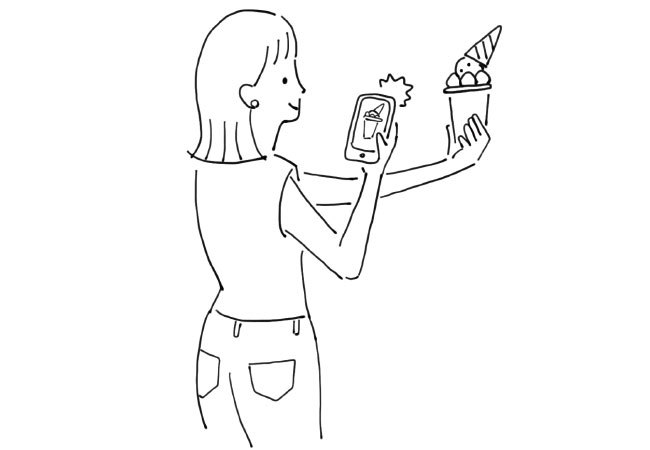
Take ice cream brands as an example: consumers might buy ice cream prioritizing Instagrammability over their preferred flavor, while manufacturers develop menu items specifically designed to be shared on social media.
All of this could be seen as an effort to transform products and actions into "talking points" (where "talking points" here encompass both real-world conversations and social media post topics).
Whether it's finding the perfect angle or editing photos for Instagram likes, or adding numerous hashtags, I believe people are instinctively aiming to transform their consumption into more powerful "talking points." Considering this, when creating news through collaborations, it's essential to refine the plan from the perspective of maximizing its value as a talking point.
Whether partnering with a big-name brand or unveiling an unknown output, the method itself isn't the main issue. What matters is the calculation behind "Who should we tell? How far should we go? How should we communicate it? And is it a topic people will want to share?" – ensuring the news is embraced as the consumer's own talking point.
If I were to add one point, it's that while it's certainly important for the resulting topic to make it onto conversation tables, get picked up by media, and spread on social media, the ultimate goal is to drive consumers to actually buy the product or use the service – to prompt real action and real experience.
I believe the ideal destination for brand collaborations is to become a topic that garners attention and, beyond that, directly contributes value to the heart of the business.
Things you've never seen, things you have seen
When creating ads, there's an unspoken rule that "unprecedented ideas are the ultimate goal."
Generally speaking, things that make people think, "Oh, that's a common one," or "I've seen that somewhere before"—in other words, "second-hand ideas"—tend to be the most disliked (though, of course, some things are popular precisely because they repeat the same framework).
However, when creating products or services, "something never seen before" isn't always the only thing that gets proper recognition.
Every day, somewhere in Japan, new products and services are born and disappear. Among them, "things we've seen before" – or, put another way, the repeated demand for the same thing – signifies that the product has been accepted and loved by society as a staple. This is something that should be celebrated.
In such cases, collaborative product and service development represents one of the few methods capable of using "familiar elements" to create something "unseen."
They allow for entirely new challenges while inheriting and leveraging the fanbase and public image cultivated over time. You could call it a hybrid of reassurance and innovation. That's precisely why products and services born from collaborations tend to have a strong impact and often become surprising news stories.
Underpinning these new challenges is the painstaking branding work done up to this point. Keeping this in mind and expressing gratitude, collaborations that breathe new life into the brand are what we should strive for.
Collaboration for all working people
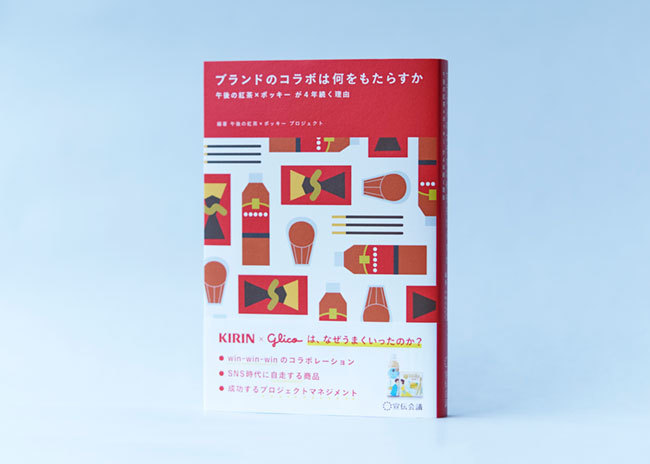
Following the book's publication, I was invited to hold several talk shows at bookstores including Daikanyama Tsutaya Books and Aoyama Book Center Main Store. While I expected mainly advertising professionals, attendees included people from manufacturers, service companies, designers, media professionals, students, and all sorts of occupations.
A common thread among everyone was the difficulty in bringing new business ideas or projects to fruition—whether driven by personal initiative or by management directives like "Do something new!" Obstacles ranged from internal traditions to inflexible team structures. Some came seeking solutions, while others were simply at a loss, unsure how to proceed.
That's precisely when collaboration can be the breakthrough. Use it as a tool to achieve what was previously impossible: team up with outsiders and advance projects in an unconventional setting. You'll surely encounter results unattainable alone.
And someday, we'll completely remove barriers like departments or competitors. People from various companies will increasingly come together to work on a single project. If the ultimate form of collaboration evolves into something this fluid, I believe Japanese business will become much, much more enjoyable.
Well, this concludes our six-part series.
Thank you for reading to the very end.
Was this article helpful?
Share this article


Newsletter registration is here
We select and publish important news every day
For inquiries about this article
Author

Sakamoto Yako
Dentsu Inc.
Business Production Bureau (on secondment to CACDO)
Copywriter/Interactive Art Director