Note: This website was automatically translated, so some terms or nuances may not be completely accurate.
 How Will TripTech Change Inbound Tourism Operations? [2/2]
AI Multilingual Translation and TripTech (Travel × Technology)

Miki Yamamoto
Nippon Telegraph and Telephone East Corporation (NTT East)

Egashira Rui
Dentsu Inc.
Dentsu East Japan Inc., in collaboration with Dentsu Social Insight Lab, conducted a marketing trial themed around "Triptech" (combining "Trip" and "technology"). This trial utilized the multilingual AI translation engine " Hikari Cloud cototoba" for SNS big data analysis. Furthermore, in March, the results of this verification were presented at a seminar for government agencies, local authorities, and businesses involved in inbound marketing.
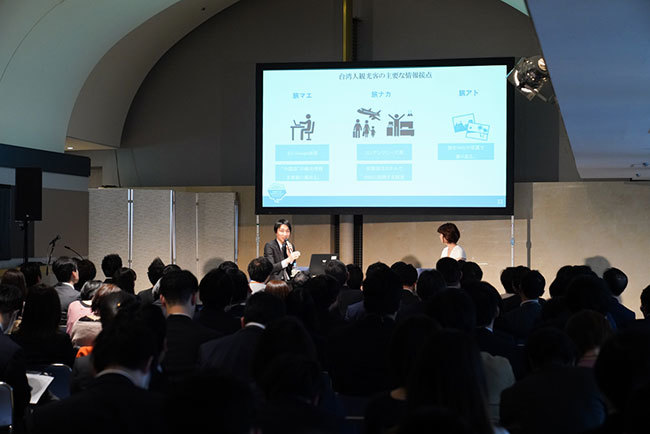
Ms. Mikiko Yamamoto of NTT East Japan Inc., who led this trial, and Mr. Rui Egashira of Dentsu Data & Technology Center will discuss the potential of AI translation and TripTech, which are indispensable for future inbound business.
"cototoba" – AI that can be customized for inbound "learning"

Egashira: This series of trials (proof-of-concept experiments) conducted with NTT East Japan began when Ms. Yamamoto approached us with the request: "We want to create inbound-focused content based on the full volume of tweets from visitors to Japan on Twitter." That's when we learned about "Hikari Cloud cototoba" (hereafter cototoba). We felt it was precisely the solution to address the challenges our social media marketing team faces daily.
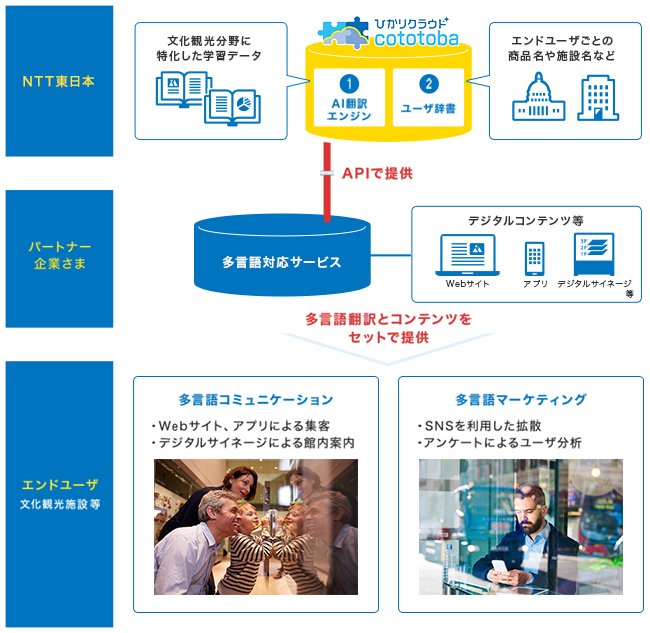
Yamamoto: Thank you. Our cototoba is a cloud-based translation AI. What sets it apart from other machine translation systems is that, in addition to learning general text and vocabulary, it has been trained on a massive amount of data specifically focused on the "cultural tourism field = inbound sector." We've particularly strengthened the language used in scenes along the visitor's journey, such as transportation, cultural and tourist facilities, lodging, dining, and shopping.
Egashira: As a result, it becomes a translation engine that's easy to use for companies developing services and businesses targeting inbound tourists. What specifically are these cultural tourism-related terms?
Yamamoto: For example, the term "大浴場" (ōyokoba) literally translates to "Big Bath" in English. However, unless it's properly translated as "Public Bath," foreign visitors won't understand it's a public facility. We've enhanced our training to include this kind of nuanced care.
Egashira: So even for general nouns like "大浴場," it avoids simple literal translations and instead translates appropriately within the cultural tourism context. This is achieved through domain-specific training data.
Yamamoto: Yes. That said, it's not simply a matter of having more training data. You need to increase the number of GPUs proportionally to the data volume. On the other hand, there's also the risk of overfitting, where accuracy decreases inversely proportional to the amount of data. The principle of "quality over quantity" is starting to gain recognition in the world of translation AI.
Egashira: Another crucial aspect for tourism businesses is proper nouns—place names, personal names, souvenir names, and facility names specific to each region. When Dentsu Inc. Social Insight Lab previously collected foreign tourists' tweets about Tohoku tourism, a certain translation engine produced the baffling phrase "Date Masamune" in the English output. It failed to recognize "DATE MASAMUNE" as a proper noun referring to the Sendai warlord Date Masamune. In that regard, I believe cototoba's ability to handle proper nouns is a major advantage.
Yamamoto: Yes. We've strengthened coverage for high-frequency proper nouns in the inbound tourism domain and are continuously expanding our target scope. Additionally, cototoba features a "user dictionary" section. Customers can register their own proper nouns, such as company product names or facility names, to reflect them in translation results. It can also handle unique phrasing specific to companies or regions. I believe it's an AI that can grow while meeting diverse needs.
Egashira: During the trial we conducted together, we also performed comparative experiments with other companies' general-purpose translation services to objectively demonstrate cototoba's accuracy. The results showed positive outcomes across all metrics: using cototoba increased the appearance rate of place names related to the Tohoku region by 8%, and the translation error (mistranslation) rate decreased by 22 points.
Yamamoto: That's a relief (laughs). We'll continue improving cototoba to provide even more accurate translations going forward.
A Proof-of-Concept Experiment to Understand the Tourism Dynamics of Taiwan's Millennial Generation and Drive Action
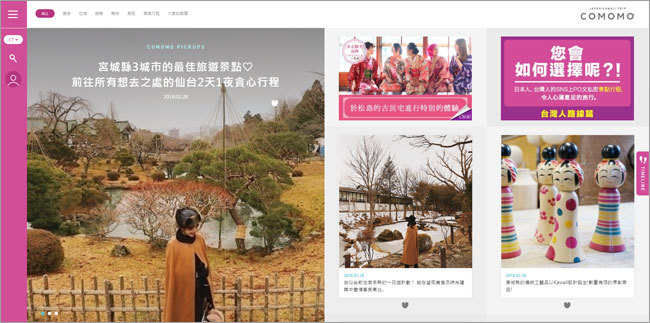
" COMOMO " – A Tourism Information Site for Japan's Tohoku Region Focused on the Theme of KAWAII
Egashira: I'd also like to discuss the trial's marketing outcomes. With the cooperation of LCC (low-cost carrier) Peach Aviation, we experimentally posted content on their tourism curation site "COMOMO," using that as a basis for various verifications and data collection.
COMOMO is a site featuring tourism information for Japan's Tohoku region, themed around KAWAII. It supports four languages and specifically targets Taiwanese women in their 20s and 30s. We tried a marketing approach: what kind of response would we get if we posted articles on this site based on SNS analysis results?
Yamamoto: Yes. First, we collected 60,000 pieces of SNS data on "what Taiwanese people are tweeting about Tohoku tourism." We translated this using cototoba and analyzed it together with Dentsu Inc. Social Insight Lab. Then, we created four pieces of content: "Articles based on SNS analysis results (partial use, full use)" and "Articles by Japanese editors using no SNS data at all (with/without on-site research)." These were published on COMOMO.
Egashira: Translating and analyzing the SNS data enabled us to improve the accuracy of our previously developed metric, the "Most Hidden Gem Points" (MAP), and develop solutions like "Spontaneous Sightseeing Spot Analysis" and "Spontaneous Souvenir Analysis."
First, regarding "Most Hidden Gem Points," this system indexes and lists spots based on the hypothesis that locations receiving few mentions but high positive evaluations are likely hidden gems. The "Incidental Sightseeing Spot Analysis" and "Incidental Souvenir Analysis" analyze foreign visitors' posts in a famous tourist area to extract "highly satisfying places to stop by, meals, and souvenirs that are frequently posted alongside posts about that area." We created articles proposing sightseeing routes based on this analytical data.
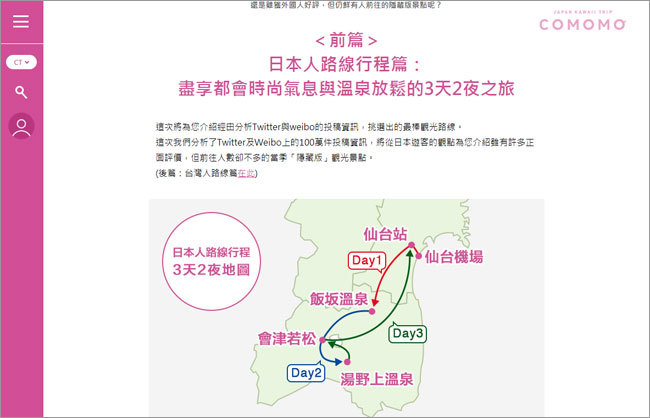
Tourist route proposal articles published on COMOMO. Users can virtually experience routes connecting hidden gems popular with Japanese tourists and routes connecting hidden gems popular with Taiwanese tourists, accompanied by numerous images.
Yamamoto: That's right. We also discovered that the demand for "incidental sightseeing" is particularly high among "mid-trip" travelers. Content driven by insights from the analysis, such as comparing routes of Japanese tourists versus Taiwanese tourists, garnered significant attention at the business-oriented seminar held after the trial.
Egashira: To summarize the COMOMO trial findings: articles fully leveraging SNS data achieved approximately 10 times the average page views compared to those without such data. They also had higher return rates and longer average session durations (about 1 minute longer). This clearly confirmed the value of SNS analysis. Going forward, alongside translation services, there seems to be a growing need for integrated inbound marketing solutions that combine this kind of "analysis" and "insights" with concrete promotional strategies.

Contributing to Inbound Marketing for 60 Million Annual Visitors Using SNS Big Data as a Resource

Egashira: What prompted your team to take on the challenge of "translating SNS big data"? Whether it's English or Chinese, the language millennials (the digitally native generation who came of age after 2000) use on SNS has unique expressions and nuances, making translation extremely difficult.
Yamamoto: Yes, it is indeed very difficult. However, from the perspective of social innovation, it feels like a natural progression for translation AI. This is because the "travel industry" now ranks fourth in global GDP, a massive industry following retail, finance, and mining. Tourism, in particular, is closely linked to job creation, export expansion, and social infrastructure development, which is why countries worldwide are focusing on international tourism. I believe Japan, too, must now focus not only on "hospitality" but also on the "tourism business" perspective to establish a stronger global presence.
A major recent shift is that "travelers have gone digital." With the rise of LCCs and social media, travel styles have shifted from group tours to individual travel. This means that from the perspective of companies driving the travel business, "travelers are becoming harder to see." Meanwhile, the voices of Millennials, who are driving travel consumption, are massively accumulated and continuously amplified on social media. For the future of the travel business, isn't it essential to view SNS as the mainstream of marketing and adopt the approach of "catching needs and trends from SNS and reaching them via SNS"? That's also why we reached out to Dentsu Inc. Social Insight Lab – we resonated with their research domain and vision of analyzing user insights on social media.
Egashira: Thank you. SNS is indeed a platform that serves as both the gateway and exit for consumer behavior, allowing companies not only to understand "what millennials are thinking" but also to approach them directly.
Yamamoto: That's right. However, when it comes to leveraging SNS for inbound marketing, there's inevitably a "language" barrier that makes connecting the entry and exit points difficult. We thought many companies likely face this challenge.
Egashira: I heard the March inbound marketing seminar generated an unexpectedly strong response. I also had the opportunity to speak there, and I was amazed by the sheer number of attendees and the energy in the room. It really reinforced my sense that inbound strategies are now the most critical theme for many tourism businesses and their surrounding stakeholders.
Yamamoto: Through this trial and the seminar, I too have reaffirmed the importance of foreign SNS marketing. Since announcing the COMOMO trial, we've received numerous inquiries from companies across various sectors: manufacturers, distribution, finance, real estate, and app services.
Egashira: As Japan promotes itself as a tourism-oriented nation, demand for services catering to foreign visitors will only continue to grow. How do you foresee the future of inbound marketing, Mr. Yamamoto?
Yamamoto: Japan's domestic demand is inevitably shrinking due to the declining birthrate and aging population. Government projections indicate the workforce will drop to 54.5 million by 2030. Conversely, annual inbound tourists are expected to reach 60 million, with travel spending in Japan projected at 15 trillion yen. Furthermore, data shows that 35% of Chinese travelers continue purchasing items bought during their trip via cross-border e-commerce. Including these "post-trip" touchpoints, how to effectively market to this "annual consumption activity of 60 million visitors" is becoming an increasingly important theme for companies.
Egashira: As translation AI advances and becomes more widely available, opportunities for inbound marketing will expand even for regional stakeholders who previously struggled with cost and usability barriers. I believe our role is to leverage such technology to support inbound marketing.
Yamamoto: Exactly. I hope translation AI becomes a linguistic infrastructure, evolving into a component that supports diverse businesses—revitalizing regional areas, expanding manufacturing exports, and creating new customers for retail. Of course, it's not just translation AI; combining various digital tools like content and advertising will invigorate the travel business. I'd love to see "Trip Tech" become a buzzword around 2019-2020 (laughs).
Egashira: We also aim to refine and systematize our insights and expertise in social media big data analysis even further, contributing to inbound marketing. Thank you for today.
Was this article helpful?
Share this article


Newsletter registration is here
We select and publish important news every day
For inquiries about this article
Author
Miki Yamamoto
Nippon Telegraph and Telephone East Corporation (NTT East)
Business Development Division, Third Department
Office Services Section Manager
Egashira Rui
Dentsu Inc.
Data & Technology Center
Director