
Note: This website was automatically translated, so some terms or nuances may not be completely accurate.
 Advertising Legal Pitfalls Explained in 3 Minutes [9/9]
Regarding Advertising Restrictions for Specific Industries
This series will focus on practical points from the book 'Advertising Law,' explaining them in a Q&A format.
Q. I've been commissioned to create an advertisement for a non-principal-guaranteed investment trust. We've learned about the Act Against Unjustifiable Premiums and Misleading Representations, Copyright Law, and portrait rights/publicity rights. We believe creating the ad based on this knowledge should be fine.
Is there anything else we should be careful about? Previous installments explained that when planning and creating advertisements, one must be mindful of the Act Against Unjustifiable Premiums and Misleading Representations' disclosure regulations, Copyright Law, and portrait rights/publicity rights. So, are the laws to be mindful of the same for all products and services?
A. Depending on the industry, advertising may be regulated by laws specific to that sector (industry-specific laws).
Advertisements for financial products, as mentioned in Q, are also subject to regulation under the Financial Instruments and Exchange Act. Industry-specific legal regulations concerning advertising may exist. While these are diverse and cannot be comprehensively covered in depth here, we will outline advertising regulations for several industries as examples. However, advertising regulations under industry-specific laws are not limited to these industries.
[Basic Knowledge]
1. Financial Advertising Regulations
(1) Disclosure Requirements
Financial instruments business operators, etc., when advertising the content of their financial instruments business activities, are subject to the following disclosure obligations stipulated by the Financial Instruments and Exchange Act:
① Trade name, company name, or personal name of the financial instruments business operator, etc.
② The fact that they are a financial instruments business operator, etc., and the registration number of said operator
③ Important information likely to influence customer judgment (e.g., the total amount or calculation method of fees and compensation payable by the customer, the amount of margin the customer must deposit)
For television and radio commercials, due to the nature of these media, it is sufficient to disclose the following two items instead of ③:
・A statement indicating that losses may occur due to fluctuations in interest rates or similar factors
・The need to thoroughly read the contents of the pre-contract disclosure document (or prospectus)
(2) Method of Disclosure
Facts that may disadvantage customers, such as the risk of loss, must be clearly and accurately displayed as risk information.
(3) Prohibition of Exaggerated Advertising
When advertising the content of financial instrument transactions conducted by financial instrument business operators, etc., regulations prohibit "making representations that are significantly different from the facts or that are likely to mislead people" regarding matters such as profit expectations, contract cancellation, loss burden/profit guarantees, and predetermined compensation amounts.
2. Advertising Regulations for Medical Services (Hospitals)
Medical (hospital) advertising is regulated by the Medical Service Act, and the details of these regulations are summarized in the Ministry of Health, Labour and Welfare's Medical Advertising Guidelines. Matters specifically highlighted as prohibited items in the Medical Advertising Guidelines are as follows:
① Advertising matters not permitted for advertising
[Example] Mortality rates, postoperative survival rates, treatment using unapproved drugs
"Celebrities also receive treatment at our hospital"
② Advertising containing false information (false advertising)
[Example] "Absolutely safe surgery!" "Specialist physician approved by the Ministry of Health, Labour and Welfare"
③ Advertisements implying superiority over other hospitals or clinics (comparative advertising)
[Example] Our hospital boasts the largest number of physicians in the prefecture
④ We are one of Japan's leading hospitals in liver cancer treatment
④ Exaggerated advertising (exaggerated claims)
【Example】A hospital licensed by the governor!
⑤ Advertisements containing content that cannot be proven as objective facts
【Example】Patient testimonials, "This is a relatively safe surgery."
⑥ Advertisements with content contrary to public order and morals
[Example] Advertisements using obscene or cruel images
⑦ Advertisements with content that undermines dignity
【Example】Foolish advertisements
⑧ Advertisements containing content prohibited by other laws or regulations
[Example] "We can prescribe the medication '○○ Tablets'."
(Proper Advertising Standards for Pharmaceuticals, etc.: Advertising targeting the general public (non-medical professionals) is prohibited for pharmaceuticals supplied for the purpose of being prescribed by physicians.)
3. Red Cross Mark
The emblem of a red cross on a white background (hereinafter referred to as the "Red Cross Emblem") is used to protect people wounded in war, military medical units providing aid to such people, Red Cross aid workers, facilities, etc., from attack. The Red Cross Emblem is internationally protected as a symbol of neutrality, and international treaties and laws stipulate that it cannot be used for purposes other than Red Cross activities.
Therefore, no entity other than the Red Cross Society or those authorized by the Red Cross Society may arbitrarily use this emblem (including the name "Red Cross") or similar emblems in advertising.
Furthermore, prohibited marks include not only the red cross on a white background, but also the red crescent, the red lion and sun, and the red crystal.
This concludes the overview of advertising regulations specific to certain industries.
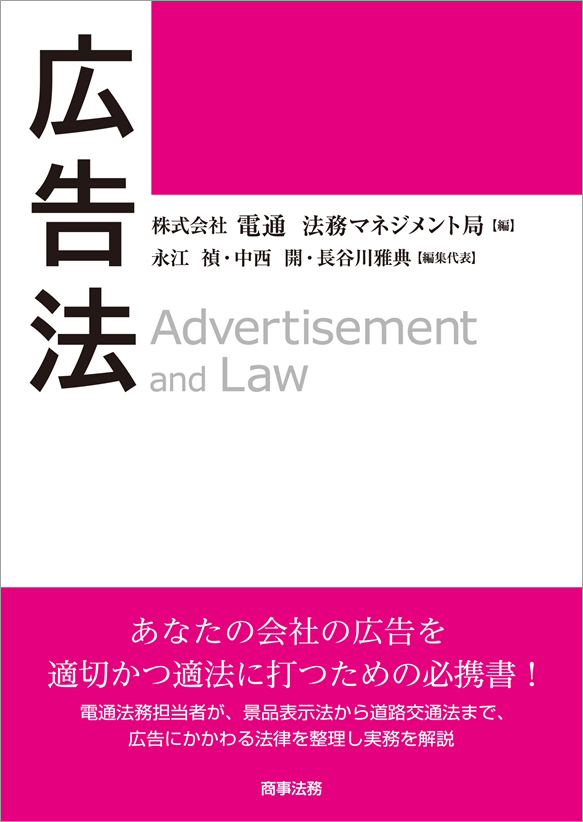
This concludes the final installment of the series "Understanding Advertising Legal Pitfalls in 3 Minutes." For a more detailed understanding of advertising regulations, please consider consulting the book Advertising Law, which comprehensively explains advertising-related laws and regulations from both practical and theoretical perspectives.
Thank you very much.
Was this article helpful?
Share this article


Newsletter registration is here
We select and publish important news every day
For inquiries about this article
Back Numbers

Author

Masanori Hasegawa
Dentsu Inc.
Legal Management Bureau
