
Note: This website was automatically translated, so some terms or nuances may not be completely accurate.
 Advertising Legal Pitfalls Explained in 3 Minutes [8/9]
What are the unique challenges of displaying content on the internet?
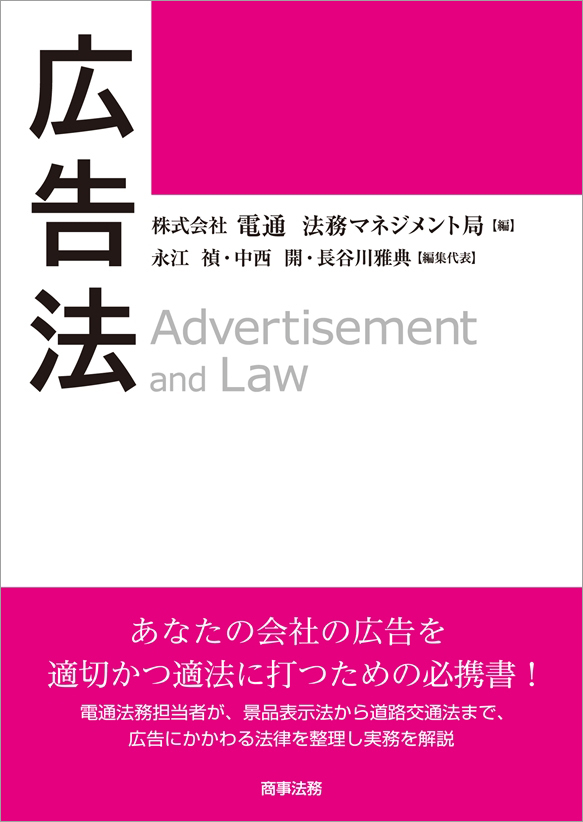
This series will focus on particularly practical points from the book Advertising Law, explaining them in a Q&A format.
Q. I am building a mail-order webpage.
I need to include a lot of information—product descriptions, prices (including discounted prices and discount conditions), order procedures, payment methods, returns, etc.—so I expect to split this information across several separate pages.
Are there any points to note in this case? Due to the nature of the internet medium, general consumers may not be able to see all the information at a glance. This happens when information spans multiple pages, as in the question, or when users must scroll to view all the information.
Given these characteristics of the internet medium, are there any particular display methods we should be mindful of?
A. Even in online displays, representations that mislead general consumers and unfairly attract customers are prohibited.
Care must be taken to avoid misleading general consumers through the method of display. Specific legal regulations exist for the internet domain. However, for internet advertising, regulations originally intended for the physical world often apply. One such regulation is the unfair representation prohibition under the Act Against Unjustifiable Premiums and Misleading Representations, introduced in Series No. 4.
This time, we explain points to note regarding representations on the internet from the perspective of unfair representation regulations.
[Basic Knowledge]
Regarding representations on the internet, the points to note under the Act Against Unjustifiable Premiums and Misleading Representations are essentially the same as for other media. Representations concerning matters related to products, etc., that mislead general consumers and improperly attract customers may constitute an unfair representation.
In online consumer transactions, general consumers often cannot easily view the entirety of the displayed content at a glance. This makes it easier for them to be misled during product selection or ordering compared to in-store, face-to-face sales. Consequently, consumer harm can spread more readily. Therefore, specific issues and points to note unique to online representations exist, such as the following.
1.Key Points for Displaying Important Information in Hyperlinks
In online transactions, information may be linked to external pages using hyperlinks. Specifically, when a consumer clicks on embedded elements like colored text, underlined text, or images with colored borders (hereinafter referred to as "hyperlink text"), the screen they are viewing shifts to the linked page, allowing them to view its content.
The linked page may contain important information (including negative information) relevant to the consumer's selection of products or services. Depending on the display method, consumers may be unable to obtain this important information, including negative information. In such cases, consumers may mistakenly believe that the product content or transaction terms are significantly superior or more favorable than the actual product or those of competing businesses, potentially constituting an unfair representation under the Act Against Unjustifiable Premiums and Misleading Representations.
Specific Example
A case where the hyperlink text is phrased abstractly, such as "Additional Information," while prominently displaying "You can return it if you don't like it," but the linked page states the return condition as "Returns must be made within 5 days including the day of product arrival."
If the linked page contains important information for selecting products, it must be easily accessible to consumers.
Specifically, regarding the hyperlink text:
① Use specific language that clearly indicates what the linked page contains, enabling consumers to recognize the necessity of clicking.
② Display it clearly, considering font size and color scheme, to prevent consumers from overlooking it.
③ Place the link near the relevant information so that general consumers do not overlook it.
These points require attention.
2.Key Points for Displaying Information Update Dates
In online transactions, the content displayed on web pages (including product details or transaction terms) can be easily altered. Consider a scenario where the information update date is not displayed, making it unclear when the displayed content was last updated.
In such cases, problems like the following could arise. For example, imagine a display emphasizing the novelty of a product with phrases like "New Product" or "Top-of-the-Line Model." If it's unclear when the displayed information is current, consumers might mistakenly believe the product is still new, even if it is no longer "new" or "top-of-the-line."
Similarly, if a display states something like "Big Sale Starting Today for One Week," but it's unclear when the information was posted, consumers might mistakenly believe the sale is still ongoing even after it has ended.
Therefore, the date the information was updated must be clearly communicated to general consumers.
Specifically:
① For the information update date: When display content is changed, clearly and accurately indicate the latest update time and the specific changes made.
② For information that is outdated and no longer reflects current facts, immediately revise the webpage content.
These points require attention.
The above covers (part of) the key points to note regarding the Act Against Unjustifiable Premiums and Misleading Representations when displaying information online.
For more details, please refer to 'Advertising Law', which comprehensively explains advertising-related laws and regulations from both practical and theoretical perspectives.
Was this article helpful?
Share this article


Newsletter registration is here
We select and publish important news every day
For inquiries about this article
Back Numbers


Author

Masanori Hasegawa
Dentsu Inc.
Legal Management Bureau

