
Note: This website was automatically translated, so some terms or nuances may not be completely accurate.
 Advertising Legal Pitfalls Explained in 3 Minutes [6/9]
What about contract fees for advertising appearances?
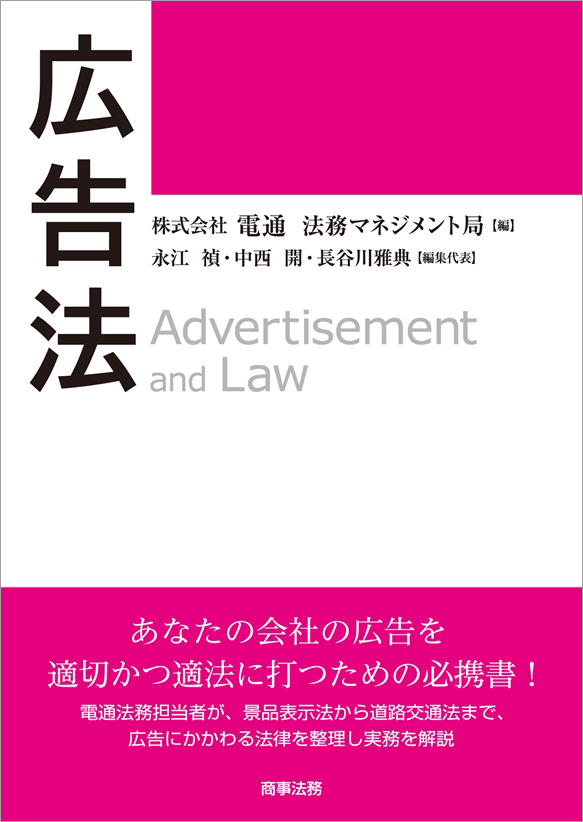
In this series, we will focus on particularly practical points from the book Advertising Law and explain them in a Q&A format.
This time, we focus on advertising appearance contracts and the legal relationships involved when advertisements use portrait photographs, videos, names, etc. (hereinafter referred to as "portraits, etc.").
Q. I've heard Japan doesn't have a specific law like a "right of publicity law."
Why must we pay a contract fee to talent when entering into an advertising appearance contract, even without such a law? I understand the appearance fee as compensation for the service of performing, but I don't quite grasp the contract fee. An advertising appearance contract is formed by mutual agreement between the advertiser, who wants the talent to appear in the ad, and the talent, who is willing to appear in exchange for compensation. If both parties agree that payment of a contract fee is a condition of the appearance, it is paid based on that agreement. Therefore, the answer to the question in Q, "Why must it be paid?", is "Because they agreed to pay it."
Now, let's examine why it is common in advertising appearance contracts to agree on a contract fee separate from the payment for the appearance itself.
A. While there is no specific law like a "right of publicity" statute, individuals do have the right to demand cessation of unauthorized use of their likeness or to seek damages when it is used without permission. This right has been established through the accumulation of precedents in various court cases.
The portraits of celebrities, such as entertainers and athletes, possess the power to attract customers (customer appeal). The right to demand an injunction or seek damages when a third party uses one's portrait, which possesses such customer appeal, without permission (in other words, the right to allow a third party to use it for a fee) is called the right of publicity.
The fee paid under an advertising contract can be considered compensation for the handling of the talent's publicity rights (i.e., permission to use the talent's portrait). As mentioned, celebrities have the right to seek an injunction or damages if their portrait is used without permission, based on their publicity rights. Therefore, in practice, paying compensation secures permission to use the portrait.
You can understand that this naturally applies to cases where photographs or videos showing a celebrity's face are used in advertisements, or where advertisements are created using the celebrity's name, such as "Recommended by [Celebrity Name]".
[Basic Knowledge]
How should we consider cases where the portrait or name itself is not used? Also, while we assume a celebrity is a living person, how should we consider cases involving individuals who have already passed away or non-human entities?
1.Cases Not Directly Using Portraits or Names
① Using a body part in a way that identifies it as belonging to the celebrity
② Using an illustration of the celebrity in a way that identifies them as the actual person
⇒ Both constitute unauthorized use of the celebrity's customer appeal, potentially infringing on their publicity rights.
③ Hiring lookalikes
⇒ This is a complex issue requiring a balancing of interests※1 from the following perspectives
・The fact that the actual person's likeness is not being used
・The fact that impersonation should be respected as entertainment
・While not using the celebrity's portrait or other personal attributes, it utilizes the image the celebrity possesses (or has cultivated)
However, care must be taken to avoid causing misunderstanding that the impersonator is the actual celebrity and to ensure it does not constitute defamation or slander against the celebrity.
※1 Comparing the interests of the parties and stakeholders, as well as other public interests, for the purpose of a reasonable interpretation of the law.
2.Cases involving the use of portraits of deceased celebrities
① There is no established doctrine. Consideration should be given on a case-by-case basis, taking various circumstances into account.
② From an advertising business practice perspective, factors to consider may include the following:
(1) Whether direct descendants are living
(2) Whether there is an entity entrusted with managing the portrait
(3) Whether there is a fan organization and whether there have been past complaints regarding advertising use
(4) Whether the use of the portrait is inappropriate for political, ideological, diplomatic, or religious reasons
(5) Whether there are any factual errors or defamatory content
In cases (1) and (2), fees may be paid to direct descendants or the company managing the portrait for its use in advertising (regardless of whether legally required).
3.Cases involving objects possessing non-human customer appeal (e.g., famous animals※2 or famous buildings)
① The publicity rights of objects are not legally recognized.
② However, if the shape or name of the object is considered to have customer appeal, it is entirely possible that the owner or manager of that object could assert some claim against unauthorized users.
③ In practice, to avoid such claims, sufficient consideration is necessary when using objects owned or managed by third parties in advertising. Obtaining the owner or manager's consent (and paying a usage fee) for advertising use is not uncommon.
※2 There was a case where a game software used the name of a famous racehorse without the owner's consent. The racehorse owner sued the company that produced and sold the game software, seeking an injunction against sales and damages.
For more details, please refer to the book 'Advertising Law', which comprehensively explains the legal regulations related to advertising from both practical and theoretical perspectives.
Was this article helpful?
Share this article


Newsletter registration is here
We select and publish important news every day
For inquiries about this article
Back Numbers

Author

Masanori Hasegawa
Dentsu Inc.
Legal Management Bureau

