
Note: This website was automatically translated, so some terms or nuances may not be completely accurate.
 Takasaki Takuma's Creative Clinic Special Edition [1/3]
The "Aging Scent of Expression" and Its Specific Remedy
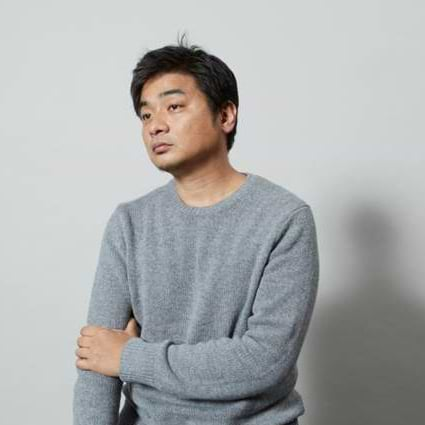
Takasaki Takuma
<Table of Contents>
▼The True Nature of "Old Man Smell" is "Déjà Vu"
▼Why Advertising Must Stay "Several Steps Ahead"
▼ "Originality" Can Eliminate Old Age Smell!
The True Nature of Old Age Smell is "Déjà Vu"
My beloved junior colleague Tomita-kun (pseudonym) is incredibly cocky.
He can't hide the fact that somewhere deep down, he finds me "annoying" – a trait his youth makes impossible to conceal. I understand perfectly, having been exactly the same myself. Working together, the major decisions rest with me, so it's inevitable he feels some stress.
"How can I avoid losing to your terrible proposals?"
There it is, Tomita-kun's terrible question. He's attacking me indirectly.
"Oh, I don't mean you, Mr. Takasaki."
Even Tomita-kun seems to have noticed my guard. After thinking for a moment, I taught him my secret move.
"In those situations, I'd say something like, 'Isn't that a bit outdated?'"
"That's super harsh."
Yeah. Honestly, if Tomita-kun said that to me now, I'd probably hold a grudge for about half a year. Looking back, I was quite an inconsiderate youngster myself. But it's also true that when you're young, that kind of resistance is about all you can muster.
Plans that easily gain client consensus often carry a sense of déjà vu. Experienced adults tend to flow into that direction to get the project approved and move the work forward.
The belief that expression must always contain new challenges is weak against the word "delivery." Facing adults falling one after another to the dark side, the powerless youngster couldn't even shout, "This has to be more interesting!" while ignoring his own project's shortcomings. Instead, he constantly uttered, "Isn't that kinda old?" What a troublesome, annoying young punk I was.
In truth, this phrase was quite effective. That single line from a youth feigning innocence often reset the meeting back to square one.
"Déjà vu might be like the stale smell of aging in expression."
"What do you mean?"
"That 'feels old' sensation comes with déjà vu, you see."
"I'll use that too."
Tomita-kun's eyes lit up.
"Tomita-kun, don't use that on me."
"Huh? Takasaki-san, you're surprisingly vulnerable to that sort of thing, aren't you?"
Tomita-kun smirks. Oh no, I've let the one person who absolutely mustn't know about it get a hold of my weakness.
The only way to silence this cheeky, lovable junior, Tomita-kun, is to keep coming up with projects that make him admit defeat. I have no choice but to reject his proposals outright.
But the truth is, part of why I keep working with this troublesome junior is because I crave this kind of pressure.
With age and experience, my planning speed has increased, but that also means I tend to land on "predictable outcomes" too quickly. Experience often clips the wings of imagination. This "predictable outcome" is the biggest cause of that stale, stale smell. It's a dumping ground for déjà vu.
The vaccine against this stench of age is my cheeky junior, Tomita-kun. The fresh pressure breathing down my neck from behind provides a good kind of tension. During the process of finalizing a plan, I inevitably start thinking, "Would Tomita-kun genuinely say 'This is great'?" which forces me to avoid predictable outcomes.
Plus, he's always lying in wait, eyeing opportunities to eliminate my plans. As a vaccine against creative age-related odor, he's undoubtedly top-tier.
Why Advertising Must Walk "Several Steps Ahead"
Advertising is also the job of walking just a few steps ahead of the world, pointing out what everyone will soon love. It leads everyone's curiosity.
"Wouldn't it be faster to just use the hottest celebrities or music right now?"
Tomita-kun, that's certainly true. You'd get a lot more immediate reactions. But if advertising starts running behind the times, people will eventually lose interest in it. I don't think people will invest their time or energy in information that holds no promise of "something new."
It's only natural that ads made with what's currently popular—meaning "slightly outdated" things—end up smelling stale. I simply can't imagine an ad with that stale smell striking a chord in people's hearts and becoming an unforgettable encounter.
"I see. For example, in graphics, we create comps using photos. Since those are made from existing material, they're full of déjà vu, right?"
"Exactly. We end up with that format because of all the approval processes, but maybe what we should rethink is the approval process itself. Creating an environment where newer ideas can more easily break through is probably part of being creative."
"A proposal with images just copied from the internet is absolutely out of the question."
There it is. Tomita-kun's signature boomerang. The proposal on this very table has images you found online pasted right into it. Tomita-kun is short-sighted. Or, to put it kindly, straightforward.
"That sense of déjà vu also means a lack of originality, right?"
While talking with Tomita-kun, I started thinking about how to get rid of that sense of déjà vu.
Slowly, Tomita-kun began jotting notes in his notebook. Its cover was boldly marked with "Hmm Hmm" in marker.
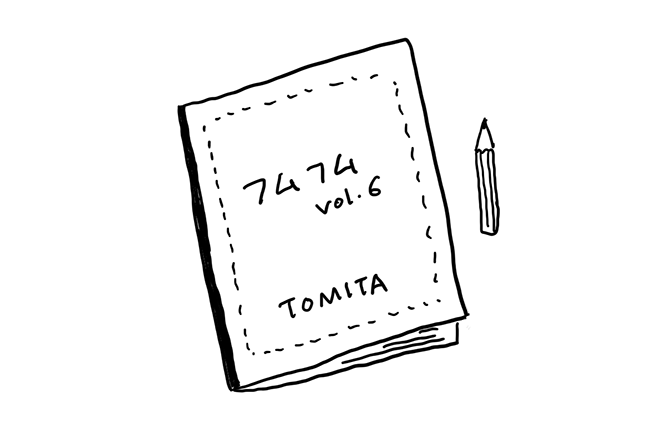
"What's that notebook for?"
"Oh, it's a notebook for jotting down good things Mr. Takasaki says."
I kinda felt like he was making fun of me, but whatever.
"In that sense, there are people who, even if they're young, come up with unoriginal ideas that reek of old age."
There it is. The deadly boomerang strikes again. He continues asking questions, completely oblivious. What a thick-skinned guy. I'm almost jealous.
"But if originality just means throwing out weird stuff willy-nilly, I could do that all day."
Tomita-kun, that's not what I mean. Originality here doesn't mean something alien or different. I took a sip of coffee, searched for my words slowly, and spoke.
"Originality" wards off that old-man smell!
"Since it's communication, the goal is getting the other person to act, right? Originality has to be an idea with a mission to reach that goal.
On top of that, I think it's about whether it's something only you could come up with, even if there are 10 people, 100 people, or 1000 people."
"Hmm hmm."
So, how do we eliminate that sense of déjà vu and bring out originality? One thing to consider is the existence of "constraints."
Working in advertising, you face countless troubles and unexpected, impossible demands. But expressions created by overcoming those troubles become overwhelmingly stronger than those made by sticking with your initial idea.
That's surely because the act of "overcoming constraints" ultimately generates ideas different from others and imbues the expression with originality.
So troubles and challenges are actually something to welcome. You, Tomita-kun, embody this perfectly.
"Troubles and challenges? Come to think of it, Takasaki-san, you often say the opposite of everyone else during meetings. Is that on purpose?"
Tomita-kun, if it wasn't on purpose, that just makes you a dangerous person. So that's how you saw me...
Anyway, "saying the opposite" might be my own way of combating that old-man smell. It could be a warm-up exercise to loosen my mind for leaping into original projects. It's true, when I say the opposite of what we've built up in meetings, I often come up with new ideas.
"Hmm hmm."
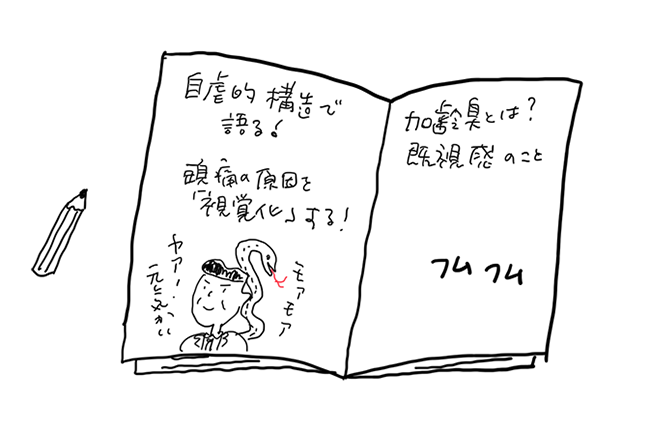
Tomita-kun finally wrote "Hmm hmm" directly into his notebook. I want a heart of steel like his.
Advertising will keep changing rapidly from here on out. Navigating these rough waters looks genuinely fun. Things that just pretend to be new vanish in the blink of an eye.
I'm genuinely excited to see how expression will transform and what answers Tomita-kun and his team will arrive at.
Was this article helpful?
Share this article


Newsletter registration is here
We select and publish important news every day
For inquiries about this article
Author