
Note: This website was automatically translated, so some terms or nuances may not be completely accurate.
 Takasaki Takuma's Creative Clinic Special Edition [2/3]
Strengthening the Core of Creativity Through "Verbalization"
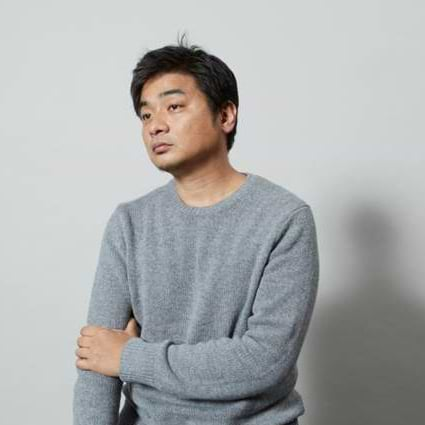
Takasaki Takuma
<Table of Contents>
▼The Importance of "Information Unrelated to Yourself"
▼Are You Thinking in Terms of an Extension of Past Advertising?
▼Try to "Put into Words" the Changes of the Times in Your Own Way
The Importance of "Information Unrelated to Yourself"
The other day, I had the opportunity to write this piece for the Nishinippon Shimbun.
Information Unrelated to You Is Precisely What Matters
Advertising expressions are highly sensitive to societal shifts, and recently, the move away from "mass" audiences has accelerated. Data-driven approaches, known as targeting, have become prominent—directly delivering ads tailored to individuals based on their behavior patterns. Naturally, this efficiency makes it popular with clients. This method isn't limited to advertising; it's applied to all forms of "information."
People say we've become "convenient" because we only receive the information we want. But is that really the case? Could it be that only the senders have become more convenient?
Is information unrelated to oneself truly unnecessary? Back when television reigned supreme in the living room, cosmetic commercials taught us about the changes in beauty, and whiskey ads we couldn't afford taught us the meaning behind the middle-aged man's back, tasting the sorrow of life. Television, which forced us to watch commercials, was undoubtedly a device for learning about "others' values."
We call the gathering of people sharing the same values a community, and we develop communication directed towards it. Because there is one strong value there, deep relationships are easy to form. However, a tendency to exclude everything else also emerges. It becomes a kind of village, and once inside, that community seems like the whole world. The mechanisms designed to increase the efficiency of information can actually be said to be rapidly distancing us from people with values different from our own – in other words, from the existence of "others" in our lives.
Knowing others. Understanding others' values. This cultivates imagination. Imagination is the starting point of kindness. The weakening of television and mass media might be robbing us of something vital—something we unconsciously sensed through our skin and perceived our place in relation to others. Advertising is said to be a mirror of the times. Perhaps we've entered an era of community-building where imagination toward others has diminished—an era where cultivating kindness requires effort.
Technology evolves at an accelerating pace, dramatically transforming our environment. It's exhilarating to revel in the era at the forefront of this evolution. Yet, whenever we gain something, we inevitably lose something else. I want to remember this. I want to be someone who can truly imagine the lives of others, not just my own.
(Published in the Nishinippon Shimbun, December 23, 2018)
After the manuscript was published, at our usual coffee shop, my beloved cheeky junior Tomita-kun (pseudonym) said apologetically:
"Takasaki-san, your column is getting a lot of 'likes'!"
There was a bit of a sting to his tone. It seemed Tomita-kun didn't actually think it was "likable."
"Got a problem with it?"
"I just noticed the people hitting 'Like' are mostly middle-aged guys."
Ouch. He might be right. The reactions were especially strong when I linked it on Facebook.
"Do you have a different opinion, Tomita?"
"I don't think it's different, but I feel like it's time to move past this whole 'change or no change' talk."
Ouch. That might be true. The younger generation probably thinks, "Enough with the 'rise of digital and what we've lost because of it' talk—let's talk about the future."
"It just feels kind of old-fashioned."
Ah! Tomita-kun, you've already used the weapon I taught you the other day ( see previous column ). But this attack isn't aimed at my project, it's aimed at my way of thinking, so it doesn't hurt that much.
Because ways of thinking can always be updated. While right-brain deterioration is inevitable, left-brain decline can be covered up endlessly. In fact, the left brain improves with experience, so we should verbalize events like this as much as possible and make them our own.
Indeed, maybe it's time to stop debating whether things will change or not. Instead of voicing such opinions, we should focus on creating concrete outputs that embrace serendipity. Output speaks far louder and holds far more value than mere opinions. Oh dear, have I become just another old man spouting opinions without action?
Aren't we just thinking in terms of an extension of traditional advertising?
"But I think this community concept is good."
Oh no. Tomita-kun is totally outclassing me.
"I came up with a non-mass project idea. Could you take a look?"
Suddenly, I found myself intrigued by the term "non-mass" Tomita-kun keeps throwing around lately.
"Tomita-kun, you keep saying 'mass' and 'non-mass'... But just by saying that, it feels like you're only thinking from a mass perspective."
"Huh? What do you mean?"
That question mark over his head is kinda creepy. Like a rebellious son.
"Maybe the whole idea of replacing mainstream with non-mainstream is already outdated."
I decided to counter with, "Isn't that outdated?"
"Ugh."
Tomita-kun growled, turning his grunt into printed text.
"Takasaki-san, you're absolutely right. I can't argue with that. I was thinking about covering what we could do with TV commercials using other means. But yeah, that really is old-fashioned. Especially since creatives have finally been freed from the constraints of media."
Seeing Tomita-kun looking more reflective than usual made me feel quite amused, but then his words, "creative work freed from media," really caught my attention.
"Liberated from media" – that phrasing feels overly dramatic. Without a platform for expression, we can't really make waves. But what happens to commercials once freed from the TV format? I still don't see today's video ads as expressions liberated from that framework.
For instance, it might bring us expressions liberated from the time constraints of "on-air" schedules. We might start creating materials designed to be used for ten or twenty years from the outset. That perspective could transform the very nature of video. Indeed, people already archive old commercials on YouTube and enjoy them as current content.
Comparative advertising, long considered incompatible with our national character, might emerge as a new form of entertainment. Perhaps a year-end tradition could be a showdown between Company A and Company B, like a pro wrestling match.
In any case, if we only think along the lines of the past, we risk missing a huge opportunity. I have a feeling that filmmakers coming from completely different fields, creating entirely different kinds of visuals, will revolutionize the era.
My approach is built on the thrill of being seen by everyone and the respect that comes with it. Now, as the very concept of "everyone" is fading, there's a danger my sensibilities themselves are becoming outdated. Time to start over from scratch, I guess.
I'll try to "put into words" the changes of the times in my own way.
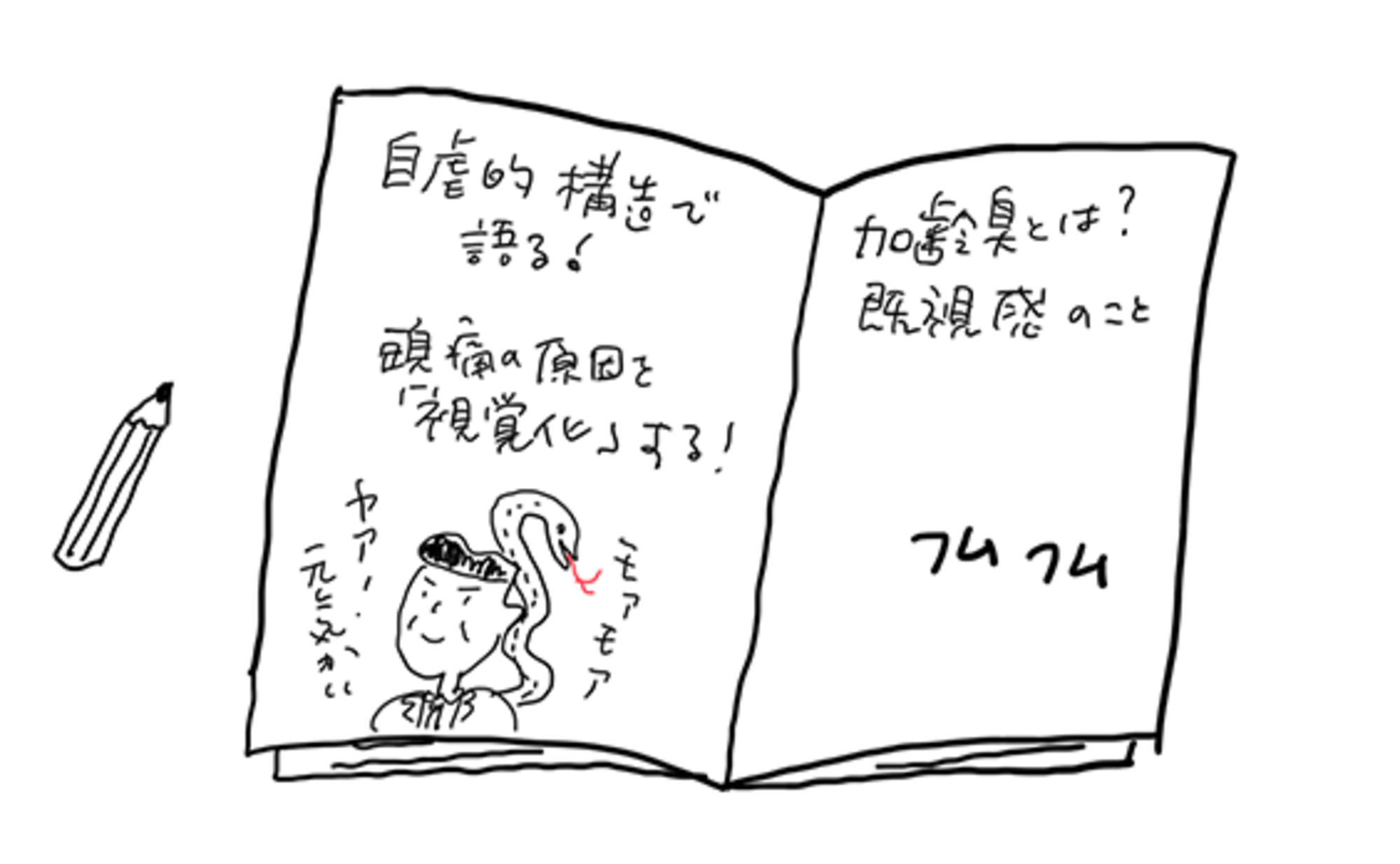
"Hmm hmm"
Tomita-kun jotted down what I blurted out in his notebook.
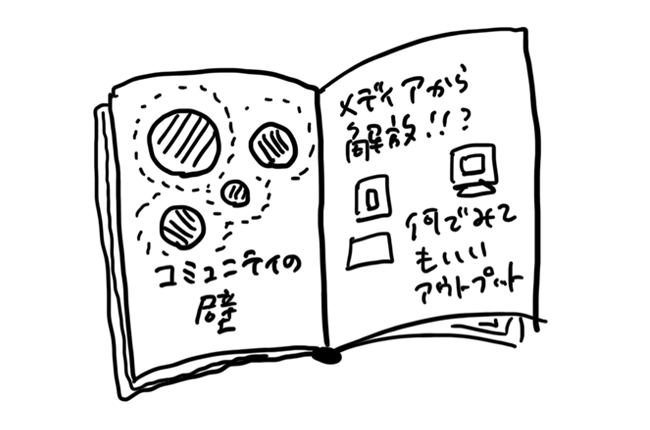
"Takasaki-san, you put things into words right away, don't you?"
"Would you call it 'putting things into words'?"
"You talk while thinking a lot during planning sessions too, right?"
"That's exactly what verbalizing is."
"That's 'genkoka' for you."
When Tomita-kun says it, it somehow sounds like a bad habit, but I actually think this "verbalizing" is a very important act. Putting the changes in the world, the changes in media, into your own words. Why does that expression hit the mark? Why doesn't this one? When you give a really successful technique a name like "the XX method," it suddenly becomes a skill.
I know I'm repeating myself, but the deterioration of the right brain is something we can't help. We just have to train our "mental muscles" in our own way to keep them flexible. However, the left brain can be trained endlessly. And most planning can be built and refined using the left brain. Once you've done that, you just wait for the right brain to make its leap.
Verbalizing ideas is like core training for creativity. Planning is perishable. If you don't verbalize and understand the times, your ideas will become misaligned.
The other day, when I met Mr. Yuji Horii, the creator of "Dragon Quest," and discussed the movie adaptation copy, he pointed to the word "hero" in my copy and said, "That word might carry too much weight now." I was utterly astonished by the sheer sharpness of his intuition.
Once pointed out, I understood. But that initial intuition—that sensitivity—might be something only geniuses possess. I felt ashamed for casually using the word "hero" just because it was Dragon Quest. Since my talent for feeling is weak, I have no choice but to use my left brain to compensate for my right brain.
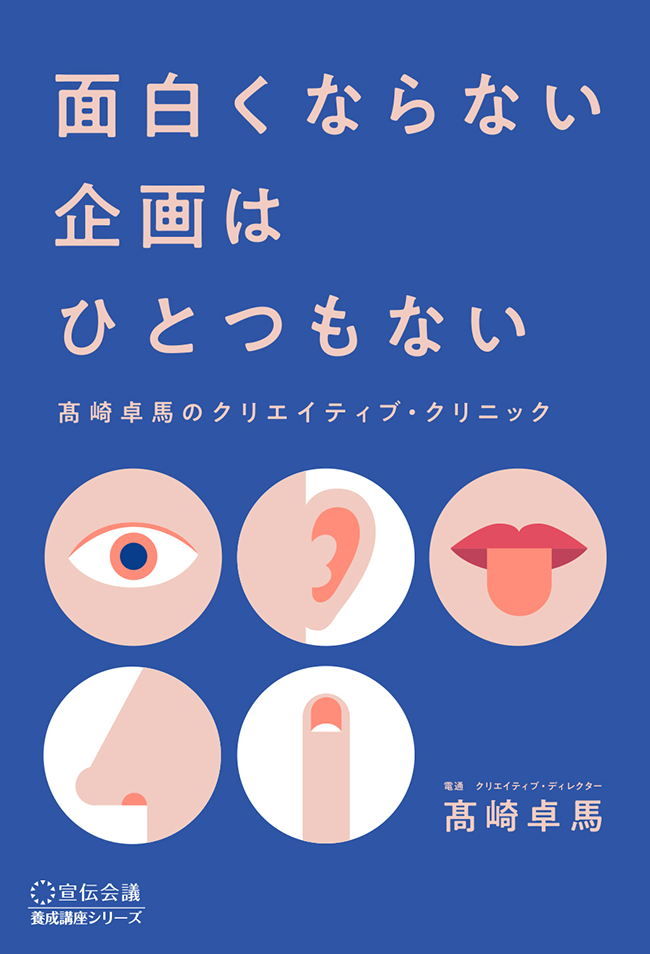
"We touched on something similar in that recent book, in the conversation with Mr. Nakahata."
"Yeah. In the part about love and courage. I haven't quite grasped that kind of feeling yet. That's my challenge."
Tomita grinned.
"Also, your next challenge, Takasaki-san, is nurturing your juniors."
Tomita-kun... I might actually like you.
Was this article helpful?
Share this article


Newsletter registration is here
We select and publish important news every day
For inquiries about this article
Author