
Note: This website was automatically translated, so some terms or nuances may not be completely accurate.
 Takasaki Takuma's Creative Clinic Special Edition [3/3]
If you discover a good mission, your expression score will naturally improve.
Takasaki Takuma
<Table of Contents>
▼The Challenge of Tomita-kun's Wedding Video
▼What Expression Will Resonate with Everyone at a "Reception" Where Diverse Communities Mix?
▼Once the Mission is Set, the Expression Suddenly Appears
The Difficult Task of Tomita-kun's Wedding Video
"Could you make a wedding video for us?"
My beloved junior Tomita-kun is finally getting married. That makes me incredibly happy. And apparently, they're having a fairly proper ceremony. I felt happy seeing that thoughtfulness toward his partner.
But... I never expected this request. I'd been vaguely thinking I needed to diet to fit into a suit, so this caught me off guard.
"Takasaki-san, you seem better at that than speeches."
Tomita-kun, why must you diss my speech skills to praise my video skills? Well, it's for my cute junior, and I've made quite a few wedding videos back in the day. It'll be good practice after so long. I guess I'll give it a shot.
"Oh, and no celebrities or anything. She doesn't really get that kind of thing."
Ah, he saw right through me. I'd instantly thought I could just lightly ask that person or that other person I work with on shoots for comments, and it wouldn't flop. Damn. Tomita-kun is sharp in these situations. He's the type you don't want as a client.
After that, I couldn't focus on planning all day because I kept thinking about the wedding video. The viewers will be right there watching it play, and of course, I'll be there too. I'll be exposed. It's a live event with no room for corrections once it starts. The fear of messing up is practically traumatic.
And the biggest factor complicating the project is that multiple communities exist there. Family members are there. Distant relatives too. Grandpas and young people alike. Old friends unaware of my current job, and professional acquaintances I associate with.
"I'm super excited. I won't watch it until the day of."
Tomita-kun, any hints? You know we can't perform at our best without constraints, right? Just give us your usual list: "Don't do that bit," "Make sure her family is included," "But keep it short," "Go for heartfelt over gags," "Lady Gaga is okay as a special guest." Just keep them coming. Give us something to work with.
"We're leaving it all up to you. We trust you, Takasaki-san."
Hee. We're in big trouble. Just when we need it most, we get this devilish order: "Make it freely." Our job is to flip constraints into ideas and get praised as "truly amazing." Tomita-kun, you're definitely the type I never want to be a client.
What kind of expression would resonate with everyone at a "reception" where diverse communities mix?
That day, I couldn't come up with a single idea. Everything felt like it would fall flat. The next day, I flipped the switch and decided to treat this as just another job.
- Defining the Mission
- The expression method to achieve it
It's a very basic thing, but I decided to think it through thoroughly.
First, let's define this video's mission. What exactly do we need to achieve? What's common among all the different people who'll be there?
It's "Tomita-kun and his girlfriend." Videos like this need laughter and love. To generate laughter, I first thought "teasing Tomita-kun" was essential.
When interpreting complaints about commercials, I often find that "not understanding" is the root cause. The moment someone thinks "I don't get this," they feel alienated. To justify that alienation, the emotion "annoyance" arises, which then crystallizes into a complaint like "I don't think they should air something like that."
Therefore, the most crucial element in creating laughter is eliminating this "I don't get it" feeling. In the case of a wedding reception, the universal common ground is "Tomita-kun."
When teasing Tomita-kun, we mustn't forget the naive presence of the woman who chose him. In other words, the ideal is teasing Tomita-kun in a way that makes her laugh.
Not long ago, I met Tomita-kun's parents at some awards ceremony. I remember his mother being very unique and cheerful, and his father sincere and kind-hearted. The fact that Tomita-kun came from these two is a miracle in the opposite sense.
"Do his parents like her?"
At my question, Tomita-kun started bragging like I'd never seen him do before.
"Marrying her is my greatest act of filial piety. They both say so."
Hmm. I locked onto that expression on Tomita-kun's face, one I'd never seen before. I decided to make it the thing that would surprise and delight him the most. Well, the mission was set.
- [Objective] Make Tomita-kun laugh with genuine delight
How to achieve it. Once the mission was set, ideas emerged like fog clearing. Clear vision. I decided on a strategy to keep Tomita-kun out of the loop.
In other words, make everyone except Tomita-kun the participants, and use his absence to highlight him. Since he said he wouldn't watch it "until the day itself," it would also be a surprise. Surprise is the ultimate weapon that grabs hold of people's hearts.
Plus, no matter how much we tease Tomita-kun, his family are involved, so there's definitely love there. And for Tomita-kun, his family and girlfriend's words should be his most treasured possessions.
- [Method] Interview Tomita-kun's family and girlfriend without him knowing
But that alone isn't funny enough. Even if we try to make it funny, there are limits because they're amateurs. So I came up with a plan: just edit the questions and answers as we see fit. It's applying montage theory—changing meaning through editing.
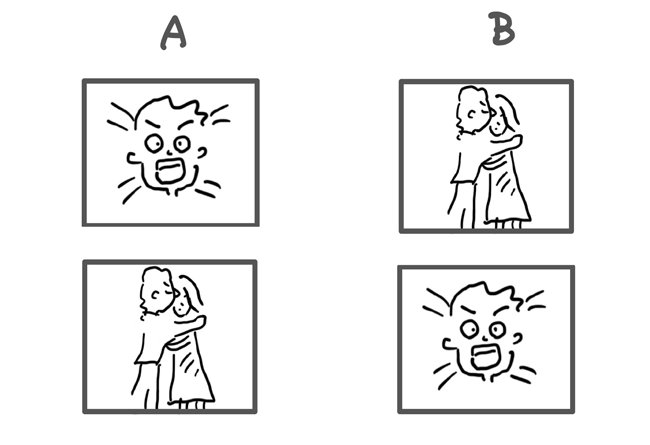
For example
- (A) Surprised
- (B) Hugging
If you sequence these two clips (A) → (B), it looks like joyful surprise at their meeting. But if you sequence them (B) → (A), it looks like the person hugged had some problem. That's how editing creates a completely different meaning.
Once the mission is confirmed, the expression appears suddenly
We ask Tomita-kun's father and mother questions like, "What would happen if you encountered an alien?" or "Describe an eel in words." They answer very seriously. Right before that footage, we insert questions like "What do you think about her?" or "What do you think about your son?" as titles.
Question: "How did you feel when you first met her?"
Mother: " I was scared. I disliked her."
Question: "What kind of child was Tomita-kun when he was little?"
Father: "He was tiny, with big eyes, and all slimy."
The editing continues like this. So at first, everyone goes "Huh?" The sharp ones start to realize around the third clip that the questions and answers are somehow mismatched.
Question: "What would you do if your girlfriend poured you a drink?"
Father: "Well, I'd totally knock her out. Or rather, since knocking her out might be a problem, I'd probably call the police? Hey, Mom?"
Mom: "I actually don't like it. Especially that chewy feeling when you bite into it."
Eventually, everyone starts imagining what the original question was and bursts out laughing. Then, in the latter half, they weave in a slightly heartwarming story, gradually mixing in tales of childhood hardships or nice things they couldn't say directly, steering the aftertaste toward "emotion."
This way, everyone at the ceremony can enjoy it at their own level, and they can also enjoy Tomita-kun's flustered reaction as he sees the video for the first time right there. It gives the live footage a double dose of entertainment.
Truly, Tomita-kun's parents and his girlfriend's endearing character made the video wonderful. What a treasure of a family for Tomita-kun.
Once the mission is defined, the expression suddenly materializes. Unlike an orientation, this act determines what the work should achieve and why it exists. It becomes entirely the creative director's job. If the mission is wrong, no matter how interesting the concept, it won't work.
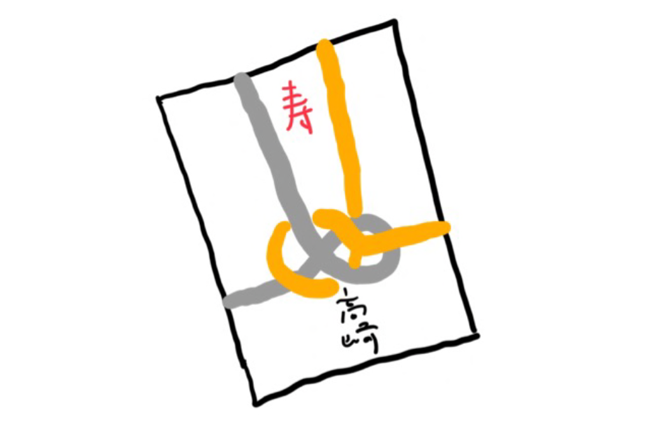
"I'm so glad I'm your junior, Takasaki-san."
Oh, Tomita-kun, are you crying? With a personality like yours, you'll surely hit many walls from now on. Things won't always go smoothly. But seeing your family, I felt like you'll manage somehow. I think I understand why I somehow like you. This job often blurs the lines between on and off, but first and foremost, cherish this wonderful family.
"But when you wear a suit, Takasaki-san, you look like a Shichi-Go-San kid."
Shut up.
Was this article helpful?
Share this article


Newsletter registration is here
We select and publish important news every day
For inquiries about this article
Back Numbers
Author