Note: This website was automatically translated, so some terms or nuances may not be completely accurate.
 Learning Global Business at Dentsu Inc. Aegis Network EIBA Report [1/5]
Working at a Digital Creative Agency in India
In Search of Secret Creative Spice
Me: "I read the brief. When's the next meeting?"
Person A: "Probably tomorrow."
Me: "What time tomorrow?"
Person A: "In the afternoon, I guess?"
If this conversation were happening in our Tokyo office with a new hire, I would have politely explained the importance of asking for someone's time in business and taught them how to schedule appointments in Outlook.
But this is India. An office in Gurgaon, an economic hub with full-blown air pollution. And the person I'm talking to is an excellent boss.
Since January 2019, I've been working at Dentsu Webchutney, a digital creative agency and part of the Dentsu Inc. Aegis Network in India.
My title in Japan was Copywriter/Creative Planner. I spent about ten years planning and producing integrated communications. I came to India as a member of Dentsu Inc.'s EIBA(※) training program to gain experience in "global business" at an overseas office.
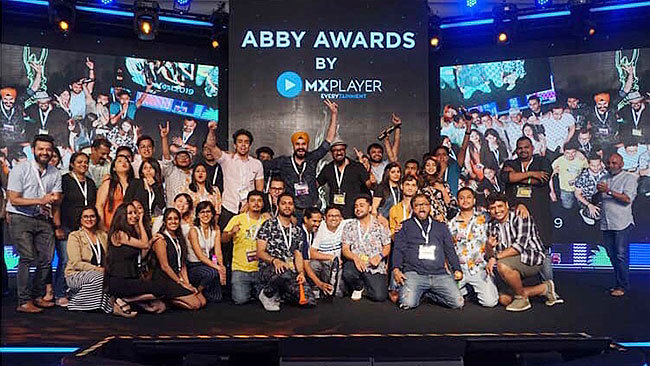
India's digital advertising market is growing remarkably fast, with an annual growth rate exceeding 30%. Dentsu Webchutney is a company that has achieved significant results within this market. At GOA FEST, India's largest advertising festival, it won Digital Creative Agency of the Year for two consecutive years and this year also won Agency of the Year in the PR category.
It also won the Black Elephant, the grand prize at the Kyoorius Creative Awards, part of the One Club series known for its strict standards on idea quality. The winning entry, "Hagglebot," was an idea for India's leading e-commerce site, Flipkart. It allowed users to haggle with Google Assistant, replicating the quintessential Indian shopping experience of bargaining, to get discounts. This combination of local context and technology reportedly garnered significant support.

Working in the same office, I wanted to uncover the secret behind their growth. That expectation brought me here. Surely there must be some secret spice, like a unique Indian approach rooted in their mathematical strength, or a way of finding insights unique to a country with such linguistic and cultural diversity!
However, even after spending about five months here, the intricately blended secrets of their work remain elusive. Much of what I imagined stemmed from stereotypical misconceptions. The bulk of "creative work in the digital advertising market" wasn't secretive at all—it was just a steady accumulation of down-to-earth, diligent work, much like in Japan. Still, I feel I've come to understand several key elements supporting this office's growth. So this time, I'd like to introduce two "spices" of Dentsu Webchutney that I've discovered through my work so far.
Spice #1: Speed in Responding to Change
The exchange at the beginning of this article is a conversation I actually have almost every day. Just looking at the scheduling methods alone, you can see how different things are compared to Japan.
Similar anecdotes might lead many to assume Indians are lax about time. As the joke goes, IST stands for India Stretched Time, not India Standard Time – and indeed, their sense of time differs greatly from Japan's. However, working alongside them reveals they are anything but "sloppy."
While schedule management is flexible, once they get started, the speed at which they move things forward is incredibly fast. Their burst of speed, especially in getting a first draft out, is truly remarkable.
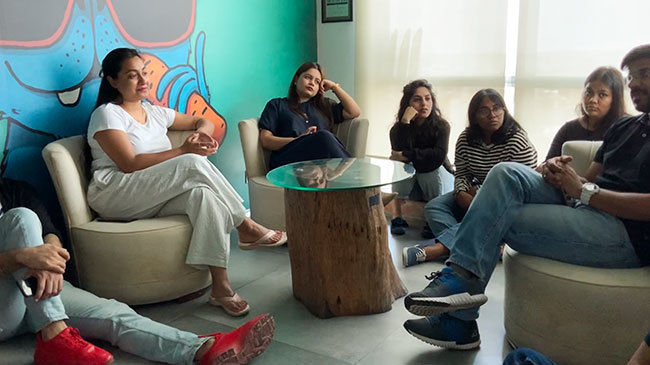
During competitive presentation prep, if a morning brief was shared, by evening we'd have a meeting where everyone brought their proposals. It was common to have two or more meetings in a single day for the same presentation. Preparation for meetings was mostly verbal, with little written material. Discussions would sometimes start spontaneously around desks.
After several days of such discussions, everything is suddenly documented. At the Tokyo office, the sales team and producers meticulously scheduled everything, and meetings for a single project were typically spaced 1-2 days apart. Getting used to this pace was quite challenging.
In the Japanese style, staff individually brainstorm ideas, document them, and bring them to meetings. By the time everyone gathers, ideas are significantly developed and refined. This also makes it easier to share with absent members and review discussions later.
In contrast, the style here involves repeated, spontaneous discussions based on the idea that "sharing the best solution in the moment is the fastest way to find the optimal one." Verbal communication carries significant weight.
Since meeting minutes aren't taken and data isn't shared, it initially felt inefficient—like we kept repeating the same discussions, with comments like "That's different from what you said last time!" or "Wait, wasn't that already decided?"
However, as I participated in several projects, I gradually came to understand the strengths of this approach.
Here, the fundamental "premise" underpinning a project often changes. While Japan has terms like "orientation reversal," here the client's challenges, budget, media/platform landscape, and even national policies can shift dramatically.
It's a place where things like a key person suddenly leaving the company, TikTok downloads being banned, or high-denomination banknotes being abolished happen as a matter of course. It's only natural for briefs to be overturned.
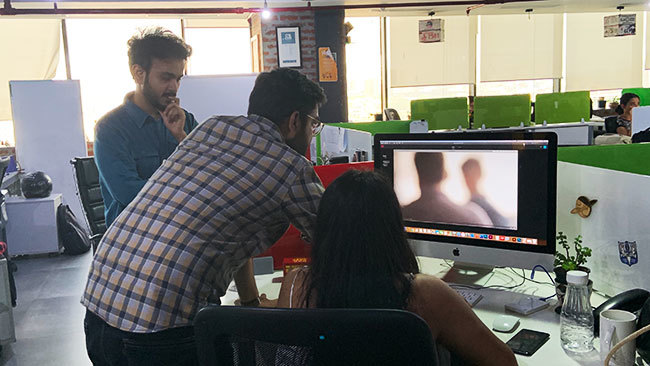
When that happens, speed is absolutely essential in responding. If you spend time "reviewing," "organizing," and "documenting" each step, the precision of the plan might improve at intermediate stages, but the risk of wasted effort increases. The secret to getting more ideas out into the world in this rapidly changing market isn't to nail everything down before moving forward. It's to decide while thinking, create while deciding, and change while creating.
A prime example of this speed in action is "Voice of Hunger," which won Silver in the Direct category at this year's Cannes Lions. This campaign for food delivery app Swiggy involved creating waveforms resembling food shapes using Instagram's Voice DM feature. It launched in February 2019 – just about two months after Instagram added Voice DM.
Spice #2: An Uncompromisingly Proactive Proposal Stance
Another secret is the proactive approach: continuously making independent, proactive proposals. In this office, "proactive proposals" are not optional or a service—they are practically mandatory. Regardless of the project, the moment they open their mouths, it's proactive.
This applies not only to competitor presentations or new client work, but also to ongoing clients and even projects where the creative content or media are already largely decided. They persistently add proactive ideas to their proposals.
Having experienced Japan's approach of meticulously implementing finalized plans, I sometimes get nervous thinking, "Proactive is great, but shouldn't we stop planning and start creating soon or we'll miss the deadline?"
This stems from the reason mentioned earlier: in a market where "fundamental assumptions change," it's risky to only respond to what's demanded at any given moment.
Furthermore, as I continued working, I realized that the very founding of Dentsu Webchutney itself significantly influenced this approach.
At the gala party for GOA FEST, I had the chance to speak with the two founders and ECDs of the company.
They shared the story of how their company, which started 20 years ago as a small offline design studio, spotted the potential in India's nascent digital advertising market (at the time the company was founded, India's internet penetration rate was less than 1%) and gradually expanded their business.
They recounted how, for their first banner ad job from a global corporation, they persistently proposed ideas beyond the brief until they finally secured an opportunity to execute them. How these proactive proposals led to award-winning campaigns and invitations to pitch against competitors. How as their client base grew, so did their team, eventually establishing offices in three locations. And how, in their 14th year, they decided to join the Dentsu Group to access a broader global network.
To expand our business as a creative agency, we must constantly keep our antennae tuned to the challenges of our clients and society, and continuously demonstrate that we are a company capable of delivering more than what is requested. Writing it down makes it sound obvious, but hearing it in the Tokyo office, where there were over 200 people in my cohort alone, carries a completely different sense of urgency.
For me, working in the same office as the "founder" was a first. Speaking in a calm tone, the founder stated, "This year we won 'Agency of the Year' for digital and PR, so next year we want to return to our roots and aim for design too." Yet, I sensed the strength of someone who built and sustained a company.
Looking at the global advertising industry, companies that didn't exist ten years ago have become major clients and platform giants, and even they might not exist ten years from now. Webchutney's clients, like Flipkart and Swiggy, are Indian unicorns. Precisely because they themselves started as a startup, they understand the situation of their clients – the need to grow at breakneck speed and constantly improve their services – deeply as partners.
Yet the fundamentals of creativity remain the same
Beyond the two "spices" introduced here, this office likely holds many more secrets to its growth. At the same time, as an advertising agency within the Dentsu Group, there are also many commonalities. Particularly, the core principle of creativity – "The thinker is the most important, but the one who can bring it to the world is even more important" – feels unchanged no matter where you are. My days in India will last at least another six months. I want to realize as many ideas as possible and discover as many creative spices as I can.
(※)EIBA (Emerging International Business Assignment)
A practical training program where young employees are dispatched for one year to Dentsu Inc. Aegis Network locations as part of developing next-generation talent. The goal is to gain business experience in a cross-cultural environment and acquire the perspective, skills, and network necessary to lead projects, both domestically and internationally.
Was this article helpful?
Share this article


Newsletter registration is here
We select and publish important news every day
For inquiries about this article
Author

Mami Koyama
Dentsu Inc. Web Chat Ni (India)
Associate Creative Director