Note: This website was automatically translated, so some terms or nuances may not be completely accurate.

Dentsu Inc. Diversity Lab (DDL), which researches the Diversity & Inclusion field (an approach aiming to respect each person's diverse individuality and promote social participation for all), announced the results of its large-scale survey "LGBT Survey 2018" (effectively an LGBTQ+ survey)※1 in January 2019.
This report examines corporate initiatives, which play a crucial role in promoting understanding of LGBT individuals. As awareness of human rights for LGBT people has grown, diverse corporate activities have been significantly impacted. Addressing LGBT issues has become an urgent priority for companies, affecting both external marketing activities targeting customers and internal policies for employees.
*1 Regarding the definition of LGBTQ+
In DDL's "LGBT Survey," individuals belonging to sexual minorities such as LGBT have been referred to as the "LGBT community" for convenience.
This term excludes individuals who fall under the "Sexuality Map" (which categorizes sexuality based on biological sex, gender identity, and the gender of the person one is attracted to) as straight: those whose biological sex assigned at birth aligns with their gender identity and who are heterosexual.
Therefore, this "LGBT group" also includes "Questioning (Q): individuals who are unsure or have not yet determined their gender identity or sexual orientation" and others.
Municipal and Corporate Movements
Regarding the same-sex partnership ordinances and systems introduced by Shibuya Ward and Setagaya Ward in October 2015, the life insurance industry was among the earliest to take action. Previously, beneficiaries of life insurance policies were limited to spouses or children. Following these ordinances, the industry rapidly examined what system changes were necessary.
Simultaneously, awareness grew within companies that many employees identified as LGBT.
Furthermore, the Olympic Charter prohibits discrimination based on gender or sexual orientation. The procurement code established by the Organizing Committee requires bidding companies to commit to non-discrimination against LGBT individuals.
Amidst this momentum, Tokyo, the host city for the 2020 Games, passed and enacted the "Ordinance Aiming to Realize the Human Rights Respect Principles Stated in the Tokyo Olympic Charter" in October 2018, prohibiting discrimination against LGBT individuals.
As many companies sought clear guidelines on how to address LGBT issues, the "work with Pride (wwP)" conference, designed to explore measures supporting LGBT employees, began in 2012 as a corporate study session and information-sharing forum.
In 2016, the "PRIDE Index" was established, comprising five indicators (P: Policy = Action Declaration, R: Representation = Community Involvement, I: Inspiration = Awareness Activities, D: Development = HR Systems & Programs, E: Engagement/Empowerment = Social Contribution & Outreach). This system began evaluating and recognizing companies based on their actual practices. In 2018, 153 companies and organizations entered, with awards given as follows: Gold (130 companies), Silver (18 companies), and Bronze (5 companies).
Effectiveness of Internal Company Initiatives
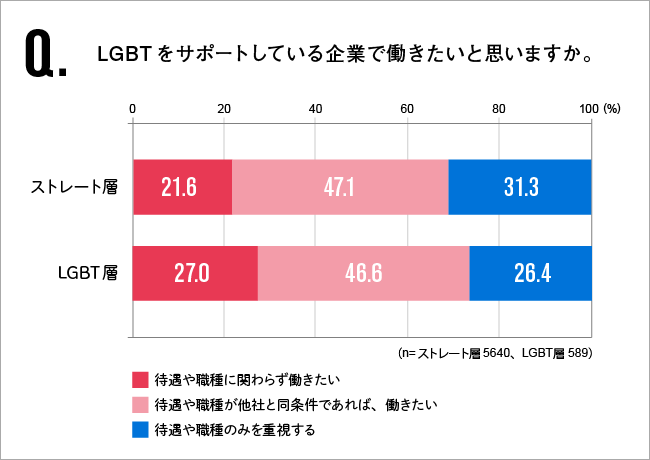
The "LGBT Survey 2018" continued the question from the previous 2015 survey regarding the relationship between companies and LGBT individuals: "Would you like to work for a company that supports LGBT people?" 68.7% of straight respondents answered affirmatively (21.6% would like to work regardless of treatment or job type; 47.1% would like to work under the same conditions), a 4.7-point increase from 64.0% in 2015 (12.7% and 51.3%, respectively).
Furthermore, the top box response ("Would work regardless of treatment or job type") reached 21.6%, a 1.7-fold increase. This directly reflects the view that "companies friendly to LGBT individuals are also friendly to all employees, respecting individuality and providing a comfortable working environment." This trend suggests a growing emphasis on this perspective over the past three years.
Many universities in Japan already have established LGBT clubs conducting various activities. Examples include companies holding information sessions specifically for LGBT students and NPOs supporting job hunting organizing events to match students with companies.
It is no longer uncommon for companies to train interviewers with manuals on LGBT knowledge to prevent SOGI harassment (Sexual Orientation and Gender Identity Harassment).
In an era where Japan's working population is shrinking and the risk of bankruptcy due to labor shortages is increasing, companies demonstrating an LGBT-friendly stance can unlock numerous possibilities: attracting top talent, reducing employee turnover, increasing employee engagement with the company, and improving performance.
Impact on Corporate Marketing Activities
Companies addressing LGBT issues also appear to have an advantage in their customer-facing marketing activities.
When asked, "Would you actively use products/services from companies that support LGBT?" 54.1% of straight respondents agreed (10.0% would actively use them regardless of price/content, 44.1% would actively use them if price/content were comparable to competitors). This represents a 1.4-point increase compared to 52.7% in 2015 (8.7% and 44.0% respectively).
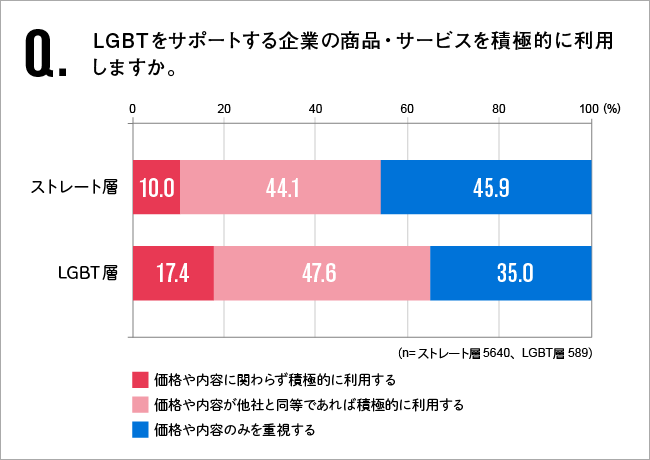
In increasingly commoditized competitive markets, fostering goodwill toward companies by being LGBT-friendly proves a highly effective strategy. Notably, positive sentiment toward companies respecting diversity extends beyond LGBT individuals themselves, frequently extending to straight customers. Case studies confirm that campaigns supporting LGBT communities lead to increased foot traffic and sales among straight customers.
Corporate Initiative Stages
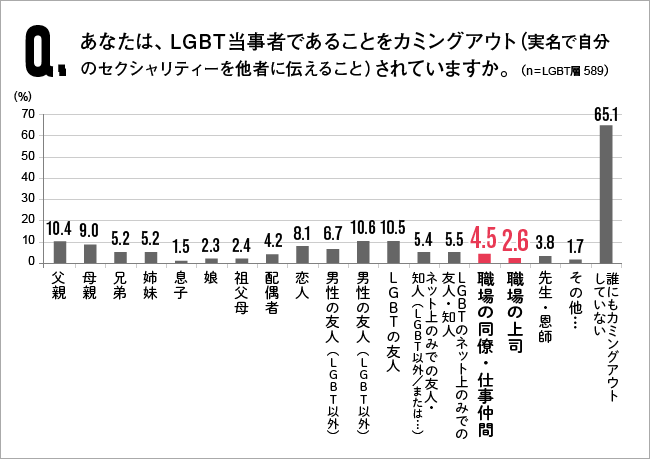
Regarding who they came out to, "workplace supervisor" was 2.6%, and "workplace colleagues" was 4.5%, indicating workplace coming out is not widespread. On the other hand, "haven't come out to anyone" reached 65.1%, showing coming out itself is overwhelmingly uncommon.
Furthermore, when asked, "Does your company have support systems regarding sexual diversity?", only 16.3% of respondents answered "Yes" (5.5% said there are sufficient support systems, 10.8% said there are support systems but they are insufficient). This indicates that the current state of support system implementation is far from adequate.
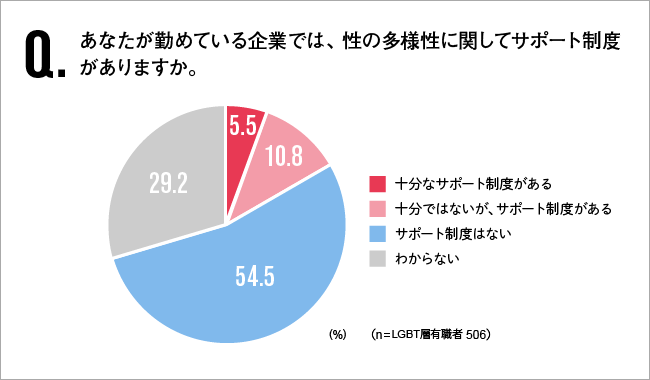
Even if support systems exist, they are meaningless unless two conditions are met: their operation must be designed so that using them does not lead to outing (forced disclosure of sexuality), and superiors or colleagues who learn of such use must not engage in discriminatory words or actions. I believe we have now entered a phase where improving both "systems and corporate culture" as two wheels is absolutely essential.
Moving Beyond Corporate Initiatives
As a platform for directly showcasing corporate activities and a mechanism for engaging non-LGBTQ+ employees within the company, exhibiting at Japan's largest diversity event, Tokyo Rainbow Pride, is an ideal opportunity.
This year, the Pride Festival was held on April 28th and 29th at Yoyogi Park in Tokyo, attracting a record 200,000 participants. The number of sponsoring exhibitors reached 278 companies, showing an upward trend even when compared to the past three years. The event saw significant media coverage and exposure, creating a vibrant atmosphere.
In Europe and the US, we see examples of companies themselves implementing timely campaigns with creative ideas around LGBT issues.
For example, in Brazil, the phrase "That cola is Fanta" was reportedly used as a discriminatory expression against gay people. In response, Coca-Cola Brazil shipped cola cans that actually contained Fanta, timed to coincide with Rainbow Pride. Their message was: "This cola is Fanta, but so what?"
As a result, this expression transformed overnight into a phrase supporting the LGBT community. The campaign generated significant positive buzz and produced tremendous PR impact. It offers major insights for future corporate communication strategies.
About the Solutions Provided by Dentsu Inc. Diversity Lab
To address such social conditions and corporate trends, DDL offers various solutions.
For both internal and external audiences, we provide lectures on essential LGBT basics and global trends, leveraging extensive networks and research grounded in public opinion.
For corporate employees, our offerings include: - Formulating corporate policies - Revising internal systems - Training programs and workshops - Establishing and promoting Ally Communities*2 - Participating in LGBT events - Planning and consulting for recruitment activities
For client-facing activities, we provide consulting on product and service development, customer service manuals and role-playing, planning and production of advertising communications, and PR activities.
The theme of the imminent Tokyo 2020 Olympic and Paralympic Games is "Unity in Diversity." This is expected to lead to increased media coverage of LGBT topics and heightened societal interest.
Furthermore, within the already significant "SDGs" framework, many of the 17 goals address human rights themes like gender equality. Companies have reached a stage where they must seriously engage with LGBT issues, both to fulfill their social responsibilities and to enhance employee engagement.
※2 Ally Community: A group of people who are not LGBT themselves but support and assist LGBT individuals in their activities.
※3 Unity in Diversity: A public relations message representing diversity and harmony, meaning "Let's connect everyone's brilliance."
<Preliminary Screening Survey Overview>
・Survey Participants: 60,000 individuals aged 20–59 ・Survey Area: Nationwide
・Survey Period: Friday, October 26, 2018 – Monday, October 29, 2018
・Survey Method: Internet survey
<Dentsu Inc. LGBT Survey 2018 Overview>
・Survey Participants: 6,229 individuals aged 20–59 (589 LGBT individuals / 5,640 straight individuals)
・Survey Area: Nationwide
・Survey Period: Friday, October 26, 2018 to Monday, October 29, 2018
・Survey Method: Online survey
Was this article helpful?
Share this article


Newsletter registration is here
We select and publish important news every day
For inquiries about this article
Back Numbers

Author