Note: This website was automatically translated, so some terms or nuances may not be completely accurate.
 Opportunity lies in the SDGs! [6/7]
<CASE STUDY> We examined the "latest examples" of SDGs in the activities of local governments and companies.
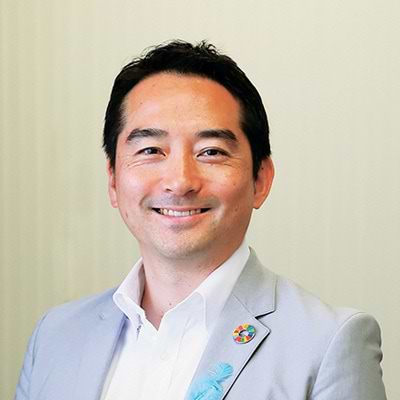
Igarashi Rissei
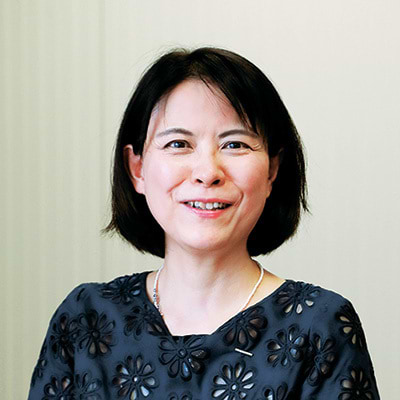
Ikeda Yuri
Dentsu Inc.
Case ①
Dialogue: Examining the Ideal State of SDGs Through Tsukuba City's Advanced Examples
The Ideal Form of SDGs
Tsukuba City in Ibaraki Prefecture is known as one of the world's leading research and academic cities.
After announcing its "Sustainable City Vision" in February 2018, it was selected as an "SDGs Future City" by the Cabinet Office in June of the same year. To find insights for SDGs activities through examples of advanced administrative initiatives, Dentsu Inc. Team SDGs' Yuri Ikeda interviewed Mayor Tatsuaki Igarashi.
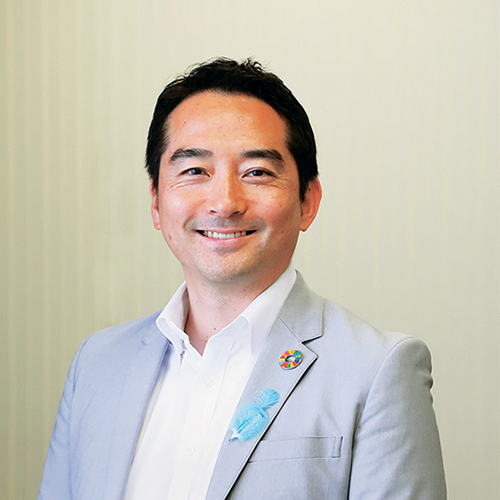
, Mayor of Tsukuba City Mr. Tatsuaki Igarashi
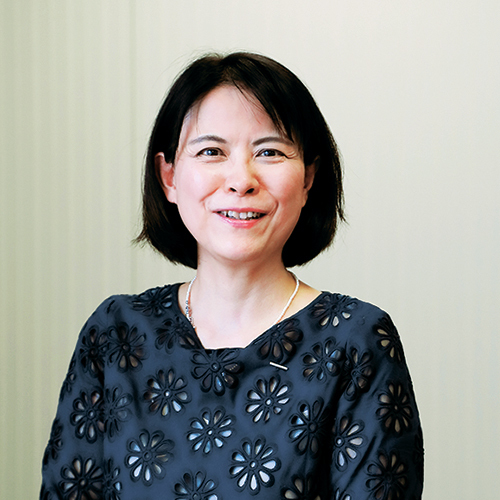
Ms. Yuri Ikeda
The SDGs are the world's common language
Ikeda: Tsukuba City was selected as an SDGs Future City. What prompted your decision to pursue the SDGs?
Igarashi: Tsukuba City has an environment developed as a research and academic city, hosting the 1985 Tsukuba Expo and opening the Tsukuba Express in 2005. The characteristic of Tsukuba City's SDGs is combining Society 5.0 with the SDGs. The goals of Tsukuba City and the SDGs are aligned. We see it as Tsukuba City's mission to contribute to humanity, not just to bring happiness to citizens through science and technology.
Furthermore, "building an inclusive society where no one is left behind" is my political creed. Although I'm no longer involved since becoming mayor, I originally managed a farm employing people with disabilities. Seeing firsthand the realities faced by people with disabilities and those involved in agriculture made me understand society's unsustainable state. It was in this context that I learned about the SDGs, with their keywords of "sustainability" and "inclusivity," and decided to place them at the core of municipal policy.
Ikeda: So for a mayor who was already aiming for a sustainable society, working on the SDGs was a natural progression.
Igarashi: Yes. Rather than devising plans specifically for the SDGs, it was more a process of linking existing initiatives to each SDG goal. For example, the plan to "operate autonomous wheelchairs" connects to goals like "Sustainable Cities and Communities" and "Good Health and Well-being."
Ikeda: What benefits did you see from communicating the city's activities through the lens of the SDGs?
Igarashi: The SDGs neatly organize the challenges and serve as a common language, which is invaluable. Simply saying "inclusive society" without context is hard for people to grasp, but framing it within the SDGs makes it much clearer. Furthermore, last November, I was invited as Japan's first mayor to the All-Africa Mayors Summit in Morocco, allowing our plans and initiatives to be known beyond borders. I feel this kind of expansion is only possible because of the common language provided by the SDGs.
Solutions that see each goal as part of a connected line, not isolated points
Ikeda: Could you tell us about the SDGs initiatives Tsukuba City is currently focusing on?
Igarashi: Our primary focus is addressing child poverty. While Tsukuba is known as a science city, over 1,200 children in our current elementary and junior high school generations have needed support because their families couldn't afford school backpacks. Our concrete initiatives include the "Tsukuba Children's Blue Feather Fund," which gives donors a blue feather to spread the circle of support, supporting community-run children's cafeterias, and issuing tutoring coupons.

Ikeda: This relates to SDG Goal 1 on "No Poverty" and also Goal 4 on "Quality Education," doesn't it?
Igarashi: Yes. I aim to develop initiatives that connect the various SDG goals not as isolated points, but as interconnected lines. For example, Tsukuba City faces another challenge: despite thriving agriculture, there are few places where people can eat locally grown vegetables and rice. One possible solution is for the city to certify and promote "locally sourced restaurants," encouraging consumption of local ingredients to stimulate economic circulation. But this alone is still a point. If we then have those restaurants contribute a portion of their sales to the "Blue Feather Fund," and further, if parents from impoverished households struggle to find work, employ them at those restaurants. Building this kind of interconnected approach to solve issues like Goal 11 "Sustainable Cities and Communities," Goal 1 "No Poverty," and Goal 10 "Reduced Inequalities" is one way I believe we can significantly enhance the effectiveness of our SDG efforts.
In other words, the SDGs are a "measure of kindness."
Ikeda: Tsukuba City's SDG initiative is anchored by the statement "A Measure of Kindness for the Future: Tsukuba SDGs." The design incorporating this measuring stick is wonderful, but could you share how this concept came about?
Igarashi: When we sought to involve citizens in our SDGs efforts, we faced the challenge that the SDGs themselves are difficult to explain. We needed language that anyone could understand, and that led us to the rephrasing "A Measure of Kindness for the Future." It's a way of communicating that we should adopt a "measure of kindness" that looks at whether "everyone can be happy" (= inclusivity) and whether "we are considering the future" (= sustainability).
Ikeda: I find this to be a very impressive and clear way to express the SDGs.
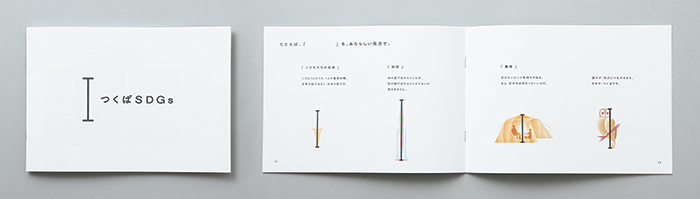
"Children's Future" One in seven children lives in poverty. This isn't a story about the world; it's about Japan.
"Science" – Making working on another planet feel as common as working in another country.
"Education" If the desire to learn exists, then any method of learning is valid. A city where play connects to learning. That is Tsukuba.
Igarashi: We spent considerable time discussing this with staff members. However, the crucial point isn't deciding on the statement itself, but ensuring it permeates the organization. I believe it's vital that I keep repeating the phrase "the measure of kindness" from here on. Even Tsukuba City's concept, "A city where you can see tomorrow's world," took about 10,000 repetitions in various places before people finally remembered it. It's the same for companies, right? When delivering a vision to an organization or society, it won't stick if the president just says it once.
How to Engage Others in SDG Activities
Ikeda: How do you promote understanding of the SDGs within your organization?
Igarashi: We created mechanisms to make staff want to engage with the SDGs, such as redesigning all employees' business cards with the "Measure of Kindness" design and providing SDGs badges to those who complete SDGs training. To involve citizens, it's crucial that all city hall staff, not just some, deeply understand the SDGs. Even if citizens show interest, if staff react with "What are the SDGs?", that enthusiasm fades.
Ikeda: On the other hand, what are you doing to raise awareness among citizens about Tsukuba City's SDGs activities?
Igarashi: We're already running several buses, but we'll change the wrapping design on all public buses in the city to the "Measure of Kindness" design. We're also creating installations visible in various locations. We hope that by sparking curiosity with "What's that?" and having people see them repeatedly, awareness will gradually spread.

The design motifs created for the pamphlet are also being adopted for the wraps on public buses running throughout Tsukuba City. This naturally creates opportunities for citizens to see them, aiming to increase awareness of the SDGs. Approximately 30 types of illustrations visualizing the "Kindness Scale" have been created, each themed around a specific concept.
Ikeda: The "Tsukuba SDGs Partners" initiative launched this April is also an appealing effort.
Igarashi: The Tsukuba SDGs Partners is a project to gather members who will work on SDGs alongside the city. For individual members, we provide a certificate of recognition to those who complete the lectures. Group membership is for organizations already implementing initiatives within the city or planning to do so. It's crucial that people don't just think, "Oh, the city is doing something," but instead internalize it as "We are the changemakers." We're thrilled that when we open recruitment, we quickly exceed capacity, showing how much interest citizens have in the SDGs.
Ikeda: Finally, please share a message for Dentsu Inc. readers who are business professionals.
Igarashi: Tsukuba SDGs Partners is still actively recruiting! It's open to anyone active within the city, so we welcome participation from individuals and groups outside the city as well. After all, the 17th SDG goal is "Partnerships." We believe we can't do this alone—we need everyone to join in.
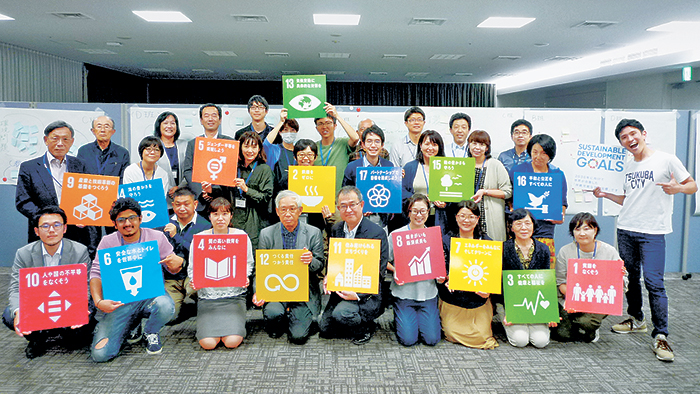
Certificate of Partnership." Through networking events and workshops, each participant is developing a sense of ownership in solving the city's social challenges.
Case ②
Companies are also promoting initiatives like this
<Saraya's Initiative>
Improving hygiene in Africa through "handwashing," while also creating jobs
Recipient of the Deputy Chief Cabinet Secretary (Minister for Foreign Affairs) Award at the 1st Japan SDGs Awards(*)
※Japan SDGs Awards: Recognizes companies, organizations, and other entities
and organizations that contribute to achieving the SDGs.
Established at the 3rd SDGs Headquarters meeting in June 2017.
Saraya, the first company in Japan to develop and commercialize medicated hand wash liquid, now offers a wide range of products and services related to hygiene, the environment, and health.
It implements the "1 Million People Handwashing Project," allocating 1% of the shipment value of designated hygiene products to support UNICEF's handwashing promotion activities in Uganda. Additionally, it established the local subsidiary "Saraya East Africa" in Uganda, providing locally produced disinfectants and hygiene manuals that include usage instructions. This initiative not only improves hygiene in East African countries but also creates local employment opportunities.
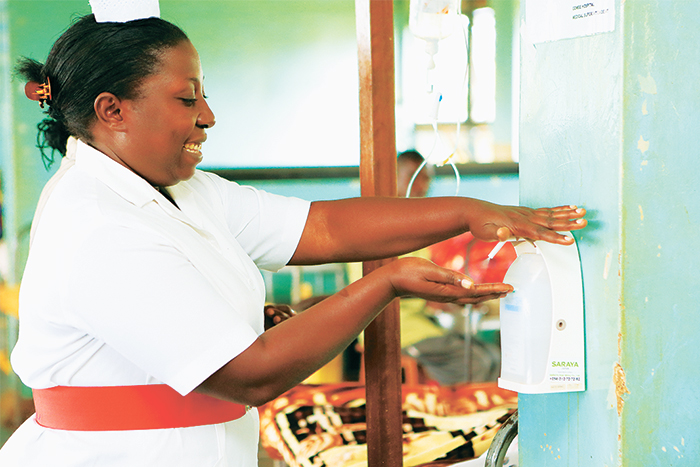
business that expanded from handwashing awareness in UNICEF-supported communities to deploying alcohol
Furthermore, through initiatives like using sustainable palm oil (RSPO-certified oil) and conserving biodiversity in oil palm production areas, we are also raising awareness among Japanese consumers about ethical consumption (choosing products and services that consider the environment and society).
Contributes to five targets under the SDGs: 3 "Good Health and Well-being," 6 "Clean Water and Sanitation," 12 "Responsible Consumption and Production," 14 "Life Below Water," and 15 "Life on Land."
<LIXIL Initiatives>
Providing affordable, high-quality toilets to developing countries
Recipient of the Deputy Chief Minister (Minister for Foreign Affairs) Award at the 2nd Japan SDGs Awards
LIXIL develops and provides water-related products and building materials for homes.
To address global social and sanitation challenges, LIXIL offers the affordable, innovative "SATO" simple toilet system. Through "locally rooted social business" in collaboration with international organizations and NGOs, LIXIL also advances sanitation awareness reform and sanitation infrastructure development.
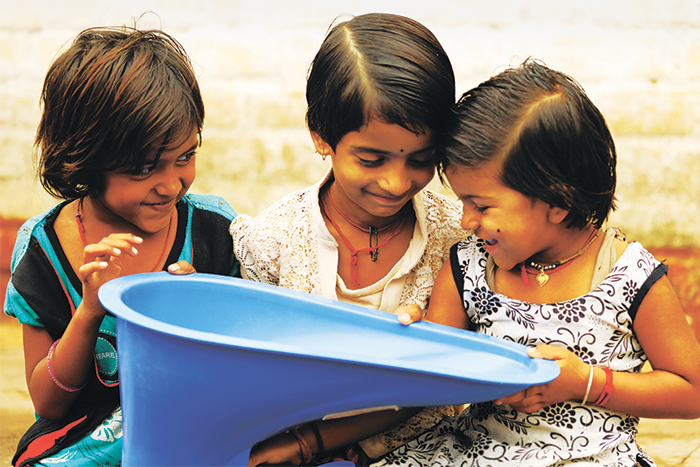
SATO is now shipped to over 25 countries, and in June, it was announced that the business achieved its first profitability in Bangladesh. Furthermore, through the CRM initiative "Toilets for All Project," where one SATO unit is donated to a developing country for every LIXIL shower toilet purchased domestically, it has created a model for solving social issues. Its inclusivity is also recognized, as it creates jobs by comprehensively handling local production, sales, installation, and maintenance, while promoting gender equality through the provision of toilets.
The initiative contributes to six SDG targets: 1 (No Poverty), 3 (Good Health and Well-being), 5 (Gender Equality), 6 (Clean Water and Sanitation), 9 (Industry, Innovation and Infrastructure), and 17 (Partnerships for the Goals).
Was this article helpful?
Share this article


Newsletter registration is here
We select and publish important news every day
For inquiries about this article
Back Numbers


Author
Igarashi Rissei
Mayor of Tsukuba
Ikeda Yuri
Dentsu Inc.
PR Planning Bureau