
Note: This website was automatically translated, so some terms or nuances may not be completely accurate.
 Through competitive programming, let's make Japan a powerhouse of highly skilled IT professionals! [3/9]
What is the reality of AtCoder, a treasure trove of highly skilled IT professionals?

Naohiro Takahashi
AtCoder Inc.
In this series, we explore the recruitment and development of highly skilled IT professionals with world-class programmer Naohiro Takahashi. This time, Takahashi discusses the reality of AtCoder—the company he leads that hosts competitive programming contests—and its future outlook.
What is AtCoder? What kind of talent is there?
AtCoder is a Japanese service that hosts online competitions for "competitive programming," a topic covered in this series.
Highly skilled programmers from around the world gather, with approximately 5,000 participants simultaneously competing every Saturday to demonstrate their programming abilities and algorithm construction skills.
So, what kind of people participate in such a high-level contest as AtCoder?
When you hear about people participating in a programming contest every Saturday night starting at 9 PM, you might imagine they're extremely studious individuals passionately dedicated to skill improvement.
Of course, many participants fit that description. However, the majority of AtCoder users don't participate solely for study or skill improvement. In fact, a significant number of users play AtCoder as a "game."
They enjoy the entire process—being given a problem, devising an algorithm, and writing the program—as a game. AtCoder and the competitive programming world are filled with many such people.
Balancing the "educational value" demanded by the real world with the "entertainment value" that sustains motivation
When AtCoder participants were asked, "Why do you participate in AtCoder?" the survey results were as follows:
https://twitter.com/chokudai/status/1187208275026034688
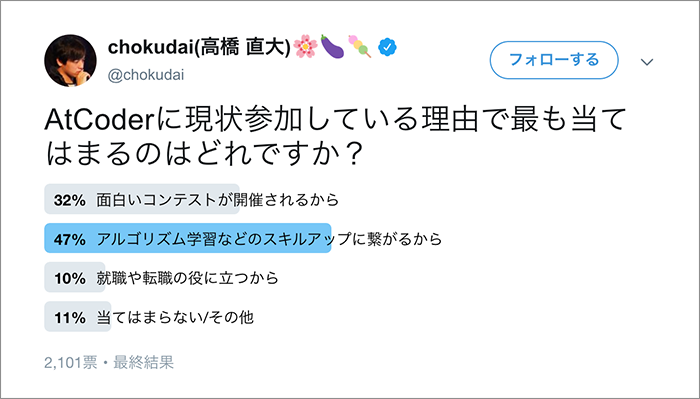
Indeed, many users expect skill improvement, such as learning algorithms. However, a significant number also voted for "because interesting contests are held." This is a crucial element.
At first glance, competitive programming might not seem particularly entertaining. However, it secures its entertainment value through two key elements: "mathematical puzzle-like aspects" and "competitiveness." Below, we'll explain these points.
First and foremost, the "mathematical puzzle" element is fascinating. The world of computer science is filled with mathematics, and many people find enjoyment in "solving these problems mathematically." I believe I covered the appeal of this aspect quite thoroughly in the first installment of this series.
If you find this puzzle aspect engaging, you likely have aptitude for it. Those who don't may not be well-suited for competitive programming. If you found the first installment interesting, I encourage you to give competitive programming a try.
Incidentally, nearly half of AtCoder employees have advanced to the finals of international competitive programming championships. Furthermore, AtCoder problems are carefully selected by our staff from submissions by top contest participants. Consequently, AtCoder problems are widely regarded as the most interesting in the world, not just domestically but internationally.
Next, regarding "competitiveness": providing a structured contest environment with leaderboards is one factor that fuels the fun.
I don't think many people say, "I love solving Drill Inc. problems!" However, even among those people, quite a few enjoy participating in a 100-cell calculation competition.
This is because clearly defining the "competitive nature" of racing against the clock in the 100-cell calculation creates benefits like the competitive element of racing against others and the tangible sense of improvement through your times, making it enjoyable to tackle.
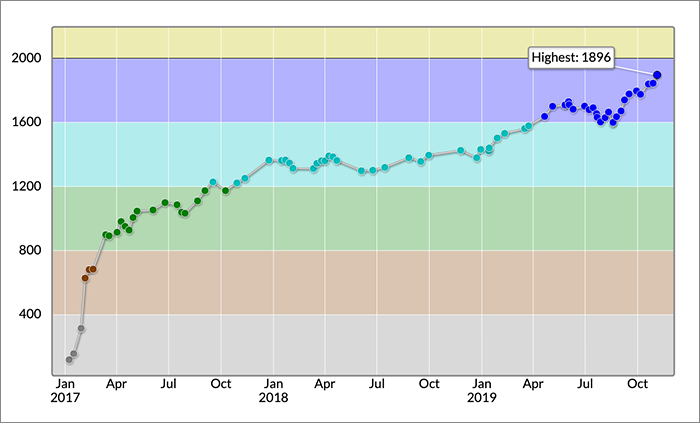
AtCoder also incorporates various elements to make the competitive aspect enjoyable. For example, your "rating," a measure of your skill level, updates each time you participate in a contest, making it easy to see how your skills are changing. Furthermore, your name changes color at certain rating thresholds, allowing others to instantly gauge your skill level just by the color of your name.
Beyond that, competitive programming has established itself as a kind of online game where participants find enjoyment in increasing their "number of solved problems," discover rivals on platforms like Twitter and relish the wins and losses, or get excited seeing the submission times of the world's top programmers competing in contests.
To be perfectly honest, competitive programming isn't the most efficient way to learn algorithms or programming. I agree with the argument that if you can maintain sufficient motivation, studying from textbooks or deciding what you want to build and then learning the relevant applied fields is more useful.
However, very few people can maintain high motivation while continuously studying skills needed for the future society. Competitive programming has developed as a culture precisely because it combines two elements: "being useful in the real world" and "being a reasonably enjoyable online game." This is why so many young people today are starting competitive programming.
Companies Casting Eager Eyes on AtCoder Talent
Now, AtCoder is a gathering place for such talent. How do various IT companies view these individuals?
While the participants themselves enjoy AtCoder as an online game, from a corporate perspective, they become "extremely high-caliber IT talent who participate in contests every Saturday night and diligently study outside of class or work hours on other days."
Regardless of their actual motivations, the sheer number of individuals possessing overwhelmingly superior abilities is staggering. Those in the top 30% of AtCoder, the "green" tier (800-1199 points in the previously mentioned image), match the top 1-2% on algorithm skill checks from other job-hunting sites.
As the high capabilities born from the intense motivation of competitive programming participants have become widely recognized, many companies are now paying close attention to AtCoder. There is a growing trend to actively recruit programmers who excel in competitive programming as highly skilled IT talent.
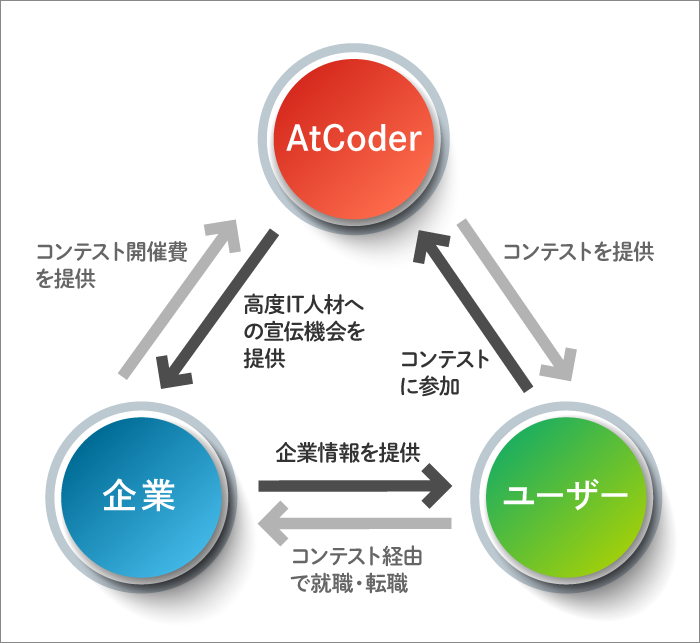
Over 20 companies have hosted contests on AtCoder to date. Competitive programming, and AtCoder itself, has now grown into a force that cannot be ignored in the IT talent market.
Not only web-based companies like Recruit, Dwango, CyberAgent, and KLab, or dynamic ventures such as MUJIN and CADDi, but also manufacturing firms like DISCO and seemingly non-IT companies like Yamato Transport are hosting contests to acquire talent.
Large-scale contests and programming skill certification services launched
Now, while many companies have held contests on AtCoder, AtCoder Inc. itself has actually spent almost nothing on advertising.
Until now, companies holding contests on AtCoder were only those extremely sensitive to technical topics, who discovered AtCoder through word of mouth or Twitter.
This means that AtCoder's top talent ends up joining or moving to these companies, while other companies struggle to attract such talent.
Therefore, in April this year, AtCoder Inc. entered into a capital alliance with Dentsu Inc., and the two companies will jointly undertake competitive programming initiatives. While AtCoder Inc. retains 100% control over the problems and contest system, Dentsu Inc.'s involvement enables AtCoder to propose its services to a wide range of companies previously out of reach.
One example is the "National Unified Programming Championship" hosted by Nikkei Inc. The finals drew 500 participants from across Japan to the venue, making it a very lively event. This contest was extremely well-received, and a second edition has already been confirmed. Similarly, the "1st Japan's Strongest Student Programmer Championship" held at Dentsu Inc. Hall also attracted a large crowd.
The utility of programming contest systems extends beyond hosting contests online. The core function of AtCoder's contest system is "evaluating the correctness of submitted programs." Leveraging this system, we will launch the "Algorithm Practical Skills Certification" service this December.
This is essentially the programming equivalent of TOEIC, a unique service that tests practical skills: designing algorithms and writing fast, accurate code. It visualizes programming skills through graded levels, enabling various applications such as assessing skill levels during job hunting or utilizing it for educational purposes. By collaborating with Dentsu Inc., we hope this service will become a standardized model.
Was this article helpful?
Share this article


Newsletter registration is here
We select and publish important news every day
For inquiries about this article
Back Numbers


Author
Naohiro Takahashi
AtCoder Inc.
President and CEO