
Note: This website was automatically translated, so some terms or nuances may not be completely accurate.
The Sumitomo Corporation Group's social contribution program "100SEED," driven by employees' voluntary initiatives.
For companies promoting SDGs and social contribution activities, it is crucial to get each employee to take ownership of the initiatives and take action on their own. However, many companies likely struggle with achieving internal alignment and effective internal communication.
This series introduces successful examples of corporate internal communication and company activities aimed at achieving the SDGs and realizing a sustainable society.
This installment introduces "100SEED (SC Emergent Evolutional Deed)," a global social contribution program by the Sumitomo Corporation Group. Originating from employee proposals as part of Sumitomo Corporation's 100th-anniversary "22nd Century Project," the program launched full-scale activities worldwide starting in 2020.
What approaches are necessary to drive initiatives at a global level and encourage employee-led actions? We spoke with Miyuki Egusa, the program leader, about the process from the launch of "100SEED" to its implementation phase.
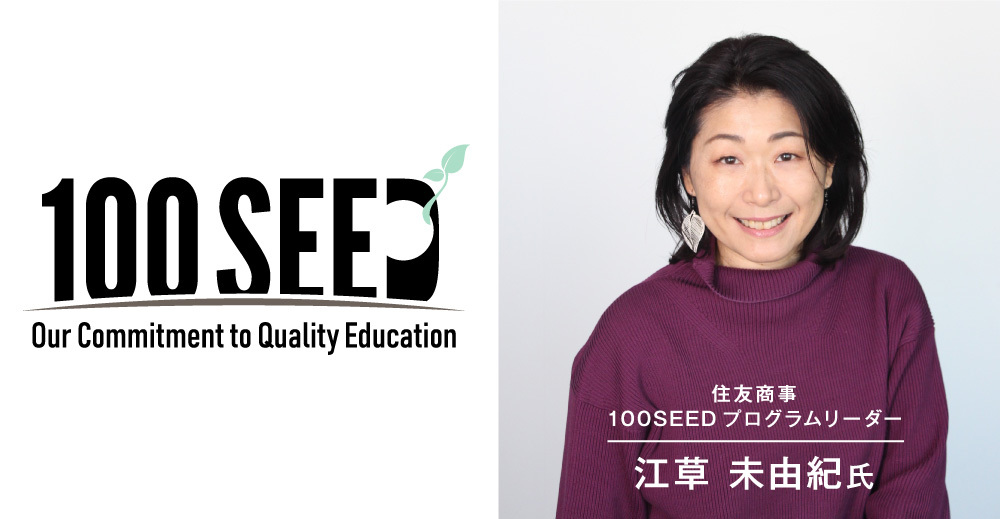
Taking time to ensure everyone truly understands is crucial
──First, could you tell us about the "22nd Century Project," Sumitomo Corporation's 100th-anniversary initiative?
Egusa: The "22nd Century Project" is a company-wide initiative launched as we celebrated our 100th anniversary in 2019. It focuses on change and challenge for sustainable growth, looking ahead to the next 100 years.
The project actually began around 2017. I participated in the planning committee myself, and our initial internal discussions focused on defining the project's purpose. We saw this once-in-a-century opportunity as a chance to evolve our corporate culture to fit the times. However, some people initially questioned, "Isn't Sumitomo already a great company?" or "Do we really need to change anything?" There were also opinions suggesting we make it something fun and exciting, like a festival.
It took considerable time before we finally settled on the direction: "Let's aim for sustainable growth through change and challenge." It wasn't as if some major catalyst suddenly made everyone point in the same direction all at once. I believe it was through repeated hearings, seminars, and further discussions that everyone gradually came to truly understand and accept the direction. Then, after the project launched, during the initial phase of thoroughly dissecting Sumitomo Corporation, we received candid opinions from all stakeholders about what we should preserve and what we should change. Building on that foundation and continuing our discussions further helped consolidate everyone's thoughts and direction.
Open to All Employees! "100SEED" Started from Employee Proposals
──Once the direction for the "22nd Century Project" was set, how did "100SEED" start and progress?
Egusa: The global social contribution program "100SEED" began with an employee proposal: "Precisely because we're at our 100th anniversary milestone, let's look 100 years ahead and do what we can for society on a global level."
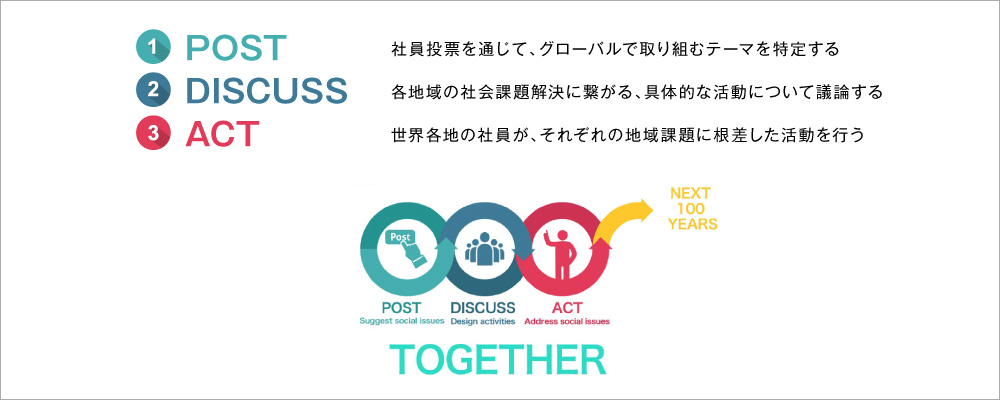
"100SEED" was structured to progress through three phases: POST, DISCUSS, and ACT. In the POST phase, the themes to be addressed were determined by employee voting. The decision to start with POST (employee voting) stemmed from the program's core concept of "full participation." Rather than having a select few decide, all employees who would actually participate were asked to vote on the social issues they wanted to tackle, choosing from the 17 SDG goals.
We were surprised and deeply grateful that far more employees participated actively than anticipated. Particularly moving was the strong participation from overseas employees. We believe this engagement was achieved by releasing the "100SEED" concept video in English and the efforts of Global Ambassadors selected in each region.
The voting results showed SDG Goal 4, "Quality Education," ranked first in every region. While the rankings for second place and below varied by country and region, employee representatives worldwide discussed their desire to create a social contribution activity that "thinks and acts together globally" with a long-term perspective. They decided on "Quality Education" as the global common theme and shared the belief that "Education is the foundation for solving all social challenges." During the DISCUSS phase, which began in May 2019, we formulated concrete action plans based on this theme.
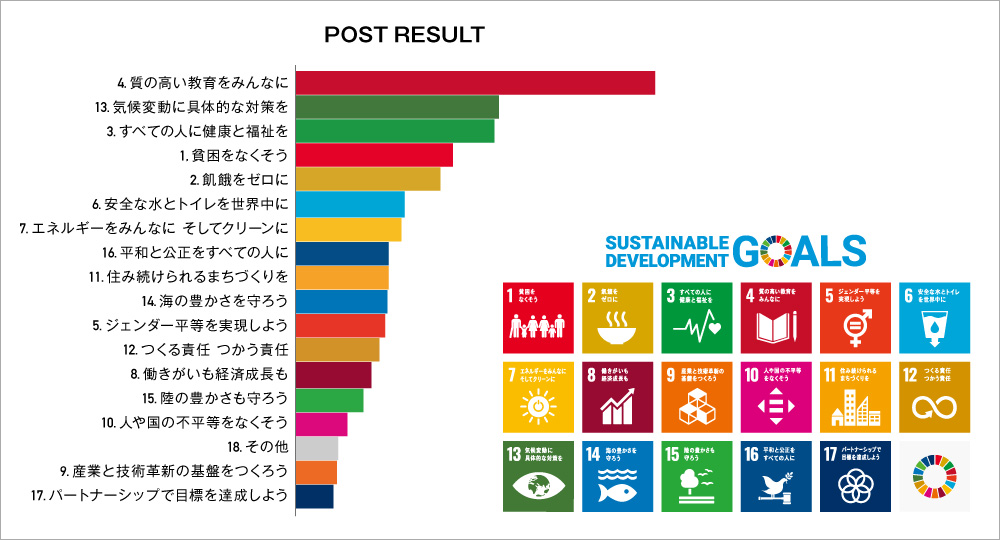
While "Quality Education" became the global common theme, the specific challenges vary greatly by region. Therefore, we decided only on the approach of "determining activity content by region," followed by extensive discussions in each area. Nationally, we held 31 workshops across Japan, gathering over 400 action plan ideas. Subsequently, we consolidated activity proposals while consulting experts from civic groups and government agencies. We then conducted an employee vote based on the perspectives of "empathy" and "willingness to participate," gathering 4,610 votes nationwide.
It took about a year to finalize the framework for these activities. Involving many people, holding repeated discussions, and conducting votes to advance the planning is, frankly, time-consuming and involves painstaking work. However, I believe it was a necessary process to engage our employees in these activities.
Setting "High-Quality Education" as a Management Challenge Based on the Spirit that "People Are the Most Important Asset in a Trading Company"
──After repeated discussions and voting led to a concrete action plan, it was finally time for the implementation phase. Could you tell us how you proceeded?
Egusa: I was appointed program leader for "100SEED" in April 2020, and just as we were about to fully enter the ACT phase, the COVID-19 pandemic hit. Partly due to this impact, it took nearly half a year from finalizing the action plan in December 2019 to actually starting activities.
During that time, we focused on establishing the operational foundation. While the initiative started as a bottom-up effort by employees, sustained company-wide commitment required top management's backing. First, the management committee resolved to recognize up to 100 hours per year of employee time spent on "100SEED" activities as work time.
Furthermore, this initiative was integrated into the corporate strategy. In June 2020, Sumitomo Corporation newly established "Advancing Sustainability Management" as a strategic pillar, setting six key societal challenges to address and corresponding long-term goals. Among these six challenges was "Quality Education," the global common theme of "100SEED."
Although Sumitomo Corporation does not operate in the education business, education is an activity that cultivates talent to solve future societal challenges and builds the foundation for addressing all kinds of issues. Furthermore, the fundamental belief that "people" are crucial for a trading company lies at the core. Therefore, I believe it was highly significant that "Quality Education" was positioned as a key societal challenge and that addressing it through social contribution activities was established as one of the company's management-level commitments.
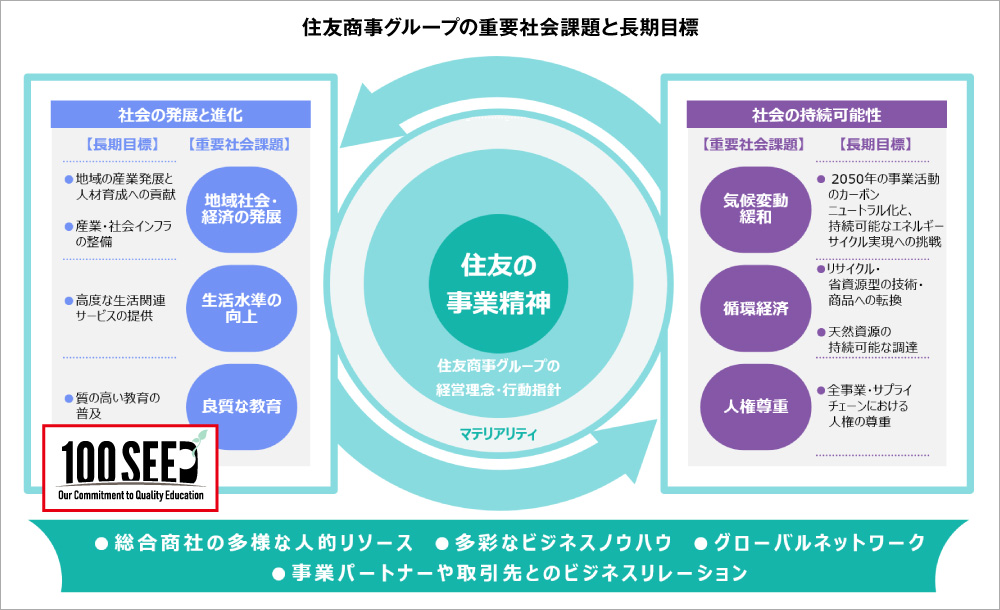
Engaging all employees to embed "100SEED"
──What did you focus on specifically to involve employees in the activities?
Egusa: Just before launch, we redefined and re-embedded "100SEED." This required considerable patience... What shocked me most was hearing some employees say, "Wasn't 100SEED over?" right as we were entering the implementation phase. I was stunned and nearly fell over (laughs). It's true we held employee votes and had heated debates. But we had only formulated the plan internally. At that moment, I realized we absolutely had to clearly communicate that launching our contribution activities for society was just beginning.
So, we redefined "100SEED" and changed the copy under the logo to "Our Commitment to Quality Education." It was also around this time we established the "100SEED Activity Philosophy" as the foundation for our work. Employees around the world, working under a common global theme, tend to carry out activities rooted in their respective regional challenges individually, which can easily lead to fragmentation. That's precisely why we decided to systematize the significance of engaging in this activity as a philosophy, creating a shared global axis.
With support from managers and teams, we visited sales departments and regional organization management, explained the initiative at company-wide and organizational regular meetings, and union seminars... Beyond just explanation, listening to opinions and providing feedback on progress and results were also crucial processes for transforming this into a company-wide movement. We also felt that the President's words at key moments carried significant weight. We engaged in careful, persistent dialogue with people at every level of the company, explaining what we were aiming to do next and what roles we wanted each person to play.
After launching the initiative, we created a platform for participating employees to share, in their own words, the fulfillment and sense of accomplishment they gained from the 100SEED activities—satisfaction and insights unattainable through their regular duties. I believe these efforts are gradually contributing to the permeation and advancement of "100SEED."
──What was the driving force that enabled you, Mr. Egusa, to take these actions?
Egusa: I joined the "100SEED" project in earnest just before ACT. So many people had poured their efforts into getting it to this point, so I felt I absolutely had to deliver results and honor their commitment. Hearing some employees say, "I thought it was over," was probably another strong trigger that made me realize things couldn't stay as they were. Especially during the first year of the implementation phase, it was a period of constantly identifying issues and resolving them swiftly, like whack-a-mole.
From 2020, we entered the implementation phase. Our goal now is to further expand our initiatives.
──Please tell us about the three activities currently underway domestically.
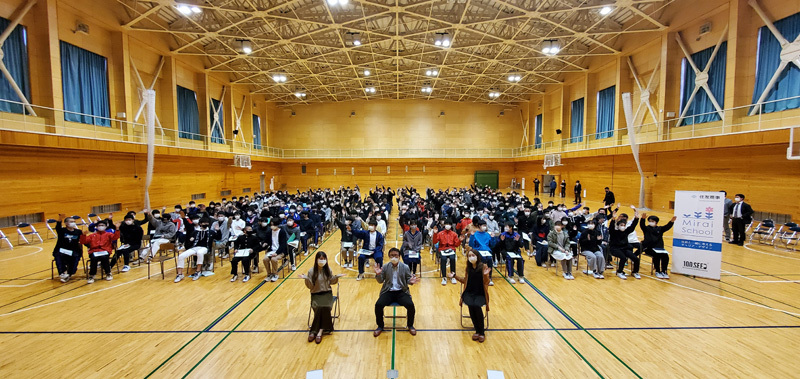
Egusa: We finally launched three activities in July 2020. The first is career education support, " Mirai School." We conduct "outreach lectures" where employees visit high schools nationwide to share their own career paths and perspectives on work, hoping to spark high school students' thinking about their future careers. The second is " Education Support Pro Bono." In this activity, teams of five employees support NPOs tackling educational challenges for three months, helping strengthen their operational foundations by solving their specific problems. The third is " Education Support Aiming for a Multicultural Coexistence Society." We support the operational activities of organizations addressing these challenges and provide learning support for children, aiming to realize a society where children with foreign roots can learn with peace of mind.
Once we actually started these activities, we received words of gratitude and positive feedback from the organizations we supported, which made us feel very proud. For example, after conducting career classes at high schools, we received many messages in post-class surveys from students saying things like, "I want to become an adult like this," or "This was my first glimpse into the adult world." Furthermore, among the organizations supported through our "Education Support Pro Bono" initiative, there have been cases where our pro bono support led to actual business contracts. We are delighted to see such concrete results being achieved.
Our clients have praised our employees' "attitude of being there for others," "meticulous work," and "reliability," confirming that our strengths are being effectively leveraged. Simultaneously, I believe this has become a valuable opportunity for our employees as well, serving as a chance to reevaluate their own careers and gain new insights. Furthermore, a positive spiral is emerging where supervisors of participating employees are joining the activities, giving me a strong sense that this is becoming a truly worthwhile initiative.
──What are your future goals for "100SEED"?
Egusa: The ultimate goal is to deliver "quality education to everyone." To achieve this, we aim to increase employee participation significantly. Our immediate goal is to consistently have over 5% of all employees participate each year. Domestically, participation grew from 150 people in fiscal 2020 to over 200 this fiscal year, so we hope even more employees will join going forward. Also, since the three activities we're currently engaged in all require a significant time commitment, we plan to develop programs that allow for more casual participation in the future.
──Finally, could you offer some advice or a message for those involved in SDGs or internal communications?
Egusa: What I've truly realized through these activities is that there is no "silver bullet" for gaining employee understanding. With "100SEED" too, we've made steady progress by taking time to listen to employee opinions and engage in dialogue. To encourage voluntary employee participation in SDGs and social contribution activities, the best approach is to steadily build upon what we can do. I believe there is no better method than this.
Sumitomo Corporation Group "100SEED" Special Site: Click here
 TeamSDGs collaborates with various SDGs stakeholders to disseminate information about the SDGs and plan and develop solutions.

Was this article helpful?
Share this article


