
Note: This website was automatically translated, so some terms or nuances may not be completely accurate.
 Start SDG actions from within your organization [2/4]
Sompo Japan University: A Learning Hub for Continuous Growth for Every Employee
Megumi Honda
Sompo Japan Insurance Inc.
Nomura Ryuya
Sompo Japan Insurance Inc.
This series introduces successful examples of corporate internal communication and in-house activities aimed at achieving the SDGs and realizing a sustainable society. The second installment introduces Sompo Japan University, the corporate university of Sompo Japan Insurance Inc.
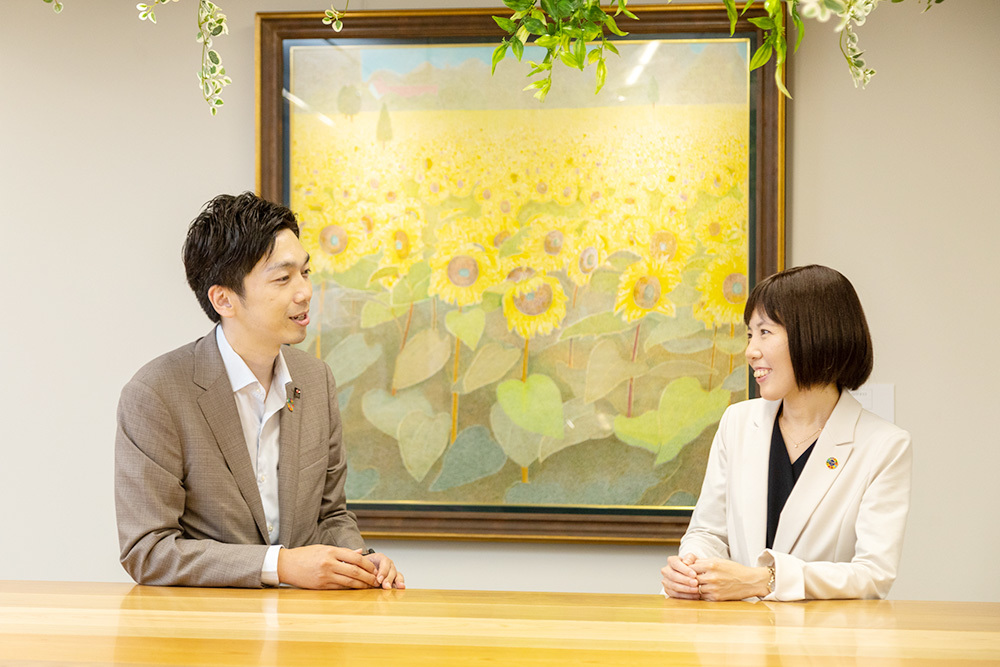
We speak with Megumi Honda from the Sustainability Promotion Department, who runs the Regional Co-creation Faculty and conducts seminars themed around the SDGs, and Tatsuya Nomura, a graduate of that faculty.
We will hear about their approaches to effectively engage employees and encourage proactive learning about the SDGs, the knowledge gained in the seminars, and how this learning is applied in practical work.
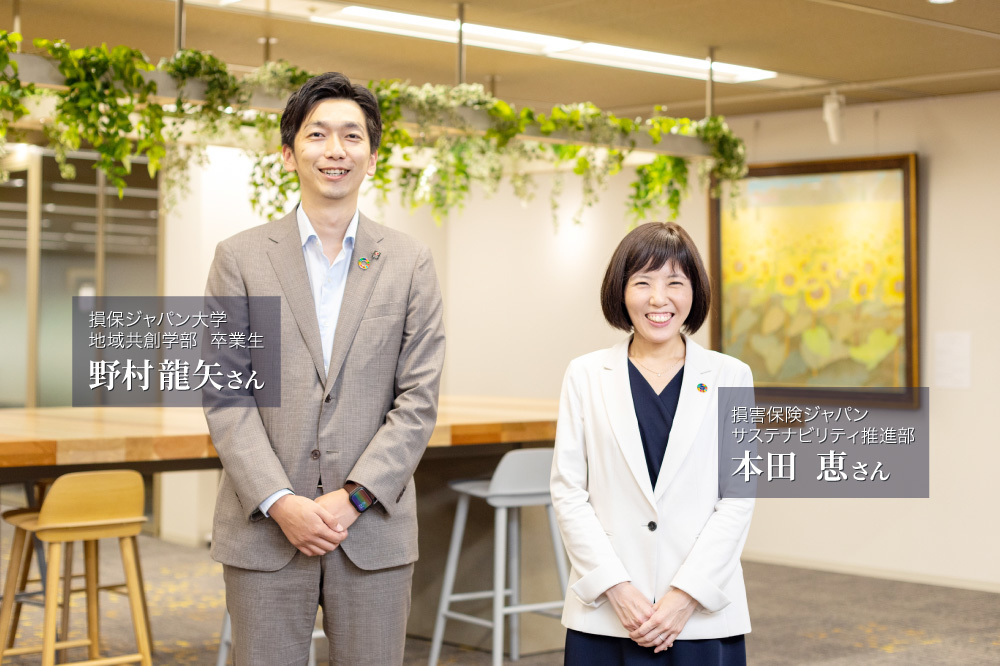

──First, could you tell us about the background leading to the launch of Sompo Japan University?
Honda: Sompo Japan University is an online corporate university where employees nationwide can learn from anywhere, regardless of position or age. Established in October 2020, its purpose is for each employee to learn, think, act, and continue growing independently. We believe employee growth leads to the company's sustainable growth and ultimately contributes to society. Through Sompo Japan University, we aim for mutual growth between the company and its employees.
The non-life insurance business we engage in is characterized by a "mutual aid system" where we support each other, making it highly significant for contributing to society and aligning well with the SDGs. While paying insurance claims when accidents or disasters occur is a vital part of our work, we also consider it an important mission to engage in disaster prevention and mitigation efforts to protect our customers' peace of mind and safety. Our company has actively implemented initiatives to address the unique challenges of each region, working closely with local communities, not only in disaster prevention and mitigation but also in solving other regional issues. Against this backdrop, we are focusing our efforts on developing human resources capable of contributing to society.
SOMPO Japan University currently offers two main types of content. One is "SOMPO LIVE," a streaming content platform where internal and external instructors conduct lectures on various themes. Each session lasts approximately 1 to 1.5 hours, with around 20 to 25 new lectures launched monthly. Employees can freely choose and attend lectures that interest them.
The other is "Seminars" (hereafter referred to as "Seminars"), which involve research and activities based on specific themes, enabling more interactive learning. The appeal lies in the ability to deeply study fields that are difficult to master through regular work in small groups. Currently, seven faculties are established: Digital, Global, Business, Diversity & Inclusion, Regional Co-creation, Marketing, and Commercial Business. Each is operated by its respective department. My department, Sustainability Promotion, operates the "Regional Co-creation Faculty" seminar titled "Exploring Social Value Creation Using SDGs as a Starting Point."

──Could you tell us about how the Regional Co-creation Faculty seminar is run and its content?
Honda: The seminar runs twice a year, in the first and second halves, with each session consisting of a five-part series. The participant capacity is about 30 people. If there are many applicants, we select participants considering factors like their motivation, region, and job type to ensure a balanced mix.
While we've previously offered SDGs training at the request of our sales branches, these were mostly one-off sessions lasting about an hour, limiting the time participants had to think for themselves. However, solving social issues requires the process of researching, thinking, and finding solutions to questions without clear answers. Therefore, to ensure participants have sufficient time to think, the Sompo Japan University seminar is conducted over five sessions.
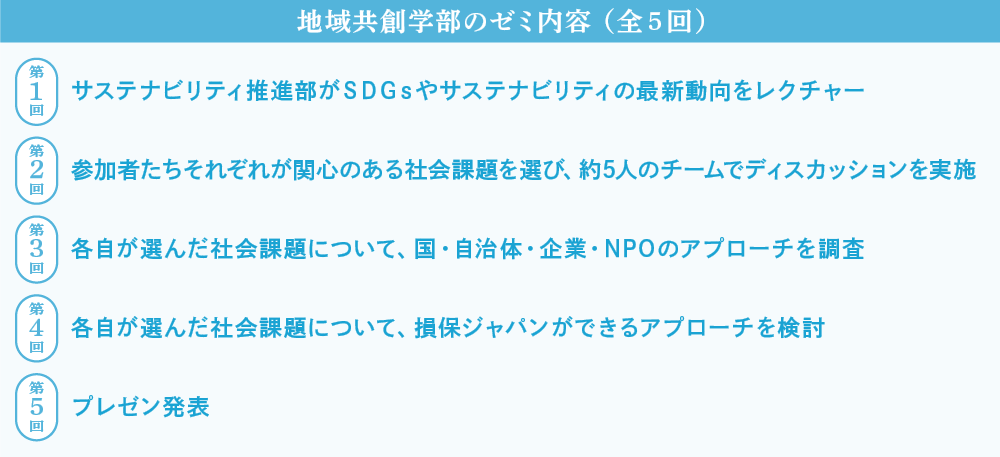
Starting from the second session, the program is largely participant-driven group work. Participants form teams, freely choose themes they wish to explore in depth, and through discussions and research, develop concrete action plans. Employees from the Sustainability Promotion Department focus less on "teaching" and more on providing backup support.
What we in the Sustainability Promotion Department most want to convey through this seminar is the mindset of "outside-in"—creating business by starting from solving social issues—and "backcasting," which involves working backward from a desired future state to determine what actions are needed now. Achieving the SDGs requires looking beyond immediate concerns, maintaining a long-term perspective, and considering what we should do now for the future. It's not just about selling insurance products; it's about broadening our view to consider "what kind of insurance products should we sell?" and "is selling insurance products alone sufficient?" We want to convey the importance of thinking through these steps via the seminar.
──What do you focus on to ensure the seminar runs smoothly?
Honda: I always prioritize ensuring psychological safety for participants. For example, in the final seminar session, we ask them to present ideas on "what our company can do regarding the challenge." We have a rule that these ideas don't necessarily have to be feasible. This is to allow everyone to think freely, without feeling pressured to come up with something "commercially viable" or constrained by rules and limitations.
Additionally, we incorporate methods for maintaining psychological safety during discussions, learned from lectures by employees with external facilitation experience. Specifically, since online discussions often start off quiet, we encourage actions like pressing the applause button after someone introduces themselves, making reactions more visible, and actively using chat to boost communication... While these are small details, many participants are naturally proactive and positive, so even minor nudges seem to make discussions more lively.
Furthermore, for the first seminar session, employees from our Sustainability Promotion Department serve as instructors to share the latest SDGs trends, so we make a conscious effort to keep learning ourselves. Personally, beyond gathering information on domestic and international sustainability trends, I also have a desire to tackle social issues. This led me to take on a side job outside the company with Atami-based NPO atamista/machimori Inc., which works on community development projects like reducing vacant homes. I've just started, but I hope to eventually feed back what I learn here into our internal operations.
To smoothly promote Sompo Japan University and recruit participants, we utilize our homepage and the internal social media platform Google Currents. Our company's internal SNS is already quite active, with approximately 2,700 members nationwide participating in the community managed by the Sustainability Promotion Department. We've established systems like encouraging posts about SDGs-related initiatives undertaken, which also helps foster internal community building. We are conscious of effectively utilizing such platforms to disseminate information about the seminars.
──Could you share something memorable from the seminars held so far?
Honda: While teams can freely choose their presentation themes, I find it fascinating how diverse approaches to various social issues emerge each time. In fiscal year 2021, presentations covered a wide range of topics including food loss, climate change, women's empowerment, education, and regional revitalization. It wasn't something the Sustainability Promotion Department specifically guided, but seeing the themes naturally spread out really highlighted the breadth of participants' interests and concerns.
Among these, the presentation by the team tackling food loss reduction stood out. They proposed events we could host at the SOMPO Museum we operate, along with ideas linking our insurance products and digital services. We're starting to see ideas that could actually be commercialized, and I feel the quality of the output improves with each seminar session. Going forward, we want to expand these activities further, such as proposing ideas with real potential for realization internally for monetization.

──Mr. Nomura, I understand you participated in the Regional Co-creation Department seminar during the first half of 2021. Could you tell us what led you to join the seminar in the first place?
Nomura: At the time I joined the seminar, I was assigned to a corporate sales branch in Tokushima Prefecture. In my daily work, I strongly sensed growing awareness of SDGs within the local community. However, I often heard voices from the field saying, "We wear the SDGs badge, but we don't know what to do specifically." Personally, while I knew the term SDGs, I couldn't clearly visualize how it related to my own life.
Furthermore, as our company's training programs rapidly expanded during the pandemic, I felt a growing sense of urgency that I needed to take a more proactive approach to learning... That's when I learned about the SDGs seminar at Sompo Japan University. I felt, "I have to do this!" and decided to apply. Even if you want to learn something new, it's quite difficult to attend double-schooling programs in regional areas. So, having learning opportunities available within the company, regardless of location, felt incredibly valuable.
──What social issue did your group, Nomura-san, tackle?
Nomura: Our group focused on the theme of "children." We decided on this theme through discussion, and surprisingly, all five members—despite varying ages and genders—mentioned "children" as a topic we were interested in. It was truly coincidental, and I was very surprised. Personally, I chose this theme because, as a parent, I've started thinking about what I can do to leave a sustainable society for the children who will lead the next generation.
Thanks to the introductory lecture on SDG fundamentals from the Sustainability Promotion Department during our first seminar session, subsequent discussions proceeded relatively smoothly. During these discussions, each member passionately shared their perspectives on challenges and approaches related to "children." We also scheduled short meetings outside seminar hours to refine each other's ideas. For the final presentation, each participant summarized their proposed initiative on a single PowerPoint slide, and we presented a consolidated version. Proposals included the "SOMPO VR Museum" utilizing our company's SOMPO Museum, creating opportunities for interaction between the elderly and children linked to the care services provided by our group companies, and establishing support mechanisms within community-based integrated care systems.
Among these, the "SOMPO VR Museum" idea particularly stuck with me. This approach aims to provide children living in rural areas—where museums are fewer compared to the metropolitan area—with opportunities to experience art, thereby eliminating their emotional poverty. While SDGs often focus on visible forms of poverty, learning about the concept of emotional poverty was a valuable lesson for me personally. The rule allowing us to "set feasibility aside" really helped spark our imagination and enabled us to think freely and enjoyably.
Also, when I shared the presentation content on our internal SNS, I received many comments even from colleagues not in the seminar. Getting that kind of response is always gratifying, and seeing how many people viewed the post really made me feel that awareness of SDGs is growing within the company.
──How are the things you learned in the seminar being applied to your work?
Nomura: Taking the seminar broadened my interests and shifted my approach from passive information intake to actively seeking out information. In my work, I think I've become able to think with a broader perspective, starting from social issues rather than just considering our company's insurance products.
Furthermore, to take concrete action, I utilized our internal side-hustle program, "SOMPO Quest," and joined the "Water Disaster Project." Here, we explore ideas for building disaster-resilient communities, including disaster prevention, mitigation, and strategies for early evacuation and recovery when disasters strike. I'm currently focusing on disaster prevention education and have even obtained my Disaster Prevention Specialist certification.
Furthermore, our company hosts workshops using our original tool, "The Action! ~SDGs Card Game~," developed to deepen understanding of the SDGs and translate it into action. Personally, while working in Tokushima Prefecture, I noticed many people expressed interest in the SDGs but felt unsure how to take action. I proposed a workshop using this game to the financial institution in Tokushima Prefecture I was responsible for.
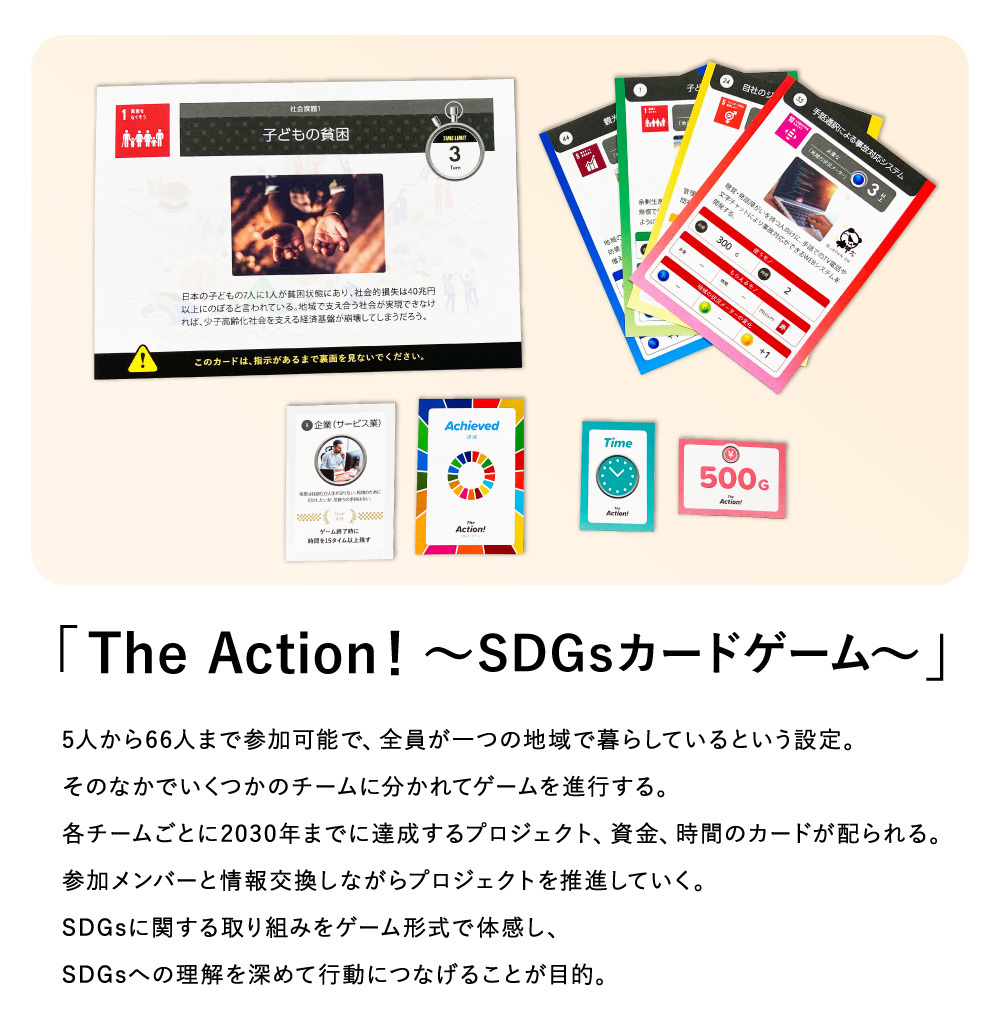
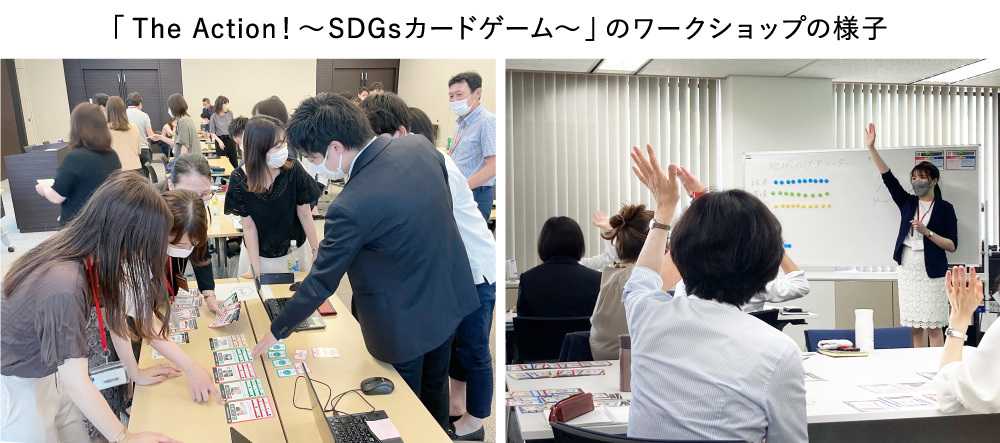
Currently, our company continues to collaborate with that financial institution, conducting workshops using "The Action! ~SDGs Card Game~" as part of our efforts to promote the SDGs and invigorate the local community within Tokushima Prefecture. I also served as a facilitator for these workshops.
In this way, the Sompo Japan University seminar provided the catalyst for various actions. I want to continue thinking about what we can do for society and give back.

──Could you tell us about the future direction of the Sustainability Promotion Department?
Honda: I feel the Regional Co-creation Department's seminar has successfully reached a certain number of employees interested in the SDGs. However, with 24,000 employees at our company, scaling this further is our next challenge. To address this, we are starting to build a system to encourage employees to independently host seminars. Since the Sustainability Promotion Department alone has limitations, we plan to package resources—such as recording initial lectures as videos—to make them accessible to more employees.
We are also advancing an internal program to certify employees as official facilitators for "The Action! ~ SDGs Card Game~." Currently, we are widely conducting workshops based on this game with various municipalities and companies.
Furthermore, our company aims to cultivate 2,000 "Social Value Creation Personnel" by the end of fiscal year 2022. We hope the card game sparks interest in the SDGs and social issues, leading participants to consider and then join the seminars at Sompo Japan University to put their ideas into practice. Through these diverse initiatives, we aim to engage employees and steadily expand the circle of our efforts.
TeamSDGs collaborates with various SDGs stakeholders to disseminate information about the SDGs and plan and develop solutions.

Was this article helpful?
Share this article


Newsletter registration is here
We select and publish important news every day
For inquiries about this article
Author
Megumi Honda
Sompo Japan Insurance Inc.
Sustainability Promotion Department
Acting Section Chief
Nomura Ryuya
Sompo Japan Insurance Inc.
Human Resources Department, Personnel Group
Acting Section Chief