
Note: This website was automatically translated, so some terms or nuances may not be completely accurate.
 UX: The Revolution That's Right Before Our Eyes [7/7]
Interconnection of UXs, service integration

Tsuyoshi Mizukawa
Recently, a phenomenon has emerged where UX (user experience) and UX are becoming interconnected. For example, users visit both various comparison sites and corporate websites. Consumers compare and evaluate products and services from different companies on comparison sites, then visit the corporate websites of companies offering products or services that interest them. This pattern of thinking and behavior is becoming established as UX.
As comparison sites gain greater traffic-driving power, companies can no longer afford to ignore them. Instead, they must collaborate by placing ads on these sites or embedding links to their own e-commerce sites. From the consumer's perspective, visiting a comparison site first to gather information and organize their thoughts is more efficient than visiting each company's site individually.
Traditionally, companies designed their own websites and e-commerce sites based solely on their own perspectives. However, going forward, they must naturally factor in traffic originating from comparison sites.
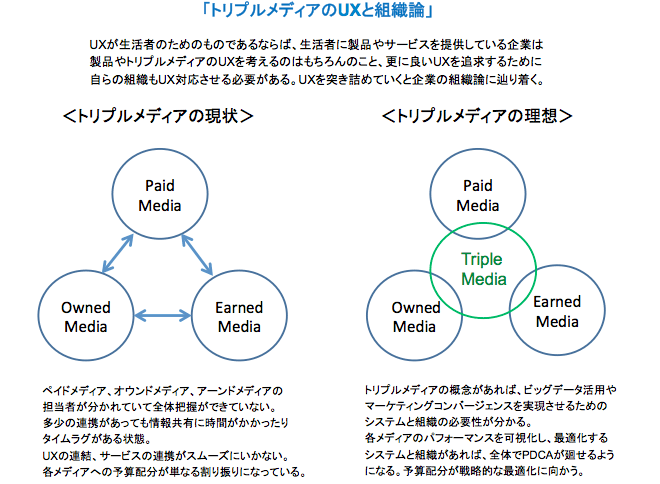
This means companies must now consider UX across not just the traditional triple media of paid media (like mass advertising), owned media (like their own websites), and earned media (like social media), but also comparison sites as a new media channel.
Comparison sites function as paid media where companies can place ads, yet they also possess elements of earned media where user reviews and opinions are posted. Furthermore, numerous charismatic bloggers and personal blogs exist that guide users on how to effectively utilize comparison sites for specific product or service categories.
In essence, building an efficient communication ecosystem UX through the triple media and surrounding media becomes crucial. This requires analyzing user tracking within the company's own site while also prioritizing the UX of how traffic from surrounding media connects.
Regarding O2O (Online to Offline), it can also be interpreted as UX connecting with UX. More companies are issuing coupons in the form of LINE stickers, demonstrating the potential for corporate coupons to be used within consumers' everyday lives where sticker usage is commonplace. In a user-centric world, the UX prepared by companies must seamlessly connect with the UX utilized by users.
Key Takeaway:
The UX prepared by companies connects with external UX, such as comparison sites and O2O initiatives.
Was this article helpful?
Share this article


Newsletter registration is here
We select and publish important news every day
For inquiries about this article
Back Numbers
Author