
Note: This website was automatically translated, so some terms or nuances may not be completely accurate.
 UX: The Revolution That's Right Before Our Eyes [5/7]
Considering "Ideal UX" from the Conditions of "Good UX"

Tsuyoshi Mizukawa
Good UX (user experience) creates new everyday landscapes. The prime example is Google's search page mentioned earlier. Search engines existed before Google. Indeed, there was a time when searching itself was novel. Eventually, the landscape of searching with Google became utterly commonplace. Amazon is also a commonplace, everyday necessity. Smartphones like Android and iPhone have become part of the everyday landscape, not just because they're always at hand, but because larger screens and improved performance mean what you could do on a PC can now be done on a smartphone.
All these are commonplace now, but viewed from the past, each was a highly innovative product or service. Their excellent UX made them seem ordinary, but initially, they were pure amazement. Those who experienced that amazement have forgotten it, and people who didn't live through that era use them thinking they've always been that way...
With that in mind, looking at the conditions for "good UX" from a results-oriented perspective:
■ Daily necessities (integrated into daily life) – Don't make users conscious of OS or device dependencies.
■ Continuously used
■ Constantly updated
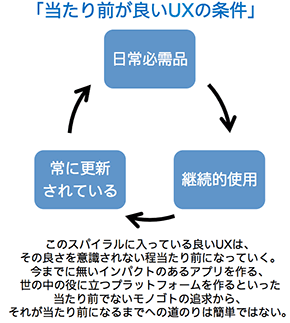 Products and services that meet these three conditions and consequently see growing user adoption can be said to have good UX.
As user numbers grow, more feedback is generated, driving improvements—creating a virtuous cycle.
This reveals the stage of "ideal UX" beyond the conditions for "good UX." It is as follows:
① Creating a new everyday experience (apps, web services, products, platforms, etc.)
② Becoming an everyday norm for people
③ Becomes an essential part of daily life = Used continuously = Constantly updated
④ Becomes a service known worldwide
A UX that achieves a certain level of penetration within a period covering steps ② and ③ can likely be considered a viable product or service. Beyond that, the impact of step ①—how much it creates a new everyday reality—will likely determine whether it expands to step ④: a service known worldwide.
This week's takeaway:
Good UX creates new everyday landscapes.
Was this article helpful?
Share this article


Newsletter registration is here
We select and publish important news every day
For inquiries about this article
Back Numbers
Author