
Note: This website was automatically translated, so some terms or nuances may not be completely accurate.
 UX: The Revolution That's Right Before Our Eyes [6/7]
The Rapidly Changing UX – From Rental Videos to Streaming Services

Tsuyoshi Mizukawa
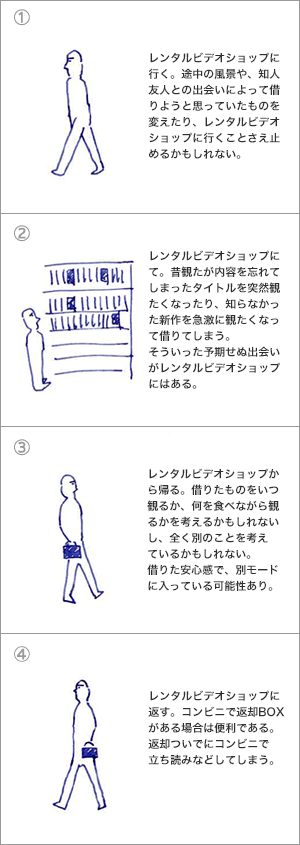 Last time, we discussed how good UX (user experience) creates new everyday landscapes. In the modern world, there's no guarantee that these everyday landscapes will remain unchanged forever.
A familiar example is the video rental industry.
The UX of products and services in the video rental industry used to involve going to a store to rent or return DVDs (or videotapes back in the day). This evolved into services that delivered DVDs to your home by mail without needing to visit a shop, and allowed returns by mail as well.
Further evolution brought online-only video streaming services like Hulu, where you don't even need to go to your mailbox or drop anything in a postbox. Hulu has no physical stores; for a monthly fee of 980 yen, you can watch on your PC, TV, tablet, or smartphone. For users, it's incredibly convenient.
At this point, while technological progress is certainly a factor, it's not just that each company's service has evolved. Rather, it's fair to say that the act of renting and watching videos, and the UX of that business itself, has evolved.
The only area where physical video rental shops might currently hold an advantage is their extensive library of older titles, not just new releases. Also, if a shop is conveniently located along one's commute or school route, many people likely stop by habitually. In any case, the choice of UX when renting videos is entirely up to the user, and currently, multiple UX models coexist. Personally, I visit physical shops and also watch Hulu.
And let's also touch on Viki, a new-sensation video streaming service that surpasses even Hulu. By surpassing Hulu, I mean that while Hulu is paid, Viki is free. www.viki.com Launched in December 2010, Viki is a free video streaming service. Its defining feature is distributing video content like TV dramas, movies, and music videos from various countries with volunteer-subtitled subtitles in multiple languages. It has established a completely new style: breaking down language barriers for all video content by leveraging the power of users worldwide who are both volunteers and avid video viewers. Its revenue source is advertising.
Another major feature is its globally formed community. Users can participate in subtitling work or exchange opinions about watched content within the community. This alone makes it a significant entertainment platform, but it also offers an aspect where users can enjoy learning languages. It can truly be called a well-thought-out, genuine global platform.
This Week's Takeaway:
Good UX creates new everyday landscapes, but it will eventually be replaced by another superior UX.
Was this article helpful?
Share this article


Newsletter registration is here
We select and publish important news every day
For inquiries about this article
Back Numbers

Author