
Note: This website was automatically translated, so some terms or nuances may not be completely accurate.
 Web3 and the Law [2/3]
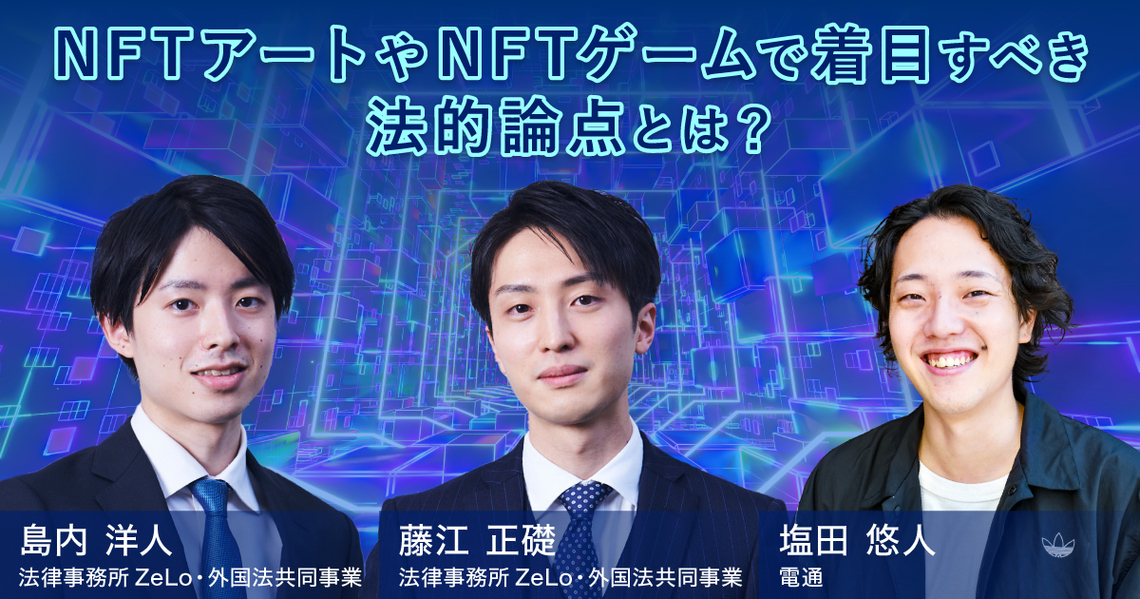
What are the key legal considerations for NFT art and NFT games?

Hiroto Shimauchi
ZeLo Law Firm・Foreign Law Joint Venture

Fujie Masamune
ZeLo Law Firm・Foreign Legal Joint Venture

Yuto Shiota
Web3, a new technology trend encompassing blockchain and NFTs, is attracting significant attention.
While its application across various industries is being actively explored, the sheer number of relevant laws and the unclear interpretation within current regulations can sometimes act as a barrier to entry. Alternatively, businesses may unknowingly incur legal risks while developing Web3 initiatives.
Therefore, Dentsu Inc. aims to contribute to the appropriate market formation of Web3 by deepening the correct understanding of legal issues through study sessions and other initiatives conducted in collaboration with ZeLo, a law firm specializing in blockchain and NFTs, and its foreign legal joint venture.
This series shares knowledge primarily based on the study sessions for readers interested in Web3 areas like NFTs. The second installment features a tripartite discussion with attorneys Hiroto Shimauchi and Masaki Fujie from ZeLo, and Yuto Shiota from Dentsu Inc.
<Table of Contents>
▼Is a License Required for Trading NFT Art?
▼Do Ownership and Copyright Arise for NFT Art?
▼Gacha Mechanics in NFT Games May Constitute Gambling
▼Do Ranking Rewards and Login Bonuses Qualify as Prizes?
▼NFT Regulation is Case-by-Case. Simultaneously Generating Ideas and Conducting Due Diligence is Crucial
Do NFT art transactions require licensing?
Shioda: I'm Shioda from Dentsu Inc.'s Business Co-creation Bureau, responsible for business development utilizing Web3. This time, we've asked two attorneys from the law firm ZeLo to clarify the legal points surrounding various challenges in NFT business. We hope this contributes to your NFT business creation. First, under the theme "NFTs and Art," I'd like to hear from Mr. Shimauchi.

Shimanouchi: While cryptocurrency is one of my specialties, in recent years, new services utilizing blockchain technology beyond simple cryptocurrency trading have been emerging one after another. I'm also seeing an increase in consultations from clients regarding NFTs. While the law may undergo significant changes in the future, I'd like to start by outlining the current situation and future prospects.
Shioda: Thank you. NFTs are literally one type of "token," but how do they differ from cryptocurrency?
Shimanouchi: The key difference lies in whether the token has individuality. For example, Bitcoin, a well-known cryptocurrency, is like money itself. Just as no one cares about the individuality of a ¥10,000 bill, no one cares about the individuality of the token itself. On the other hand, NFTs have a data structure that allows them to be imbued with individuality by embedding information into the token. In practice, they are often traded with a focus on the individuality of the embedded data within each token.
Shioda: Handling cryptocurrency requires a license. If NFTs are different from cryptocurrency, does handling NFTs require a license?
Shimanouchi: For NFTs, the main licensing requirements concern whether they fall under the Cryptocurrency Exchange Business or the Financial Instruments Business.
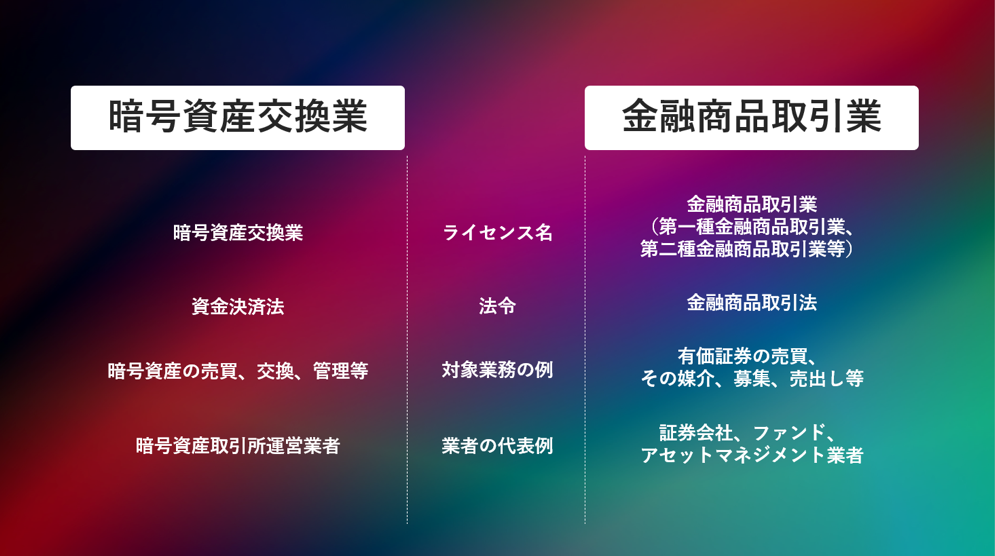
Shimanouchi: First, for cryptocurrency exchange businesses, the key point is "whether NFTs qualify as cryptocurrency." Japan has the Payment Services Act, which regulates payment services. Within this act, cryptocurrency is classified into two types: Type 1 cryptocurrency and Type 2 cryptocurrency.
Without going into detail, the key point for falling under Type 1 crypto assets is whether they are generally accepted as a means of payment in society. Regarding NFT art, since you cannot use NFT art as a payment method when purchasing goods, we can conclude it does not fall under Type 1 crypto assets.
On the other hand, the requirements for Type 2 Crypto Assets are twofold: "Is there a market where they can be exchanged for Bitcoin, Ethereum, etc.?" and "Can they be transferred electronically?" Applying this to NFT art, since most NFT art listed on marketplaces can be exchanged for Ethereum and is recorded on a blockchain, enabling electronic transfer, it could be considered a Type 2 Crypto Asset.
Shioda: So, does that mean trading NFT art requires a license?
Shimanouchi: The key document here is the Financial Services Agency's "Administrative Guidelines." Within these guidelines, the FSA provides a restrictive interpretation regarding Type II crypto assets, essentially stating: "Determine whether an asset qualifies as a Type II crypto asset based on whether it possesses economic functions equivalent to those of a Type I crypto asset, namely, whether it functions as a means of payment." In other words, if the NFT lacks a means of payment function and is traded primarily for the digital art data linked to it, it can be interpreted as not qualifying as a Type 2 virtual asset.
Shioda: So, if NFT art isn't treated as a means of payment, it's highly likely that a license won't be required. But to objectively determine that NFT art isn't a means of payment, what aspects should we focus on?
Shimauchi: For example, if numerous NFT artworks within a collection are traded at exactly the same price, it suggests individual characteristics aren't being valued, potentially indicating it functions as a payment method. Conversely, if prices vary within the collection, it suggests the unique characteristics of the digital art are being valued. Of course, interpretation depends on the actual trading circumstances, so each case requires individual review.
Shioda: I understand that while NFT art fundamentally does not qualify as a crypto asset, it's crucial to verify each individual case. Could you also explain the criteria for determining whether a Financial Instruments Business license is required?
Shimanouchi: The Financial Instruments Business Act license pertains to trading securities, so the key question is whether NFT art qualifies as a security. Stocks are a typical example of securities. In the context of NFT art, the security often discussed is a "collective investment scheme interest." This refers to the right to receive a share of profits when money is contributed to fund a business venture and profits are generated from it. Caution is needed if the business model allows users who purchase NFT art to receive some form of profit distribution.
Shioda: Does distributing proprietary tokens to NFT art holders, giving away new NFTs, or granting rights to purchase tokens at a discount constitute a collective investment scheme interest?
Shimanouchi: First, regarding whether distributing tokens (not money) constitutes "distribution," the legal definition of distribution is not limited. Therefore, as long as the distributed item has economic value, even tokens could potentially be considered a "distribution."
Shioda: Does the act of purchasing NFT art also constitute a "monetary contribution"?
Shimanai: That depends on the specific case. If the payment is for purchasing the NFT art itself—not a monetary contribution—and any new tokens distributed are merely a bonus for the purchase, that could be acceptable. However, if the purchase funds are used to launch a project and profits generated from that project are then distributed as tokens, that would require detailed examination.
Shioda: So it's crucial to confirm each case individually, as you said.
Do NFT artworks generate ownership rights and copyright?
Shioda: Next, regarding "ownership" and "copyright" – topics frequently debated with NFT art – could you explain how these should be legally structured?
Shimanouchi: Under civil law, ownership arises only for tangible objects. Therefore, legally speaking, ownership does not arise for NFTs, which are merely data.
On the other hand, copyright can arise for digital data. Therefore, copyright typically exists for the digital art linked to an NFT. Copyright is generally held by the creator—the artist or IP holder—but the law permits its transfer to others through contract. While it's not impossible to transfer copyright linked to an NFT, the original creator would completely lose their copyright, so this method isn't usually taken.
Shioda: Is there no way to control how an NFT is used other than through copyright transfer?
Shimanouchi: Typically, licensing is used. One specific licensing method involves stipulating NFT-related licenses within the marketplace's terms of service. Another is public licensing—essentially, the artist publicly declaring the license on their own website or other public platforms.
Shioda: I see. Since NFTs are often bought and sold on marketplaces, it seems that by properly establishing the terms of service, the business issuing the NFT can control how it's used. By the way, are there any legal considerations to be mindful of when operating a marketplace?
Shimauchi: The first thing operators should consider is the extent to which they will be involved in designing the license. Some cases involve leaving license design up to each individual seller of NFTs, while others involve the platform establishing a uniform license.
Additionally, if the copyright holder of an NFT artwork revokes the license or transfers the copyright to someone else, it could lead to problems. Therefore, it's necessary to take measures like including legal provisions in the platform's terms of service.
Gacha mechanics in NFT games may constitute gambling
Shioda: Mr. Shimauchi has outlined the rights related to NFT art and the legal issues on marketplaces. Next, I'd like to hear from Mr. Fujie about legal compliance in NFT distribution and NFT games.

Fujie: I was previously with a major domestic law firm, handling cases involving intellectual property, dispute resolution, and consumer law including the Act Against Unjustifiable Premiums and Misleading Representations. Today, I'd like to explain the legal issues surrounding NFT games and in-game items.
Shioda: Thank you for joining us. Could you first introduce NFT games?
Fujie: NFT games have become extremely popular both domestically and internationally in recent years. They are a major area of focus, as seen recently with the listing of "SAND," the cryptocurrency circulating within the metaverse game "The Sandbox," on Coincheck, a major Japanese cryptocurrency exchange. What distinguishes NFT games from traditional games is that players can obtain in-game items and characters linked to NFTs through gameplay, and freely transfer these assets beyond the game itself. This raises related legal issues.
Shioda: Lately, as represented by the term "Play to Earn," information about earning money through NFT games is increasing in the media. At the same time, I feel discussions are starting about whether this constitutes gambling.
Fujie: Items obtained in NFT games can be converted into cash by buying and selling them with others. This raises the question: if someone incurs costs to acquire an item, but the market value of that item ends up being lower than the cost, isn't that gambling? Gambling is generally prohibited in Japan, and not only the gambler but also those providing the gambling venue can be punished. Therefore, whether it constitutes gambling is a major issue.
Shioda: What exactly is the definition of gambling?
Fujie: Omitting the finer details, gambling is defined as "an act where two or more persons contend for the gain or loss of property or pecuniary advantage based on the outcome of chance." Applying this to NFT games, aspects like whether an item can be obtained at all, or the fact that obtainable items are determined randomly, could potentially fall under "outcome of chance." Crucially, it hinges on whether there is a "contention for gain or loss."
For instance, if you pay a 500 yen participation fee to play a game where you might obtain an item valued at 5000 yen, acquiring that 5000 yen item appears to yield a profit. Conversely, obtaining only a 100 yen item or nothing at all appears to result in the loss of property.
Shioda: Many games involve spinning gacha to obtain items. Should we be cautious about gacha in NFT games?
Fujie: Precisely. In standard game gacha systems, real-money trading is often prohibited. Even if items obtained have varying rarity, they can be objectively considered of equal value—meaning no gain or loss. However, in NFT games, items can be converted to cash through trading, leading to objective differences in their value.
Recently, arguments have emerged suggesting that the price paid to obtain an item through a gacha (the primary market price, e.g., ¥500 in the example above) and the market price of the obtained item (the secondary market price, e.g., ¥5,000 or ¥100 in the example) are separate. Even if the secondary market price falls below the primary market price, this does not constitute a loss of property. However, even this argument acknowledges that depending on the mechanism, it could be evaluated as gambling, and naturally, there are opposing views.
As no definitive legal opinion exists at present, it is safest to build a system that can be reasonably structured to ensure that, for a 500-yen participation fee, participants can obtain at least 500 yen worth of items – meaning there is no "loss" in the gain-loss dynamic. The ambiguity surrounding what constitutes gambling is also a concern for the government. Therefore, while anticipating future legislative measures, it is crucial to closely monitor developments.
Do ranking rewards or login bonuses qualify as prizes?
Shioda: Thank you. Next, consider cases where NFTs are used as promotional prizes. Are there any key legal points to watch out for in such scenarios?
Fujie: First, as a premise, offering excessive prizes is prohibited under the Prize Promotion Act, as it can unfairly distort consumer decision-making and cause harm. The maximum allowable value for prizes varies depending on how they are awarded, so specific amounts must be confirmed each time. Fundamentally, it is determined by the transaction price of the original product or service.
However, when offering NFTs as prizes, the issue arises of determining their value, as they may be items not previously circulating in the market. The price of a prize is fundamentally considered to be the price at which it would normally be purchased. For an NFT, this could be calculated by referencing the past market transaction prices of similar NFTs or the costs incurred in preparing the NFT. This point is still evolving in practice, and interpretations may be released by government agencies in the future, so it is necessary to continuously monitor developments.
Shioda: I see. Precisely because pricing is difficult, it's crucial to calculate it in a way that can be reasonably explained, such as by referencing past similar works.
Fujie: Exactly. Another perspective is whether NFTs themselves qualify as "prizes" subject to the Prize Display Act's regulations. The Act generally targets prizes that satisfy three requirements: "customer attraction," "transaction-accompanying nature," and "economic benefit." Among these, the "transaction-accompanying nature" – meaning the prize is provided alongside a transaction – often becomes the key point of contention.
For example, in a game offering ranking rewards where in-app purchases are essential to achieve high rankings, the ranking rewards could be deemed incidental to the transaction of making in-app purchases. Consequently, they might be classified as prizes, potentially subjecting them to price regulations. Similarly, login bonuses provided in paid games could be evaluated as incidental to the transaction of providing paid game services.
Conversely, in fundamentally free-to-play games, even lavish login bonuses are unlikely to cause consumer harm. Since no transaction exists, transactional nature is generally denied. However, opinions affirming transactional nature even in such cases do exist. When judgment is impossible, anonymously consulting government agencies to gauge their stance is an option.
NFT legal regulations are case-by-case. It's crucial to advance both brainstorming and thorough consideration simultaneously.
Shioda: This time, focusing on NFTs, we asked both of you to outline potentially problematic issues regarding NFT art under civil law and copyright law, and NFT games and in-game items under the Act Against Unjustifiable Premiums and Misleading Representations and criminal law. Finally, could you offer a message for those considering business development with NFT art or NFT games?
Shimanouchi: Whether licensing is required for NFT art is the biggest business barrier. Since interpretations vary by individual case, meticulous verification and review are essential. While licensing for NFT art hasn't been a major point of discussion until now, we expect stricter verification to become the norm going forward. Staying abreast of these trends is crucial.
Fujie: New NFT games are constantly emerging overseas, and we frequently receive inquiries about launching similar services in Japan. First, legal regulations differ between Japan and overseas, so careful consideration is required regarding whether the same business model can be offered. Particularly, if it constitutes gambling, it would violate the Penal Code, necessitating careful examination. On the other hand, even business models that initially appear to conflict with regulations may be legally feasible if the scheme is properly structured. Therefore, we encourage active brainstorming and repeated consultations with attorneys.
Shioda: Thank you. NFTs are a technology with the potential to solve many challenges, and I believe many people, myself included, see a future in this technology. However, it is also true that there are still many uncertainties, including legal clarifications. To enable companies to confidently expand their businesses utilizing Web3 and NFTs, Dentsu Inc. has launched the "web3 club," a cross-group organization within Japan, to provide integrated support for Web3-related businesses. If reading this article has sparked your interest in utilizing Web3 or NFTs, please feel free to contact us.
【Contact】
Dentsu Inc. web3 club: web3club@dentsu.co.jp

Was this article helpful?
Share this article


Newsletter registration is here
We select and publish important news every day
For inquiries about this article
Author
Hiroto Shimauchi
ZeLo Law Firm・Foreign Law Joint Venture
Attorney
Fujie Masamune
ZeLo Law Firm・Foreign Legal Joint Venture
Attorney