Note: This website was automatically translated, so some terms or nuances may not be completely accurate.
 Web3 and the Law [3/3]
Financial Regulation and Fundraising in Web3

Fumio Amano
ZeLo Law Firm・Foreign Legal Joint Venture

Daiki Matsuda
ZeLo Law Firm・Foreign Legal Joint Venture

Shintaro Takamatsu
Dentsu Inc.
Blockchain, NFTs, and other technologies collectively known as Web3 are attracting significant attention as a new technological trend.
While its application across various industries is being actively explored, the sheer number of relevant laws and the unclear interpretation within current regulations can sometimes act as a barrier to entry. Alternatively, businesses may unknowingly incur legal risks when expanding into Web3.
Therefore, Dentsu Inc. aims to contribute to the appropriate market formation of Web3 by deepening the correct understanding of legal issues through study sessions and other initiatives conducted in collaboration with the law firm ZeLo and its foreign legal joint venture, which specialize in blockchain and NFT areas.
This series shares knowledge with readers interested in Web3 areas like NFTs, focusing on the content of these study sessions. The third installment features a roundtable discussion with attorneys Daiki Matsuda and Fumio Amano from ZeLo, and Shintaro Takamatsu from Dentsu Inc.
Do NFTs qualify as crypto assets?
Takamatsu: I'm Shintaro Takamatsu from Dentsu Inc. Data Marketing Center. I primarily handle NFT-related businesses and Web3 projects. Personally, I have a strong interest in the potential developments in financial fields like DeFi (Decentralized Finance) and IXO, as well as how advertising companies engage within token economies. For this discussion, I'd like to focus on financial regulations. First, Matsuda-san and Amano-san, could you please give a brief self-introduction?
Matsuda: I'm Matsuda, an attorney at the law firm ZeLo. I frequently advise clients, primarily startups, on matters related to blockchain and similar technologies. I also handle cases involving finance and public affairs (activities where private entities like companies engage with governments and public opinion to foster social momentum and influence rule formation).
Amano: I'm Amano, also an attorney at ZeLo Law Office. In addition to cases involving crypto assets, I handle M&A and healthcare/medical sector matters.
Takamatsu: Thank you. First, I'd like to clarify the legal issues surrounding regulations for crypto asset exchange businesses and similar activities. As mentioned in the second article, Japan's Payment Services Act imposes regulations based on two classifications: "Type 1 Crypto Assets" and "Type 2 Crypto Assets." Therefore, when dealing with NFTs, the key question is "whether an NFT qualifies as a crypto asset."
For details, please refer to the second article. In summary, NFTs generally do not fall under Type 1 crypto assets. Regarding Type 2 crypto assets, it was clarified that NFTs are unlikely to qualify unless they are mutually exchangeable with Bitcoin or Ethereum, or even if exchangeable, they must possess economic functions equivalent to Type 1 crypto assets.
Matsuda: That's correct. The key point is whether the NFT possesses distinct individuality. For example, something like in-game currency—where each unit lacks individuality, is fungible, and can be exchanged for Bitcoin—could be considered a Type 2 crypto asset. Conversely, an NFT representing an in-game character, possessing unique individuality and non-fungibility, would likely not fall under Type 2 crypto assets.
Takamatsu: For instance, if NFTs are mass-issued and circulated in a state where they can be purchased with Bitcoin or similar, would that make them fall under Category 2 crypto assets?
Matsuda: The fact that they can be traded for Bitcoin isn't inherently problematic. What's crucial is that the NFTs themselves possess a high degree of individuality. From the user's perspective, if the NFTs appear interchangeable, there's a risk they could be perceived as crypto assets.
Takamatsu: So, highly unique NFTs would not fall under the regulations for cryptocurrency exchange businesses.
Do Play-to-Earn applications fall under the Payment Services Act regulations?
Takamatsu: Next, could you explain the points to note regarding " prepaid payment instruments " under the Payment Services Act?
Matsuda: Prepaid payment instruments refer to settlement methods where payment is recorded in advance, like prepaid cards, and then used to purchase something. For example, a system where users pre-purchase in-game currency and use that currency to buy in-game items falls under prepaid payment instruments. Prepaid payment instruments are subject to separate regulations, so caution is needed. However, whether NFTs qualify as prepaid payment instruments can be clarified similarly to the discussion on crypto assets: highly unique NFTs are not used as payment methods, so they are not considered prepaid payment instruments.
Takamatsu: Considering that, is it difficult to design "Play to Earn" applications—where players earn in NFT games—in Japan?
Matsuda: That's correct. While it is possible if the design strictly utilizes non-fungible NFTs, if the system uses fungible items (such as tokens) despite being labeled "NFT," it is highly likely to fall under either Category 2 virtual assets or prepaid payment instruments.
Takamatsu: Another point of discussion is whether a financial instruments business license is required when handling NFTs. As explained in the second session, the key issue here is whether NFTs qualify as securities.
Matsuda: Yes. If an NFT carries rights entitling the holder to receive business profits, it is highly likely to qualify as a security and fall under the regulations of the Financial Instruments and Exchange Act. While some cases might be manageable with individual structuring, fundamentally, obtaining the necessary licenses or approvals is required. Therefore, NFTs that distribute profits currently present a high hurdle.
Legal Considerations When Building an NFT Trading Platform
Takamatsu: Matsuda-san has outlined key points to consider when issuing NFTs. Next, I'd like to ask Amano-san about legal regulations related to NFT businesses. We're increasingly receiving client inquiries about selling NFTs or collaborating with famous NFTs. Could you explain the regulations to be mindful of regarding "trading"?
Amano: Trading NFTs on existing marketplaces is generally fine. However, if you build your own marketplace for trading, payment processing issues arise. Due to NFTs' inherent nature of being recorded on blockchain and considering user needs, they are often traded using cryptocurrency as payment. To facilitate the buying, selling, or brokering of cryptocurrency as part of these transactions, a cryptocurrency exchange business license is required. Similarly, managing cryptocurrency on behalf of others also requires this license.
Furthermore, if the act of a buyer paying money and transferring it to the seller is considered a "funds transfer," then either a banking license or a funds transfer business registration is required.
To overcome these barriers, potential approaches include designing services that integrate with external providers holding cryptocurrency exchange licenses, or implementing a "payment collection agency" scheme, similar to e-commerce platforms. Regardless, it's crucial to carefully evaluate the specific service you wish to implement.
Takamatsu: I see. If we build our own marketplace to sell NFTs, it seems like there will be more points to consider. Also, could you tell us about money laundering, which is often cited as a risk related to financial regulations?
Amano: Due to the difficulty in objectively valuing NFTs, there is concern about the risk of money laundering occurring disguised as NFT trading. Similar issues existed in the trade of existing art or secondhand goods, but NFTs, being particularly easy to circulate and potentially tradable anonymously, carry a risk of abuse. While specific regulatory discussions haven't progressed significantly at this stage, it's an area requiring attention to future developments. Therefore, if building a marketplace, it's essential to consider anti-money laundering measures from the outset.
Takamatsu: So as a marketplace operator, we need to be vigilant about suspicious transactions.
Token-Based Fundraising Methods and Current Regulatory Landscape
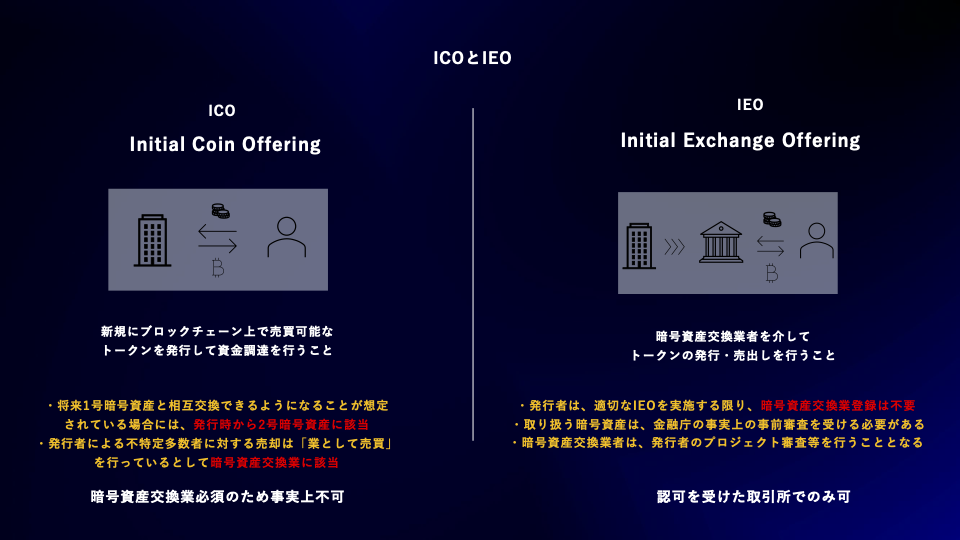
Takamatsu: I'd also like to ask about regulations concerning crypto assets. Japan experienced an ICO (Initial Coin Offering) boom several years ago, which led to widespread fraud and resulted in significant regulatory crackdowns. Recently, I've noticed the term IEO (Initial Exchange Offering) being used more frequently as a concept replacing ICO. What exactly is the difference between ICO and IEO?
Amano: An ICO involves raising funds by newly issuing tokens tradable on a blockchain. Currently, selling crypto assets to the general public by an issuer is considered "conducting trading as a business," requiring registration as a crypto asset exchange operator.
On the other hand, an IEO refers to issuing and selling tokens through a registered cryptocurrency exchange operator. By having the exchange act as an intermediary, IEOs enable transactions under the supervision of the Financial Services Agency (FSA). While issuers generally do not need to register as cryptocurrency exchange operators themselves, they must effectively undergo a pre-screening process similar to a new listing review in coordination with the FSA. IEOs are gaining attention as a replacement scheme for ICOs, which have become practically impossible.
Takamatsu: I see. While IEO cases seem scarce domestically, it appears likely that more entities, including large corporations, will increasingly pursue IEOs going forward.
Takamatsu: For our final question, could you share your outlook on how regulations surrounding DeFi are likely to evolve?
Amano: Regarding NFTs, I don't foresee any major regulations being introduced immediately. However, I expect discussions will intensify on issues where details remain unresolved, such as the money laundering concerns mentioned earlier.
Matsuda: While legal points were central this time, accounting and financial perspectives also present various hurdles for token-related matters, and we're precisely at a stage of active debate. I think a line will eventually be drawn, defining "what can be resolved up to this point, and what remains difficult beyond." We're likely entering a phase where businesses will be considered based on that line.
Takamatsu: Thank you. Hearing from both of you today, I felt that rule-making is evolving at an incredible pace to keep up with the rapidly changing world of crypto assets.
While Japan still has fewer precedents compared to overseas markets, we will continue collaborating with the ZeLo team to provide clients with secure Web3/NFT solutions—whether they aim to implement Web3 initiatives or leverage NFTs for communication. If this article sparked your interest in utilizing Web3 or NFTs, please feel free to contact us.
[Contact Information]
Dentsu Inc. web3 club: web3club@dentsu.co.jp

Was this article helpful?
Share this article


Newsletter registration is here
We select and publish important news every day
For inquiries about this article
Back Numbers
Author
Fumio Amano
ZeLo Law Firm・Foreign Legal Joint Venture
Attorney
Daiki Matsuda
ZeLo Law Firm・Foreign Legal Joint Venture
Attorney
Shintaro Takamatsu
Dentsu Inc.
Data Marketing Center